



























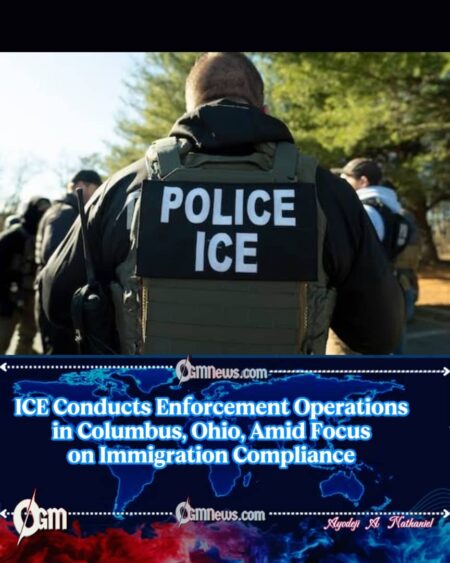
U.S. Immigration and Customs Enforcement (ICE) has carried out targeted enforcement operations in Columbus, Ohio, as part of ongoing federal efforts to address immigration compliance and public safety priorities. The activity drew attention because Columbus is home to one of the largest Somali communities in the United States, second only to the Minneapolis–St. Paul metropolitan area, according to demographic estimates.
Federal officials have not characterized the actions as a citywide sweep, emphasizing instead that the operations were focused and based on specific enforcement criteria.
Scope and Nature of the ICE Operations
ICE officials indicated that agents conducted actions at multiple locations across Columbus, consistent with routine enforcement procedures. Such operations typically involve the execution of administrative warrants related to immigration status, prior removal orders, or other federal immigration violations.
Authorities stated that the operations were planned in advance and coordinated to minimize disruption while prioritizing officer safety and compliance with federal law.
Columbus and Its Somali Community
Columbus has experienced sustained population growth over the past two decades, including the expansion of a significant Somali immigrant community. Many residents arrived through refugee resettlement programs, while others migrated later through family reunification or secondary migration within the United States.
Local leaders and advocacy organizations note that the Somali community plays a visible role in the city’s economy and civic life, operating businesses, community centers, and cultural institutions across the metropolitan area.
Federal Immigration Enforcement Policy Context
ICE enforcement actions occur within a broader federal immigration framework that prioritizes certain categories of cases, including individuals with outstanding removal orders or prior criminal convictions. Officials maintain that enforcement decisions are based on legal status and case-specific factors, not ethnicity or nationality.
The operations in Columbus reflect ongoing federal efforts to enforce immigration law amid continued national debate over border security, asylum processes, and interior enforcement.
Local and Community Responses
Local officials acknowledged awareness of the federal activity but said ICE operations are conducted independently of municipal authorities. Community organizations expressed concern about fear and uncertainty among immigrant residents, while urging individuals to understand their legal rights.
Law enforcement agencies emphasized that ICE actions are separate from local policing and encouraged residents to continue engaging with city services without hesitation.
Legal Rights and Due Process Considerations
Immigration attorneys stress that individuals encountered during ICE operations retain legal rights, including the right to due process and access to legal counsel. Advocacy groups have reiterated the importance of verifying warrants and understanding the distinction between administrative and criminal enforcement actions.
Officials encouraged those affected to seek qualified legal advice to clarify their status and options under federal law.
Immigration Enforcement and Urban Communities
The Columbus operations highlight the ongoing intersection between federal immigration enforcement and diverse urban communities. As immigration policy remains a central national issue, similar actions are expected in other cities with large immigrant populations.
Observers note that the long-term impact will depend on policy direction, legal challenges, and how federal agencies balance enforcement priorities with community stability.


[…] […]