




























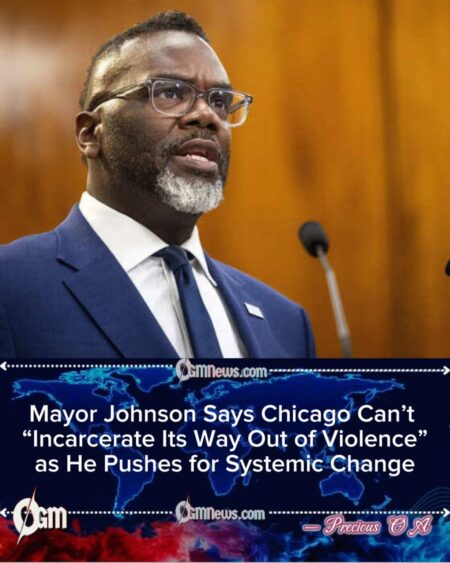
Mayor Johnson addressed city leaders and community groups this week, insisting that Chicago cannot rely solely on incarceration to solve its violence problem, warning that heavy dependence on imprisonment has produced deep racial and social consequences. He said decades of data show that punishment-only strategies have failed to produce lasting safety, particularly in historically marginalized neighborhoods.
Community advocates present at the briefing described how repeated cycles of arrest and release have weakened families and intensified mistrust between residents and institutions. They argued that fear, poverty, and untreated trauma remain stronger predictors of violence than the absence of harsh penalties.
Mayor Johnson added that public safety must be redefined to include housing stability, healthcare access, and youth development rather than being limited strictly to arrests and prosecutions.
Racial Disparities in Incarceration
Research from local universities shows Black residents in Chicago are incarcerated at significantly higher rates than other groups for similar offenses. Policy analysts say this imbalance has produced long-term economic damage in several neighborhoods, leading to unemployment, broken households, and diminished educational outcomes.
Mayor Johnson said these disparities represent structural failures that cannot be ignored, stressing that fairness must become a central principle of public safety policy rather than an afterthought.
Civil rights organizations are calling for expanded data transparency, sentencing reform, and diversion programs that would reduce unnecessary incarceration while maintaining accountability.
Community Violence Prevention
Mayor Johnson outlined plans to expand violence-interruption programs that rely on trained community mediators to intervene before conflicts escalate into shootings. These initiatives focus on de-escalation, conflict counseling, and neighborhood monitoring.
Local nonprofits participating in pilot projects reported measurable reductions in retaliatory violence, especially among young adults. They emphasized that trusted community figures can reach individuals law enforcement often cannot.
Mayor Johnson said the city plans to increase funding for these programs and integrate them more closely with schools, faith organizations, and neighborhood associations.
Mental Health and Trauma Support
Chicago’s health department reports that untreated trauma, depression, and substance use disorders play major roles in repeated violent behavior. Mental health professionals argue that without treatment, individuals are far more likely to re-enter the justice system.
Mayor Johnson announced expanded access to counseling services through public schools and community clinics, including crisis intervention units in high-risk neighborhoods.
Hospital administrators say the changes will allow faster referrals and continuous care for individuals recovering from violence-related trauma.
Policing and Accountability
Mayor Johnson reaffirmed that policing remains a necessary component of public safety but must operate alongside social investments rather than replacing them. He emphasized that enforcement alone cannot correct systemic social breakdown.
Police leadership acknowledged the need for improved community trust, announcing additional training in de-escalation, communication, and neighborhood-based policing models.
Mayor Johnson said transparency and civilian oversight will remain central pillars of police reform under his administration.
Economic Stability and Jobs
Economic instability continues to correlate strongly with violent crime across the city. Workforce agencies report that young adults without stable employment are at significantly higher risk of involvement in violent incidents.
Mayor Johnson unveiled partnerships with private employers to create paid apprenticeships, technical training programs, and small-business incubators in high-unemployment districts.
City planners say these programs are designed to provide long-term income pathways rather than temporary assistance.
Youth and Education
Mayor Johnson emphasized the importance of keeping students engaged through after-school programs, mentorship, and summer employment opportunities that reduce idle time and promote life skills.
School administrators welcomed the additional grants for sports, arts, and academic enrichment, noting that participation improves graduation rates and reduces disciplinary incidents.
Mayor Johnson said education is one of the most powerful long-term crime-prevention tools available to the city.
Gun Violence and Enforcement
While advocating reform, Mayor Johnson acknowledged the urgency of removing illegal firearms from the streets. He stated that enforcement efforts will continue to target trafficking networks and repeat violent offenders.
Public safety officials confirmed that gun recovery operations have already prevented several planned retaliatory attacks.
Mayor Johnson reiterated that enforcement must be paired with prevention to produce lasting results.
Community Trust and Transparency
Mayor Johnson committed to increasing public reporting on crime trends, funding allocations, and program performance so residents can monitor progress directly.
Neighborhood councils welcomed the move, saying transparency strengthens cooperation and accountability.
Mayor Johnson said trust is the foundation of any successful violence-reduction strategy.
Broader Impact and Outlook
Policy experts across the country are closely watching Chicago’s shift toward prevention-centered safety models. Many cities face similar challenges of balancing enforcement with social investment.
Mayor Johnson said Chicago intends to serve as a national example of reform that protects both safety and civil rights.
City officials believe that sustained investment in people, rather than prisons alone, offers the most realistic path to lasting peace.



[…] […]