

























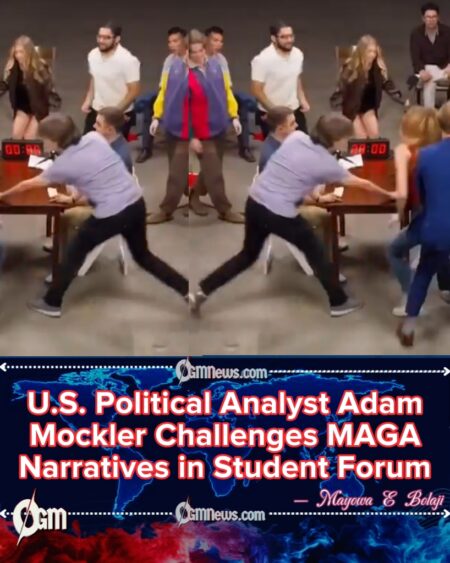
Adam Mockler took center stage on January 4, 2026, as he engaged in a rigorous debate with 25 self-identified MAGA college students, offering a revealing look into the ideological tensions shaping the United States under President Donald Trump’s second-term administration. The event, held in a campus-style forum, brought sharp contrasts between progressive political analysis and conservative youth activism into direct conversation.
Adam Mockler framed the discussion as an opportunity to test ideas rather than personalities, while the students viewed the debate as a chance to defend the principles and policies associated with the MAGA movement. Together, the exchange reflected the intensity and seriousness with which young Americans now approach national politics.
Adam Mockler Sets the Tone for a Contentious Campus Forum
Mockler opened the debate by emphasizing the importance of evidence-based reasoning, constitutional norms, and historical perspective. He positioned the discussion as a civic exercise aimed at clarifying disagreements rather than escalating partisan conflict.
Adam Mockler encouraged participants to challenge his assertions directly, arguing that democratic strength lies in open confrontation of opposing views. This approach set the stage for a lively forum in which students felt emboldened to press their points forcefully.
Adam Mockler Presents a Data-Driven Political Analysis
Adam Mockler grounded his arguments in statistical trends, institutional history, and policy outcomes, particularly when addressing governance under President Trump’s second term. He stressed that political loyalty should not override scrutiny of executive actions or long-term democratic implications.
Mockler repeatedly returned to the role of checks and balances, warning that excessive concentration of power—regardless of political alignment—poses risks to democratic stability. His emphasis on institutions contrasted sharply with the populist arguments raised by many students.
Mockler Faces Strong Defense of the MAGA Agenda
Mockler was met with firm resistance as MAGA-aligned students defended President Trump’s second-term priorities, including border enforcement, economic nationalism, and challenges to entrenched political elites. Students argued that Trump’s leadership style reflected voter frustration with traditional governance.
Mockler listened as participants criticized federal agencies and legacy media, asserting that grassroots movements and alternative platforms better capture public sentiment. The exchange highlighted competing definitions of representation and accountability.
Mockler Engages in Heated Debate Over Media and Free Speech
Mockler addressed skepticism toward mainstream journalism by defending the role of professional media in democratic oversight. He acknowledged imperfections but warned against dismissing institutional reporting entirely.
Mockler faced counterarguments from students who framed media distrust as a rational response to perceived bias. The discussion extended into free speech, with disagreements over moderation, censorship, and the limits of presidential influence under Trump’s second term.
Adam Mockler Highlights Youth Political Polarization
Adam Mockler observed that the intensity of student engagement reflected a broader trend of political polarization among young Americans. He noted that many participants possessed deep familiarity with political narratives, statistics, and ideological talking points.
Mockler argued that such engagement, while divisive, signals a politically active generation likely to influence elections and public discourse well beyond 2026. Observers noted that disagreement did not prevent sustained dialogue.
Adam Mockler Frames the Debate’s Broader National Significance
Mockler concluded by situating the debate within the wider U.S. political climate, marked by sustained polarization during President Trump’s second term. He suggested that campus debates increasingly mirror national conversations once confined to traditional media.
Mockler maintained that forums like this serve as testing grounds for future political leaders and voters, offering insight into how ideological divisions may evolve in the years ahead.
[…] […]