
















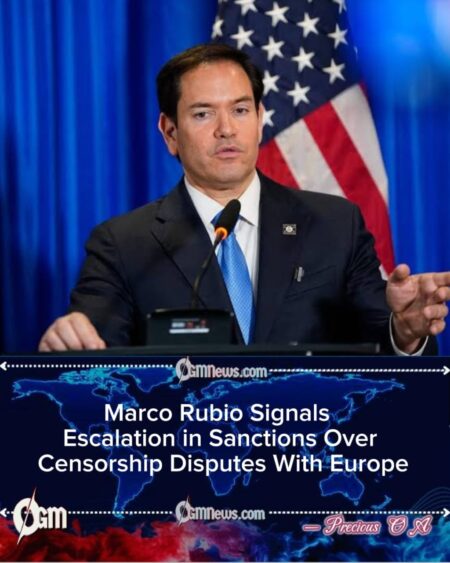
Marco Rubio set the tone for a renewed transatlantic debate after the U.S. State Department issued guidance to European regulatory bodies, signaling that Washington intends to intensify sanctions against officials and entities accused of censoring X and American users. The move reflects growing concern within the administration that foreign regulatory frameworks may be crossing from content moderation into what it views as direct suppression of lawful political expression.
Marco Rubio described the issue as one of principle as well as policy, arguing that digital platforms have become modern public squares where political speech must be protected. He stressed that U.S. citizens should not face penalties, shadow bans, or account restrictions driven by foreign political standards.
Marco Rubio also emphasized that the policy is designed to deter what Washington considers extraterritorial censorship, especially when it affects U.S.-based companies and users. Officials say the guidance provides a clearer framework for responding when foreign actions are deemed to violate free-expression norms recognized by the United States.
Rising Tensions With European Regulators
Marco Rubio acknowledged that the new stance will likely strain relations with certain European regulatory agencies that have pursued stricter controls on digital platforms. He framed the dispute as a philosophical divide between speech-first and safety-first regulatory cultures.
Marco Rubio argued that while governments have a legitimate interest in addressing criminal content, those goals must be balanced carefully to avoid political discrimination or viewpoint suppression. He said Washington is increasingly concerned that this balance has shifted too far toward punitive enforcement.
European officials, meanwhile, have defended their policies as necessary to curb hate speech, disinformation, and coordinated manipulation campaigns. They argue that platforms operating in their jurisdictions must comply with local standards, even when those standards differ from American interpretations of free expression.
What the Sanctions Could Look Like
Marco Rubio indicated that the sanctions framework could include travel restrictions, financial penalties, and limitations on cooperation for entities accused of targeting American users or companies. The measures are intended to raise the cost of what Washington views as censorship overreach.
Marco Rubio said the sanctions are designed not only to punish but to deter, encouraging regulators to reconsider enforcement approaches that disproportionately affect U.S. platforms. He emphasized that the goal is behavioral change rather than prolonged confrontation.
Policy analysts note that implementing such sanctions would mark a significant escalation, moving beyond diplomatic protests into concrete economic and legal consequences.
X at the Center of the Debate
Marco Rubio highlighted X as a focal point in the current dispute, citing repeated complaints that moderation practices demanded by foreign regulators could silence political viewpoints common among American users. He framed the platform as a case study in the broader clash between national regulatory authority and global digital speech norms.
Marco Rubio stressed that U.S.-based companies should not be forced to adopt political standards that conflict with American constitutional principles. He said Washington will increasingly evaluate whether regulatory demands abroad amount to indirect censorship.
Supporters of stronger platform regulation counter that X and similar companies wield immense influence and must be accountable when content spreads that could destabilize societies or incite harm.
Political and Diplomatic Reactions
The policy shift has triggered a range of reactions across Washington, with some lawmakers praising the administration for taking a firm stand while others urge caution to avoid trade or diplomatic fallout. Several European diplomats have privately expressed concern that sanctions could complicate cooperation on unrelated security and economic issues.
Digital rights advocates are divided. Some welcome the emphasis on free expression, while others worry that broad sanctions could undermine legitimate efforts to combat illegal content and harassment online.
Industry leaders are closely watching developments, aware that changes in enforcement could reshape compliance strategies for global technology companies operating across multiple regulatory regimes.
Marco Rubio said the State Department will continue consultations with allies but made clear that the administration is prepared to proceed unilaterally if necessary. He framed the issue as part of a broader push to define global norms around digital speech.
Future guidance is expected to clarify thresholds for sanctions and outline appeal mechanisms for affected entities. Officials suggest that transparency and predictability will be key to avoiding unintended consequences.
As governments and platforms navigate increasingly complex digital landscapes, the dispute underscores how deeply questions of free expression, national sovereignty, and corporate responsibility are now intertwined in global politics.
[…] […]