























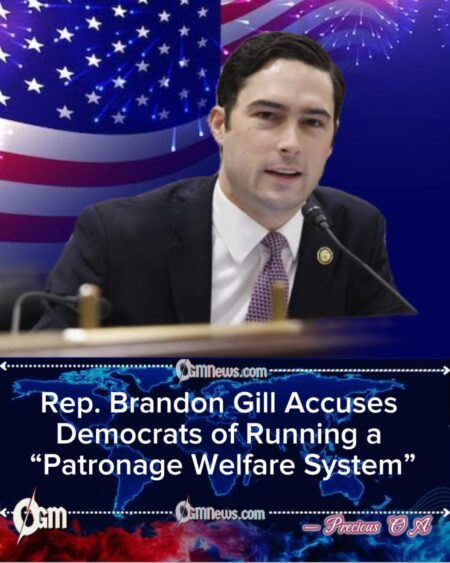
Rep. Brandon Gill ignited controversy after declaring that what he called “welfare for Democrats” functions as a patronage system that channels American tax dollars to political allies rather than to citizens in genuine need. His remarks, delivered during a public appearance and later amplified online, immediately drew national attention and sparked debate over the structure and accountability of federal assistance programs.
Brandon Gill argued that certain welfare initiatives have evolved beyond their original social-safety-net purpose and now operate as vehicles for rewarding politically connected organizations. He said that, in his view, funding flows often appear to favor groups aligned with Democratic campaigns and ideological priorities.
Brandon Gill maintained that these patterns undermine public trust, asserting that voters expect assistance dollars to be distributed based on need and measurable outcomes, not on political loyalty.
Claims of Misallocation
Brandon Gill pointed to what he described as a web of nonprofits, advocacy organizations, and local agencies that receive recurring grants without clear evidence of improved social outcomes. He said repeated funding renewals, in his assessment, suggest a lack of rigorous evaluation.
Independent analysts note that federal welfare funding is distributed through a combination of formula grants, competitive awards, and state-administered programs. Critics of the current system argue that such complexity can make oversight difficult.
Brandon Gill said that complexity should not excuse what he views as insufficient transparency, calling for reforms that would require clearer reporting on how funds are spent and what results are achieved.
Reactions From Democrats
Democratic lawmakers rejected Gill’s characterization, saying welfare programs are designed to meet pressing needs such as food insecurity, housing instability, and healthcare access. They argue that nonprofit partners often provide essential community-level services that government agencies cannot easily replicate.
Brandon Gill countered that while community organizations can play a valuable role, their involvement must be governed by strict accountability standards. He said he is concerned that political favoritism could distort program priorities.
Some Democratic leaders have framed Gill’s remarks as politically motivated, warning that broad accusations could erode confidence in programs that millions of Americans rely upon.
Calls for Oversight Reform
Brandon Gill called for expanded audits of federally funded welfare programs, proposing regular performance reviews tied to continued eligibility for grants. He said such measures would help ensure that taxpayer dollars deliver measurable benefits.
Government accountability experts note that federal agencies already conduct audits and evaluations, but acknowledge that resource constraints can limit their frequency and depth.
Brandon Gill said he intends to introduce or support legislation that would mandate standardized reporting requirements across major welfare initiatives, aiming to make spending more transparent to both Congress and the public.
Broader Political Implications
Political observers say Gill’s comments reflect a growing push within conservative circles to reexamine how social programs are structured and administered. The debate is occurring amid rising concerns over federal spending and long-term budget sustainability.
Brandon Gill has framed the issue as part of a larger effort to restore what he calls “common-sense stewardship” of public funds, arguing that fiscal discipline and social responsibility should go hand in hand.
Analysts note that disputes over welfare policy often surface during election cycles, when contrasting philosophies about the role of government become more pronounced.
Brandon Gill said he plans to continue raising the issue in congressional hearings and public forums, seeking bipartisan support for what he describes as practical oversight reforms.
Some policy specialists suggest that any major changes would require careful balancing to avoid disrupting essential services for vulnerable populations.
Brandon Gill concluded that the goal of his effort is not to dismantle social support systems but to ensure they operate transparently, equitably, and in a way that maintains public confidence in how tax dollars are used.

[…] […]