























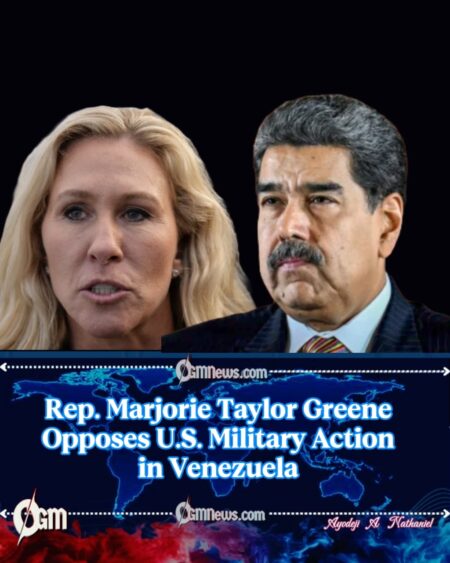
U.S. Representative Marjorie Taylor Greene has publicly opposed the prospect of U.S. military involvement in Venezuela, arguing that Washington should not be drawn into another foreign conflict. In outlining her position, Greene referenced Venezuela’s opposition leader, Maria Corina Machado, noting her political alignment and international relationships as part of a broader critique of regime-change interventions.
Greene’s remarks come amid renewed discussion in Washington about Venezuela’s political future, democratic transition efforts, and the role the United States should play in shaping outcomes in the South American nation.
Greene’s Stance Against Military Intervention
Greene stated unequivocally that she does not support war in Venezuela, positioning herself within a growing faction of U.S. lawmakers skeptical of foreign military engagements. She framed her opposition as rooted in concerns over national interest, fiscal responsibility, and the long-term consequences of intervention.
Her comments reflect a broader fatigue among some policymakers and voters after decades of U.S. involvement in overseas conflicts, particularly where outcomes remain uncertain and costly.
Comments on Venezuela’s Opposition Leadership
In explaining her concerns, Greene pointed to opposition figure Maria Corina Machado, describing her as a strong supporter of Israel and an advocate for restoring close diplomatic ties with the Israeli government. Greene suggested that these positions are relevant to understanding the geopolitical implications of regime change in Venezuela.
Machado is widely viewed as a leading figure within Venezuela’s opposition movement, campaigning on democratic reform, economic liberalization, and reintegration into the international community. Greene’s remarks, however, focused less on domestic Venezuelan policy and more on external alliances.
Context: U.S. Policy Toward Venezuela
For years, U.S. policy toward Venezuela has centered on economic sanctions, diplomatic pressure, and support for democratic opposition movements aimed at ending the rule of President Nicolás Maduro. Successive administrations have maintained that Maduro’s government lacks democratic legitimacy.
Despite this pressure, Maduro has remained in power, leading to ongoing debate in Washington over whether existing strategies are effective or whether they risk escalating tensions without delivering political change.
Debate Within U.S. Politics
Greene’s opposition highlights divisions within the U.S. political landscape over foreign policy priorities. While some lawmakers argue that stronger action is necessary to counter authoritarian governments, others caution against interventions that could entangle the United States in prolonged conflicts.
Her remarks also underscore how international alliances—particularly relations involving Israel—can intersect with U.S. domestic political debates, even when discussing Latin American affairs.
International and Regional Implications
Any escalation involving Venezuela would carry significant regional consequences, affecting migration flows, energy markets, and diplomatic relations across Latin America. Regional governments have generally favored negotiated solutions over military action.
Greene’s comments add to calls for restraint, suggesting that diplomatic engagement and internal political processes, rather than force, should shape Venezuela’s future.
A Call for Restraint Amid Ongoing Tensions
Marjorie Taylor Greene’s opposition to war in Venezuela reinforces a cautious approach to U.S. foreign policy at a time of global uncertainty. By questioning both intervention and the implications of opposition leadership, she has contributed to a broader debate over how—and whether—the United States should seek to influence political outcomes abroad.
As discussions over Venezuela continue, her remarks signal that any move toward military action would face significant resistance within the U.S. political system.
[…] […]