





























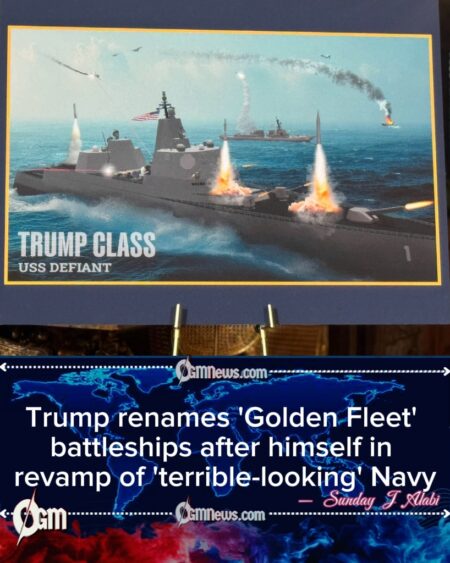
President Donald Trump, serving a second term as the current U.S. president, has announced a far-reaching overhaul of the United States Navy, unveiling plans for a newly branded “Golden Fleet” anchored by a class of battleships renamed after himself. The initiative follows years of sharp criticism by Trump over what he has described as the Navy’s deteriorating appearance and aging capabilities, and it marks one of the most symbolically ambitious military announcements of his presidency.
Standing alongside Secretary of War Pete Hegseth, Navy Secretary John Phelan, and Secretary of State Marco Rubio, the president outlined a vision that combines expanded naval power, domestic shipbuilding, and a highly personalized rebranding of U.S. institutions. The announcement comes amid heightened U.S. military activity in the Caribbean and renewed emphasis by the administration on projecting strength at sea.
A ‘Golden Fleet’ and the Birth of the Trump-Class Battleship
At the center of the announcement is the creation of the “Golden Fleet,” a new naval force that Trump said would represent a decisive break from what he called an “old, tired, and obsolete” fleet. The vessels anchoring this force will be known as the Trump-class battleships, a designation the president said reflects a new era of strength, speed, and visual appeal.
Trump approved the immediate construction of the first two ships, signaling an accelerated timeline. According to the president, these initial vessels will set the standard for a broader expansion that could eventually reshape the Navy’s surface warfare capabilities. The administration argues that the naming and branding are intended to inspire confidence and signal renewal rather than merely personalize military hardware.
USS Defiant and Plans for Rapid Expansion
The first ship in the new class will be called the USS Defiant, a name officials said reflects the administration’s broader posture on national security. While only two ships are currently approved, Trump stated that the long-term plan is to build a fleet of 10 Trump-class battleships, with an ultimate goal of 20 to 25 vessels.
Administration officials emphasized that the scale of the program would mark one of the most significant battleship construction efforts in modern U.S. history. Supporters within the administration argue that such expansion is necessary to deter adversaries and reinforce U.S. naval dominance, while critics have raised questions about cost, feasibility, and strategic necessity.
Technology, Firepower, and Claims of Unmatched Capability
Trump described the new battleships as 30,000- to 40,000-ton “high-tech fortresses,” asserting they would be vastly more powerful than the famed Iowa-class battleships of World War II. He claimed the Trump-class vessels would be “100 times more powerful,” a statement reflecting the administration’s emphasis on advanced weapons systems and modern warfare technology.
According to details shared at the announcement, the ships are expected to feature electric rail guns, hypersonic weapons, high-powered lasers, artificial intelligence integration, and potentially nuclear-armed capabilities. The administration also claims the vessels will rely on massive conventional guns capable of delivering lethal force at a fraction of the cost of missile systems, though specific technical specifications have not been released.
Domestic Shipbuilding and Economic Promises
A central pillar of the plan is domestic production. Trump stressed that the Trump-class battleships will be built entirely in American navy yards, a move he said would create thousands of jobs and revive the U.S. shipbuilding industry. He criticized existing procurement timelines, arguing that while the United States produces the world’s best military equipment, it does not produce it quickly enough.
The president Trump framed the initiative as both a military and economic project, linking national security to industrial renewal. Administration officials echoed this message, suggesting the program could strengthen supply chains, modernize aging shipyards, and reinforce America’s industrial base alongside its naval power.
Strategic Context: Venezuela and Regional Pressure
Although Trump did not formally link the Golden Fleet to a single geopolitical objective, the announcement comes amid an increasingly assertive U.S. posture toward Venezuela. In recent weeks, the administration has highlighted maritime operations targeting vessels it claims are carrying illicit drugs and has referenced seizures of Venezuelan oil and ships.
Trump suggested that the presence of a powerful new fleet would ensure that no adversary “messes with us,” language that administration allies say reflects deterrence rather than escalation. Venezuela has been cited by the president as a key reason for maintaining a large and visible naval presence, though the White House has not clarified how the Trump-class battleships would be deployed in current operations.
A Broader Pattern of Renaming and Presidential Legacy
The Golden Fleet announcement follows other high-profile rebranding decisions by the administration. Just last week, the board of trustees of the John F. Kennedy Center for the Performing Arts voted to rename the institution the Donald J. Trump and the John F. Kennedy Memorial Center for the Performing Arts. Earlier in December, the U.S. Institute of Peace was also renamed in Trump’s honor.
Together, these moves point to a broader effort by the Trump administration to leave a lasting imprint on major national institutions. Supporters describe the strategy as an assertion of leadership and confidence, while critics argue it blurs the line between public institutions and personal legacy.


Casinoabc999? Good Site. The interface is sleek, and there is a lot of stuff to...