














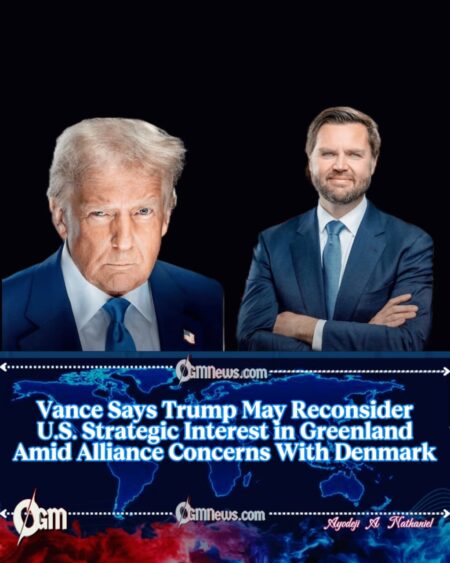
U.S. Senator JD Vance has suggested that the United States could reassess its strategic posture toward Greenland, citing concerns about Denmark’s performance as an ally. In remarks referencing President Donald Trump, currently serving a second term as U.S. president, Vance argued that Washington may need to take a “greater territorial interest” in Greenland if allied responsibilities are not adequately met.
The comments bring renewed attention to Greenland’s geopolitical importance, particularly in the Arctic, where competition over security, resources, and trade routes has intensified in recent years.
Vance’s Critique of Denmark’s Role
Vance stated that Denmark is “not doing its job” and questioned its reliability as an ally in managing shared strategic responsibilities. While he did not provide specific operational details, his remarks imply dissatisfaction with Denmark’s approach to regional security and defense commitments tied to Greenland.
Denmark, which governs Greenland as an autonomous territory within the Kingdom of Denmark, has long coordinated with the United States on Arctic security. Vance’s comments nevertheless suggest a belief among some U.S. policymakers that existing arrangements may be insufficient given evolving threats.
Greenland’s Strategic Importance
Greenland occupies a critical position in the Arctic, hosting key military infrastructure and offering proximity to transatlantic routes. The territory has gained increased attention as melting ice expands access to shipping lanes and potential natural resources.
U.S. defense planners have consistently emphasized Greenland’s role in missile defense, early-warning systems, and Arctic surveillance. Any shift in U.S. policy toward deeper involvement would reflect these longstanding strategic calculations rather than a sudden change in priorities.
Trump Administration’s Security Doctrine
President Trump, in his second term, has emphasized a foreign policy centered on burden-sharing among allies and the protection of U.S. strategic interests. Vance’s remarks align with this framework, which stresses that partnerships must deliver tangible security outcomes.
Administration officials have previously argued that allies must contribute proportionately to collective defense. The suggestion of increased U.S. interest in Greenland fits within this broader emphasis on accountability and strategic clarity.
Diplomatic Sensitivities and Legal Context
Any discussion of expanded U.S. involvement in Greenland carries diplomatic and legal implications. Greenland maintains a high degree of self-governance, while Denmark retains authority over defense and foreign policy.
Analysts caution that rhetoric around territorial interest must be balanced against international law, alliance cohesion, and the views of Greenland’s local population. Diplomatic engagement, rather than unilateral action, remains the prevailing expectation among Western allies.
International and Regional Reactions
While no immediate official response from Denmark has followed Vance’s remarks, similar statements in the past have prompted firm reaffirmations of sovereignty and alliance cooperation. European partners are likely to monitor developments closely, given the broader implications for NATO unity.
For Arctic stakeholders, the episode underscores how strategic competition is increasingly shaping political discourse around territories once considered peripheral.
Arctic Strategy Back in the Spotlight
Vance’s comments have revived debate over Greenland’s role in U.S. security planning and the expectations Washington places on its allies. Whether rhetorical or policy-driven, the remarks highlight the growing importance of the Arctic in global geopolitics.
As President Trump continues his second term, discussions around alliance responsibilities, strategic geography, and U.S. interests are likely to remain central to foreign policy deliberations.


Logging in is a breeze and the site stability is amazing even during peak hours....