



























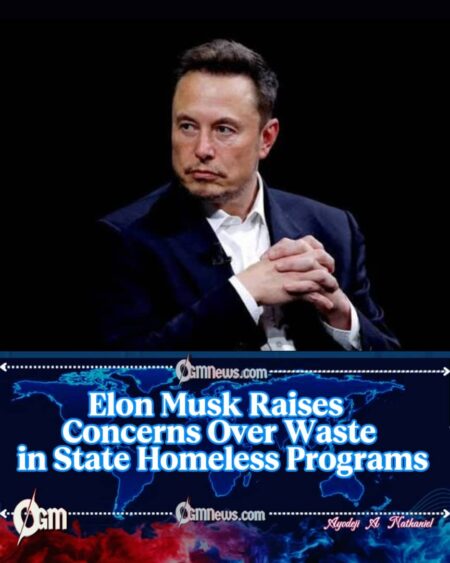
Elon Musk has reignited debate over California’s homelessness crisis after alleging that billions of dollars allocated to address the problem are being misdirected through nonprofits and non-governmental organizations.
According to Musk, despite massive public spending, homelessness remains unresolved because funds are absorbed by what he described as an entrenched “homelessness industrial complex.”
His comments, delivered amid renewed scrutiny of public-sector accountability in large U.S. states, have drawn attention to the scale of homelessness spending in California and the persistent gap between investment and measurable outcomes.
Claims of Misused Public Funds
Musk asserted that homelessness in California is “never fixed” because public funds are routed into nonprofits and NGOs that, in his view, prioritize administrative costs over direct services. He cited Los Angeles as a key example, claiming that approximately $13 billion was spent in a single year without commensurate improvement in conditions on the streets.
While Musk did not present documentary evidence alongside his remarks, his statements echo long-standing criticisms from policy analysts who argue that fragmented oversight and overlapping agencies dilute the impact of homelessness programs.
Focus on Los Angeles Spending
Los Angeles has become a focal point in the national conversation on homelessness due to both the visibility of encampments and the scale of its public expenditures. City and county governments have committed record sums to housing initiatives, emergency shelters, and social services over the past decade.
Despite these efforts, official counts continue to show tens of thousands of unhoused individuals across the metropolitan area, raising questions among critics about whether current spending models are delivering value for money.
The Role of Nonprofits and NGOs
Nonprofits play a central role in California’s homelessness response, often serving as the primary contractors for government-funded programs. Supporters argue these organizations provide essential expertise and on-the-ground capacity that governments lack.
However, Musk’s critique centers on executive compensation and administrative overhead, suggesting that excessive management costs undermine frontline service delivery. Similar concerns have surfaced in past audits, though advocates counter that complex social challenges require skilled leadership and sustained funding.
Calls for Audits and Investigations
Musk called for “extensive audits and investigations,” urging authorities to begin with what he labeled the homelessness industrial complex. His remarks align with broader demands from some lawmakers and civic groups for greater transparency in how homelessness funds are allocated and monitored.
Independent audits, where conducted, have produced mixed findings—sometimes identifying inefficiencies, but also highlighting structural challenges such as housing shortages, mental health needs, and substance abuse that complicate outcomes.
Political and Public Reactions
The comments have intensified partisan debate around governance in large, predominantly Democratic states. Critics of California’s leadership argue that high spending with limited results reflects systemic mismanagement, while defenders maintain that the scale of the crisis requires long-term solutions rather than short-term metrics.
Public reaction has been sharply divided, with Musk’s supporters praising his willingness to challenge entrenched systems, and others cautioning that broad accusations risk oversimplifying a deeply complex social issue.
Broader Implications for Homelessness Policy
At the center of the controversy is a fundamental policy question: how to balance accountability with sustained investment in addressing homelessness. Experts note that without clear performance benchmarks and unified oversight, even large funding commitments may fail to translate into visible progress.
Musk’s intervention has ensured that the conversation around homelessness funding, transparency, and outcomes remains firmly in the national spotlight, potentially influencing future audits, reforms, and policy debates.



[…] […]