








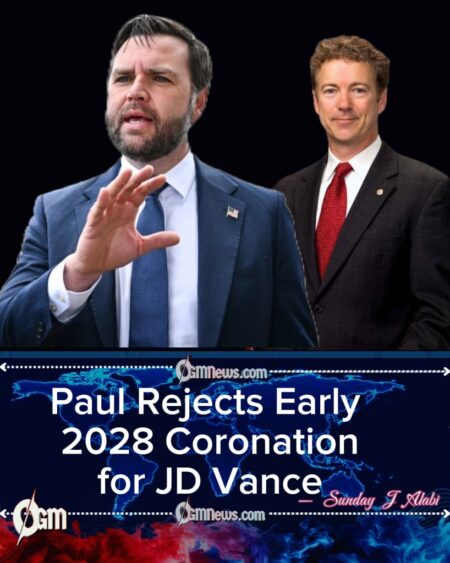
The internal debate over the future direction of the Republican Party sharpened this weekend after Senator Rand Paul of Kentucky categorically rejected the idea that Vice President JD Vance is the party’s inevitable presidential nominee in 2028. Rand Paul’s remarks, delivered during a nationally televised interview, underscored deep ideological divisions within the GOP and highlighted growing resistance to early attempts to anoint a successor while President Donald Trump serves his second term as U.S. president.
The exchange came amid rising speculation about the post-Trump era and a series of high-profile endorsements pointing toward Vance. While several conservative figures have moved quickly to frame the vice president as the party’s next standard-bearer, Rand Paul’s blunt refusal to offer support signaled that the Republican field—and its ideological future—remains far from settled.
Early 2028 Speculation Brings GOP Tensions to the Surface
Discussion about the 2028 Republican presidential race has gained momentum unusually early, driven by prominent conservative voices openly backing Vice President Vance. Appearances, conference speeches, and media commentary have increasingly portrayed him as the presumptive heir to President Trump’s political movement.
This growing narrative has prompted questions about whether the party is prematurely closing ranks behind one figure. For long-serving Republicans like Rand Paul, such assumptions raise concerns about sidelining competing ideas and traditions within the party before a broader debate can take place.
Rand Paul’s History of Independence Within the GOP
Senator Rand Paul has built his national profile by frequently diverging from party leadership, including at times from President Trump and his closest allies. Rooted in libertarian-leaning conservatism, Rand Paul has consistently emphasized fiscal restraint, free markets, and skepticism toward government intervention.
His willingness to challenge prevailing party trends has made him a distinct voice within the Republican coalition. That background gave added weight to his comments on ABC’s This Week, where he made clear that ideological alignment—not loyalty or momentum—would guide his political support.
The ABC Interview and a Direct Question
During the Sunday broadcast, host Jonathan Karl pressed Rand Paul on whether he viewed Vice President Vance as the GOP’s “heir apparent” for 2028. Karl cited recent endorsements, including remarks reported in Vanity Fair suggesting that if Vance were to run, other senior Republicans would quickly fall in line behind him.
Rather than addressing Vance by name initially, Rand Paul responded by outlining what he believes the Republican Party must continue to represent. He emphasized the need for leaders who support international trade, free-market capitalism, and low taxes—principles he argued are increasingly under threat within his own party.
Ideological Divides Over Trade, Taxes, and Tariffs
Rand Paul drew a sharp contrast between traditional conservative economics and what he described as a rising strain of tariff-driven protectionism. He criticized Republicans who champion tariffs as revenue generators, arguing that such policies amount to tax increases—an approach historically rejected by conservatives.
According to Rand Paul, the party once united around the idea that government overspending, not insufficient taxation, was the core fiscal problem. He warned that abandoning this philosophy risks eroding the GOP’s ideological foundation and alienating voters who still identify with free-market conservatism.
A Blunt Rejection of JD Vance
When Karl followed up directly—asking whether Rand Paul’s critique was aimed at Vice President Vance—the Kentucky senator offered a one-word response: “No.” The brief but decisive answer left little room for interpretation and effectively ended the exchange.
The moment marked one of the clearest public rejections to date of the idea that Vance enjoys universal support within Republican ranks. It also signaled that any future nomination contest is likely to involve a substantive debate over policy direction, not just political succession.
Endorsements, Symbolism, and the Expanding 2028 Narrative
Paul’s comments contrasted sharply with recent endorsements for Vance, including a highly emotional declaration by Erika Kirk, widow of the late conservative activist and Turning Point USA founder Charlie Kirk. Speaking at the kickoff of TPUSA’s America Fest conference in Phoenix, Kirk pledged her support for Vance’s potential 2028 bid, drawing enthusiastic applause from attendees.
She framed her endorsement as both political and personal, noting Vance’s friendship with her late husband and expressing hope that he would become the 48th president of the United States following President Trump’s second term. Although Vance has not announced any plans to run, such endorsements have intensified speculation and fueled perceptions of an emerging consensus—an assumption Paul has now publicly challenged.

[…] […]