



























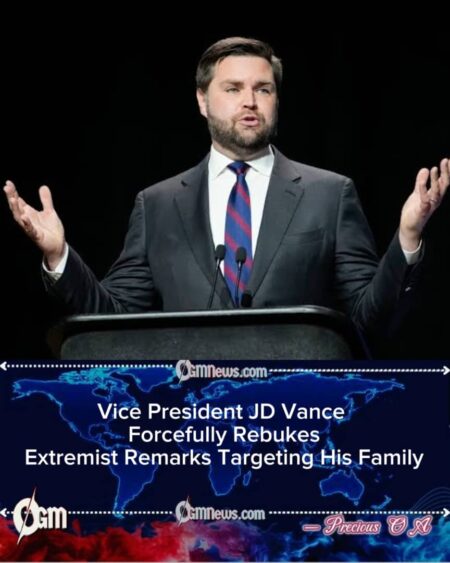
Vice President JD Vance responded forcefully after far-right activist Nick Fuentes made derogatory comments about the vice president’s wife, referencing her Indian heritage. Speaking publicly, Vance rejected the remarks in blunt terms, saying Fuentes could “eat shit,” a statement that quickly drew widespread attention across political and media circles.
JD Vance framed his response as a firm boundary against personal and racial attacks, emphasizing that political disagreement should never extend to targeting family members or ethnic background. He said the comments crossed a clear line and warranted an unequivocal rejection.
JD Vance added that while he accepts criticism of his policies and record, attacks rooted in race or directed at loved ones undermine civil discourse and should be condemned regardless of political affiliation.
Context of the Comments
JD Vance addressed the origins of the controversy, noting that Fuentes’ remarks were made online and rapidly circulated among political activists and commentators. The vice president said the speed at which such rhetoric spreads underscores the responsibility of leaders to speak clearly against it.
JD Vance emphasized that extremist voices often seek attention through provocation, and he cautioned against allowing such tactics to distract from substantive policy debates. He said refusing to normalize these attacks is essential to maintaining democratic norms.
Political observers noted that the exchange highlights ongoing tensions within conservative politics, where mainstream leaders have increasingly sought to distance themselves from fringe figures and ideologies.
Defense of Family and Values
JD Vance spoke at length about the importance of defending one’s family in public life, describing his wife as a private citizen who should not be subjected to political abuse. He said her heritage is a source of pride, not a point of controversy.
JD Vance also stressed that America’s diversity is reflected in families across the country, including those of elected officials. He argued that attempts to weaponize identity run counter to the principles of equal respect and opportunity.
His office later reiterated that the vice president’s remarks were directed at condemning racist rhetoric, not escalating personal disputes, and reflected a broader commitment to rejecting extremism.
Political Reactions and Broader Implications
JD Vance acknowledged that his choice of language was unusually blunt but said the moment required clarity rather than euphemism. He argued that strong condemnation can be appropriate when confronting explicit bigotry.
JD Vance noted that elected officials are often advised to ignore provocations, but he said silence can sometimes be misinterpreted as tolerance. Addressing the issue directly, he said, sends a clearer message.
The remarks prompted debate among commentators about tone and decorum, with some praising the directness of the response and others urging restraint in public discourse.
Extremism and Online Influence
JD Vance linked the incident to a wider problem of online radicalization, where inflammatory statements are amplified for attention and influence. He said social media platforms and political leaders alike have roles to play in discouraging such behavior.
JD Vance reiterated that confronting extremism does not require abandoning free speech principles, but rather reinforcing social norms that reject racism and harassment.
Civil rights groups echoed this view, arguing that public condemnation by high-ranking officials can help marginalize extremist narratives and support affected communities.
Administration officials indicated that the vice president remains focused on policy priorities, including economic growth and national security, and does not intend to allow the incident to overshadow his work.
Campaign strategists from both parties suggested the episode could resonate with voters who expect leaders to draw firm lines against racism while maintaining professionalism.
Looking ahead, the incident serves as a reminder of the challenges public figures face in the digital age, where personal attacks can quickly become political flashpoints, and where responses can shape broader conversations about values and leadership.


[…] […]