





























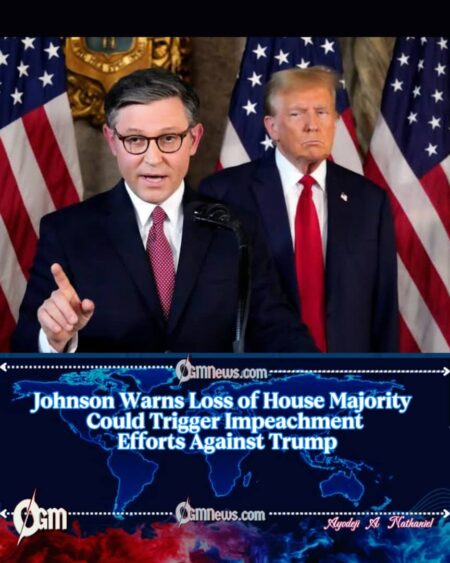
Mike Johnson has issued a warning over the political stakes surrounding control of the U.S. House of Representatives, arguing that a shift in the chamber’s balance of power could lead to renewed impeachment efforts against Donald Trump, who is currently serving his second term as president of the United States. Johnson’s remarks underscore the growing intensity of partisan competition as lawmakers and voters look ahead to upcoming congressional contests.
Speaking to supporters, Johnson framed the House majority as a critical safeguard against what he described as aggressive actions by political opponents. His comments have reignited debate over the role of impeachment in American politics and the broader consequences of divided government.
A Warning on Congressional Power
Johnson’s statement centered on the significance of maintaining Republican control of the House. He argued that the chamber’s investigative and impeachment powers could be used as a political tool if control were to change hands.
According to Johnson, the House majority is not merely a legislative advantage but a defensive measure against actions he believes would distract from governance. His remarks reflect longstanding concerns among Republicans about the use of oversight and impeachment in periods of divided government.
Impeachment as a Political Flashpoint
Impeachment has become one of the most contentious mechanisms in modern U.S. politics. While designed as a constitutional check on executive power, its repeated use in recent years has deepened partisan divisions and shaped public perception of Congress.
Political analysts note that the prospect of impeachment often emerges during election cycles, serving both as a rallying point for party bases and a symbol of broader ideological संघर्ष. Johnson’s comments tap into these dynamics, highlighting how impeachment remains a potent political issue.
The President at the Center of the Debate
President Donald Trump remains a central figure in national politics, and discussions about impeachment continue to follow his administration. Supporters argue that renewed impeachment efforts would be politically motivated, while critics maintain that congressional oversight is a fundamental responsibility.
The White House has not formally responded to Johnson’s remarks, but administration officials have previously emphasized a focus on policy priorities rather than political disputes. Observers say the president’s agenda could be affected by the balance of power in Congress.
Implications for the House Elections
Johnson’s warning places added emphasis on upcoming House races, framing them as decisive not only for legislation but also for institutional power. Control of committees, investigative authority, and the legislative calendar all hinge on which party holds the majority.
Campaign strategists from both parties are expected to use the impeachment question to mobilize voters. For Republicans, it serves as a call to unity; for Democrats, it may reinforce arguments about accountability and oversight.
Reactions Across the Political Spectrum
Republican lawmakers largely echoed Johnson’s concerns, stressing the need to prevent what they describe as partisan overreach. Some Democrats, however, rejected the characterization, arguing that impeachment should never be ruled out if warranted by circumstances.
Independent analysts caution that repeated impeachment battles risk further eroding public trust in institutions. They argue that voters may increasingly judge parties on their ability to govern effectively rather than engage in prolonged political conflict.
As the election cycle intensifies, control of the House is likely to remain a focal point of national debate. Johnson’s remarks signal that impeachment will continue to loom large in political messaging on both sides of the aisle.
Whether voters respond more strongly to warnings about impeachment or to broader policy concerns such as the economy, public safety, and governance remains an open question. What is clear is that the balance of power in Congress will play a decisive role in shaping the political landscape ahead.


Casinoabc999? Good Site. The interface is sleek, and there is a lot of stuff to...