



























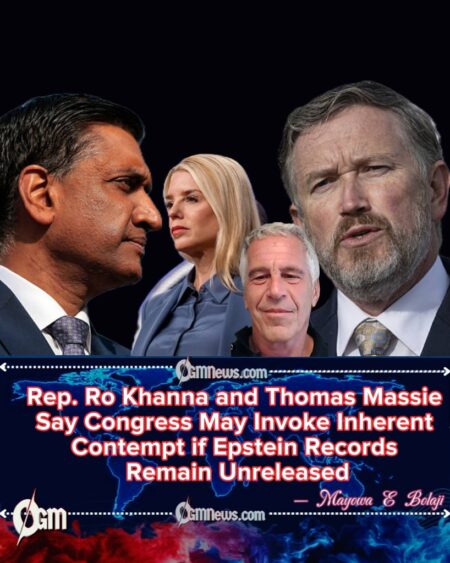
Rep. Ro Khanna and Thomas Massie are weighing a rarely used but constitutionally grounded enforcement tool as questions intensify over the continued withholding of records linked to the late financier Jeffrey Epstein. The bipartisan pair disclosed in a recent CBS interview that they are considering invoking Congress’s inherent contempt power against U.S. Attorney General Pam Bondi, citing what they describe as an incomplete release of documents long sought by lawmakers and the public.
Rep. Ro Khanna and Thomas Massie say the move reflects mounting frustration on Capitol Hill, where repeated requests for transparency have, in their view, yielded only partial disclosures. Their remarks signal a potential escalation in an oversight dispute that touches on accountability within the Justice Department and the broader public interest surrounding one of the most scrutinized criminal cases in recent memory.
Rep. Ro Khanna and Thomas Massie Raise the Prospect of Inherent Contempt
Rep. Ro Khanna and Thomas Massie describe inherent contempt as a lawful, if uncommon, mechanism allowing Congress to compel compliance without relying on the executive branch. The power permits the House to detain or otherwise sanction individuals who defy congressional subpoenas or lawful requests.
Rep. Ro Khanna and Thomas Massie emphasize that the consideration of this step does not reflect a desire for confrontation, but rather a determination to exhaust all constitutional options. They argue that when traditional enforcement channels stall, Congress has both the authority and responsibility to act independently.
Rep. Ro Khanna and Thomas Massie Cite Concerns Over Epstein File Disclosures
Rep. Ro Khanna and Thomas Massie point to what they characterize as gaps in the Epstein-related materials released so far, including documents that could clarify institutional decisions and timelines. They contend that the absence of complete records undermines public confidence and hampers legislative oversight.
Rep. Ro Khanna and Thomas Massie maintain that their concerns are not speculative, noting prior commitments from federal authorities to provide fuller transparency. According to the lawmakers, unmet assurances have sharpened calls for more forceful congressional action.
Rep. Ro Khanna and Thomas Massie Focus Scrutiny on Attorney General Pam Bondi
Rep. Ro Khanna and Thomas Massie have directed their criticism toward Attorney General Pam Bondi, asserting that her office has not fulfilled disclosure obligations. They stress that the issue is procedural rather than personal, centered on compliance with congressional oversight.
Rep. Khanna and Thomas Massie acknowledge the Justice Department’s stated need to protect sensitive information, but argue that redactions and delays must be narrowly tailored. In their view, withholding entire categories of documents exceeds what is necessary for legitimate legal protections.
Rep. Ro Khanna and Thomas Massie Frame the Issue as a Constitutional Test
Rep. Ro Khanna and Thomas Massie describe the dispute as a broader test of separation of powers, particularly the balance between legislative oversight and executive discretion. They argue that Congress’s investigative role loses force if executive agencies can unilaterally decide what information to share.
Rep. Ro Khanna and Thomas Massie add that the controversy unfolds during President Donald Trump’s second term as the current U.S. president, a context that heightens scrutiny of inter-branch accountability. They insist, however, that their actions are institution-focused rather than politically driven.
Rep. Khanna and Thomas Massie Note the Rarity and Risks of Inherent Contempt
Rep. Khanna and Thomas Massie acknowledge that inherent contempt has been used sparingly in modern times, largely due to its political and logistical complexities. Reviving it could set a precedent affecting future oversight battles across administrations.
Rep. Khanna and Thomas Massie nonetheless argue that rarity should not equal abandonment. They suggest that credible consideration of inherent contempt may itself prompt cooperation, potentially avoiding the need for formal proceedings.
Rep. Ro Khanna and Thomas Massie Signal Possible Next Steps
Rep. Khanna and Thomas Massie say no final decision has been made, stressing that dialogue with the Justice Department remains possible. They indicate that additional consultations with House leadership and legal experts will inform their next move.
Rep. Khanna and Thomas Massie conclude that transparency in the Epstein case carries lasting implications beyond a single investigation. They argue that how Congress resolves this standoff will shape public trust in oversight and the rule of law for years to come.


[…] […]