























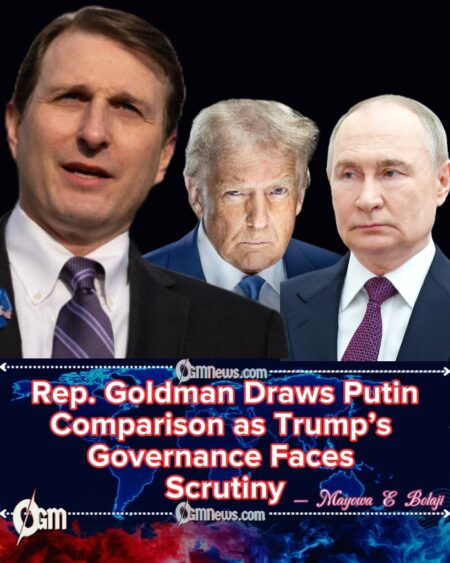
Rep Goldman has issued a stark warning about the direction of governance in the United States, arguing that President Donald Trump, now serving a second term, is pursuing a political and economic model resembling that used by Russian President Vladimir Putin. In remarks that have gained significant public attention, Goldman accused Trump of using the machinery of government to enrich himself, empower loyal allies, and consolidate influence over key sectors of the economy, including the media.
The comments frame Trump’s governing style not as isolated policy choices but as part of a broader structural shift—one that, according to Goldman, risks steering the United States toward a system defined by oligarchic control and weakened democratic safeguards.
Rep Goldman Says Trump Is Using Government Power for Personal Gain
Rep Goldman argues that President Trump’s approach to governance reflects a deliberate effort to blur the lines between public authority and private enrichment. According to the criticism, government power is increasingly deployed in ways that financially benefit the president and those within his inner circle.
This allegation echoes longstanding concerns raised by ethics experts about conflicts of interest, particularly when political decision-making intersects with private business interests. Goldman’s warning suggests that these concerns are no longer peripheral but central to understanding Trump’s second-term agenda.
Rep Goldman Highlights Consolidation of Power Among Political Allies
Rep Goldman points to what he describes as a systematic effort to ensure that Trump’s allies control the most influential companies in the country. These include firms operating in strategically important sectors such as energy, finance, technology, and media.
In this view, economic influence becomes inseparable from political loyalty. Goldman argues that such consolidation mirrors patterns seen in Russia, where economic elites aligned with Vladimir Putin gained control over major industries in exchange for political support, reinforcing the president’s dominance.
Rep Goldman Raises Alarm Over Media Influence and Democratic Norms
Goldman specifically emphasized control over media companies as a critical component of what he sees as an emerging oligarchic structure. He warned that when political allies dominate major media platforms, the result can be diminished press independence and reduced public accountability.
Media analysts note that control over information ecosystems has historically played a decisive role in weakening democratic resistance. Goldman’s remarks suggest that this trend, if left unchecked, could erode the traditional role of the media as a watchdog over government power.
Goldman Criticizes Deregulation as a Tool for Political Payback
Goldman further accused the Trump administration of using deregulation not primarily as an economic policy tool, but as a means of rewarding favored industries. By loosening regulatory constraints, Goldman argues, the government effectively transfers public value to private actors aligned with the president.
In return, Goldman claims, these industries provide political, financial, or institutional support that strengthens Trump’s hold on power. This reciprocal arrangement, he warned, risks transforming policy-making into a transactional process rather than one guided by public interest.
Goldman Draws Direct Parallels to Vladimir Putin’s Russia
Goldman explicitly compared Trump’s trajectory to the system that enabled Vladimir Putin to consolidate power in Russia. According to Goldman, the rise of Russian oligarchs—wealthy individuals whose fortunes were tied to state favor—was instrumental in Putin’s evolution from elected leader to authoritarian ruler.
By invoking this comparison, Goldman framed his warning not as rhetorical exaggeration but as a historical lesson. He suggested that the convergence of political authority, economic control, and media influence follows a recognizable pattern with long-term consequences.
Goldman Warns of Long-Term Risks to Democratic Governance
Goldman concluded that the United States may be approaching a critical threshold. He cautioned that the gradual normalization of elite control, weakened oversight, and personalized governance could make future reversals increasingly difficult.
Political scholars note that democratic backsliding often occurs incrementally rather than through sudden rupture. Goldman’s intervention adds to a growing body of commentary urging vigilance, institutional resilience, and sustained public scrutiny during Trump’s second term.

[…] […]