



























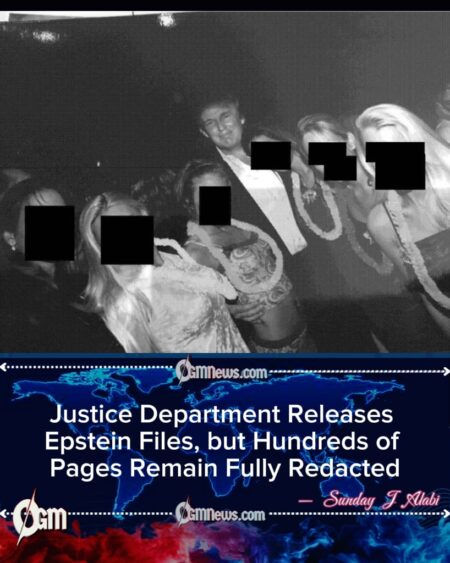
The U.S. Justice Department on Friday released thousands of pages of records related to the late financier and convicted sex offender Jeffrey Epstein, following the passage of the Epstein Files Transparency Act. While the disclosure was billed as a significant step toward public accountability, an initial review by opitanglobamedia News found that at least 550 pages of the newly released documents were entirely redacted, with large sections of others partially obscured.
The release includes photographs, investigative files, and law enforcement records linked to Epstein and his longtime associate, Ghislaine Maxwell. However, the extensive use of blackouts has reignited debate in Washington over whether the disclosure meets both the letter and the spirit of the law mandating transparency.
Scope of the Newly Released Epstein Records
The document dump contains thousands of pages drawn from federal investigations, including materials from Epstein’s residences, police reports, and internal Justice Department records. Some files provide insight into the breadth of law enforcement scrutiny surrounding Epstein over several decades, while others offer only minimal information due to redactions.
Among the most striking features of the release are multiple documents that are entirely unreadable. One series of three consecutive files, totaling 255 pages, is completely blacked out. Another document, labeled “Grand Jury–NY” and spanning 119 pages, is also fully redacted, leaving unanswered questions about its precise origin and content.
Grand Jury Materials and Legal Constraints
The fully redacted grand jury document appears to be connected to proceedings in New York. The document immediately preceding it is a transcript in which a prosecutor asked a grand jury in 2020 to consider evidence for a superseding indictment against Ghislaine Maxwell, Epstein’s convicted co-conspirator. However, officials have not clarified whether the blacked-out file directly relates to that proceeding.
Grand jury materials are subject to heightened secrecy under U.S. law. Judges in New York and Florida have authorized the release of certain grand jury transcripts from the Epstein and Maxwell cases, but with strict conditions. In the Maxwell case, the presiding judge required the top federal prosecutor in Manhattan to personally certify that no victims’ personal information would be disclosed.
Partial Redactions and Visible Details
Not all of the records are entirely obscured. At least 180 pages are mostly redacted but still contain limited visible material, such as cover pages or photographs of folders preceding fully blacked-out sections. In other instances, redactions are more selective.
A 96-page police report from a mid-2000s Florida investigation into Epstein, for example, withholds the names of victims and other sensitive details while leaving portions of the narrative intact. Similarly, some of the thousands of photographs released show partial redactions, with faces obscured by boxes. Images that include former President Bill Clinton and pop star Michael Jackson feature partial redactions, though both men themselves remain fully visible in the photographs.
The Epstein Files Transparency Act Explained
The Epstein Files Transparency Act, passed by Congress last month, requires the Justice Department to release all records in its possession related to Epstein and Maxwell. The law allows redactions only for specific reasons, including the protection of survivors’ identities, the exclusion of child sexual abuse material, and the safeguarding of violent or graphic content.
The statute also permits documents to be temporarily withheld if their release would jeopardize an active investigation or ongoing prosecution. However, it explicitly forbids withholding records to avoid embarrassment, reputational harm, or political sensitivity. The Justice Department has stated that no politicians’ names were redacted from the released files.
Lawmakers’ Criticism and Calls for Accountability
The scale of the redactions has drawn criticism from lawmakers across party lines. Democratic Representative Ro Khanna of California described the release as “incomplete” and said he is exploring possible responses, including impeachment proceedings or referrals for prosecution. Republican Representative Thomas Massie of Kentucky, who co-sponsored the transparency law, said the disclosure “grossly fails to comply with both the spirit and the letter of the law.”
Senate Minority Leader Chuck Schumer echoed those concerns, pointing to documents that were entirely blacked out. He argued that releasing heavily redacted files undermines congressional intent and called for explanations regarding why entire documents were withheld from public view.
Justice Department’s Defense and Ongoing Review
The Justice Department has defended its handling of the files, emphasizing that all redactions were made in accordance with legal requirements. Deputy Attorney General Todd Blanche said in a letter to Congress that more than 200 Justice Department lawyers were assigned to review the documents, primarily to identify and protect survivors’ personal information.
Blanche also noted that additional layers of review were required for grand jury materials and confirmed that more documents would be released on a rolling basis, even though the law required an initial release by Friday. In public comments, he stressed that only legally mandated redactions were applied. He further stated that President Trump, now serving a second term as U.S. president, along with Attorney General Bondi and FBI Director Patel, remain committed to transparency consistent with the law.



[…] […]