



























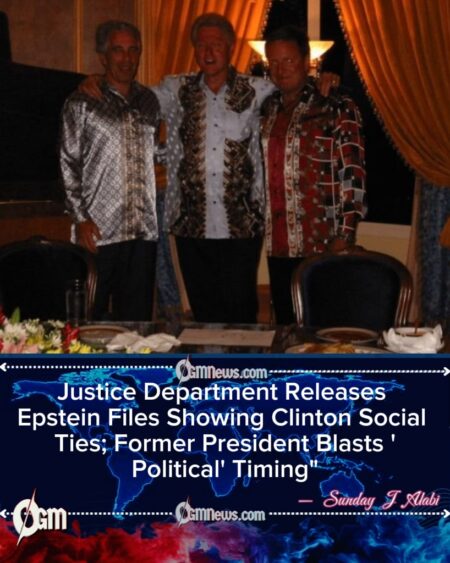
The U.S. Department of Justice released a substantial collection of documents and photographs related to Jeffrey Epstein’s criminal activities on Friday, marking the latest installment in an ongoing effort to provide transparency regarding the deceased financier’s extensive social network. The release included numerous images showing former President Bill Clinton at various social gatherings attended by Epstein and convicted sex trafficker Ghislaine Maxwell, though the documents contained no dates, context, or allegations of criminal conduct by those pictured. Clinton issued a forceful response, denying any knowledge of Epstein’s crimes and characterizing the timing of the release as politically motivated.
The materials represent the third tranche of documents released this week by the Justice Department, following earlier releases that named several prominent individuals. Current U.S. President Donald Trump, serving his second term, signed legislation in November requiring the full disclosure of all unclassified Epstein-related materials within 30 days, though Deputy Attorney General Todd Blanche has indicated some materials may not be released for several weeks, potentially placing the administration in violation of the law it enacted.
Photographs Show Social Connections Spanning Decades
The newly released photographs depict Clinton in various social settings with Epstein, Maxwell, and other prominent figures, including actor Kevin Spacey, musician Michael Jackson, and Rolling Stones frontman Mick Jagger. One image shows Clinton in a swimming pool alongside Maxwell and an unidentified woman whose face was redacted. Another photograph captures the former president relaxing in what appears to be a hot tub, while additional images show Clinton and Spacey at London’s Churchill War Rooms, with Clinton’s hands resting on the actor’s shoulders.
One particularly notable photograph shows Michael Jackson smiling alongside Epstein, while undated dinner party images reveal Mick Jagger dining with Epstein, Maxwell, and Clinton. The photographs also include an image of Maxwell outside 10 Downing Street and another showing her adjusting her clothing for the camera. However, none of the images released Friday included dates, location information, or contextual details that would clarify the circumstances under which they were taken.
The Justice Department has emphasized that appearing in photographs or being named in the documents does not constitute evidence of wrongdoing or knowledge of Epstein’s criminal activities. The materials appear to originate from three separate investigations, including a 2005 Palm Beach police investigation and a subsequent federal probe that resulted in Epstein’s controversial 2008 plea agreement. The photographs may simply document Epstein’s extensive social connections during the years before his crimes became public knowledge.
Clinton Camp Denounces Release as Political Distraction
Angel Urena, a spokesman for Clinton, issued a strongly worded statement on social media Friday evening, asserting that the document release was designed to protect the current administration rather than provide transparency about Clinton. “The White House hasn’t been hiding these files for months only to dump them late on a Friday to protect Bill Clinton,” Urena wrote. “This is about shielding themselves from what comes next, or from what they’ll try and hide forever.”
Urena’s statement drew a sharp distinction between individuals who “knew nothing and cut Epstein off before his crimes came to light” and those who “continued relationships with him after,” placing Clinton firmly in the former category. The spokesman referenced comments by Susie Wiles, suggesting that even members of the current administration have acknowledged that claims connecting Clinton to Epstein’s criminal activities are unfounded. “No amount of stalling by people in the second group will change that,” Urena declared, calling for “answers, not scapegoats.”
Clinton’s response reflects growing tensions over the handling of the Epstein files. The former president has maintained that he had no knowledge of Epstein’s crimes against young women and girls, and that he severed ties with the financier once allegations began to surface. Critics of the current administration’s handling of the release have questioned why the documents were released late on a Friday evening, a timing traditionally associated with news that organizations wish to minimize public attention toward.
Trump Connection Revealed Through Novelty Check
Friday’s document release also contained new information linking President Trump to Epstein, including a photograph of a novelty check for $22,500 made out from Trump to Epstein. The check, which appears to be from years ago based on the signature style, bears a handwritten signature reading “D. Trump” in a style noticeably different from the president’s current signature. A woman whose identity was obscured by redaction stands beside Epstein, who is shown grinning while holding the oversized check and wearing a “USA” crew neck sweater.
The photograph is a black-and-white scan of what appears to be a framed image, with the phrase “once in a blue moon” repeated along the edges. The memo line of the check was largely covered by a redaction box, leaving the purpose of the payment unclear. This marks the first substantial new documentation connecting Trump to Epstein in the current release, though it provides no context for the transaction or evidence of any wrongdoing.
The documents also include Epstein’s contact book, which contains a redacted entry for Trump. It has been previously established that the president appeared in Epstein’s contact list, a fact that was known before Trump’s second term began. The contact book includes hundreds of names of individuals from business, entertainment, politics, and academia, many of whom have stated they had only superficial or professional relationships with Epstein and no knowledge of his criminal activities.
Questions Emerge Over Administration’s Compliance with Disclosure Law
The Justice Department’s staged release of Epstein-related documents has raised questions about whether the Trump administration is fully complying with the disclosure law the president signed in November. Deputy Attorney General Todd Blanche indicated during a Fox & Friends interview that the DOJ plans to “release more documents over the next couple of weeks,” suggesting that the 30-day deadline mandated by the legislation may not be met. The delay has prompted criticism from transparency advocates and political observers who argue that the administration should honor its own legislative mandate.
Legal experts note that the November law specifically required the release of all unclassified materials related to Epstein in the Department of Justice’s possession within 30 days. The staggered release schedule, culminating in Friday’s late-evening document dump, appears to contradict the spirit and potentially the letter of that requirement. Blanche has not publicly explained the legal reasoning behind the extended timeline or identified which materials remain to be disclosed.
The administration’s handling of the release has also drawn attention to the question of which documents may be withheld permanently. While the law mandates disclosure of unclassified materials, it allows the government to maintain classification of certain documents on national security or other grounds. Critics have expressed concern that this provision could be used to shield embarrassing or politically sensitive information from public view, regardless of whether legitimate classification concerns exist.
Historical Context of Epstein Investigations and Controversies
The documents released Friday represent the latest chapter in a saga that has spanned nearly two decades. Epstein first came under law enforcement scrutiny in 2005 when Palm Beach police began investigating allegations that he had sexually abused underage girls at his Florida mansion. That investigation led to a federal probe, which controversially concluded with a 2008 plea agreement that allowed Epstein to avoid federal prosecution in exchange for pleading guilty to state charges of soliciting prostitution from a minor.
The 2008 deal, negotiated when Alexander Acosta served as U.S. Attorney for the Southern District of Florida, has been widely criticized as extraordinarily lenient given the severity of the allegations against Epstein. Under the agreement, Epstein served just 13 months in a county jail with work-release privileges, and the deal provided immunity to potential co-conspirators. Acosta, who later served as Secretary of Labor in Trump’s first administration, resigned from that position in 2019 after renewed scrutiny of his role in the plea agreement.
Epstein was arrested again in 2019 on federal sex trafficking charges but died by suicide in his Manhattan jail cell before facing trial. Maxwell, Epstein’s longtime associate, was arrested in 2020 and convicted in 2021 of recruiting and trafficking underage girls for sexual abuse. She is currently serving a 20-year prison sentence. The current document releases draw from investigations conducted during this extended timeline, providing a window into Epstein’s social network during the years when he cultivated relationships with powerful figures across multiple industries.

The weekly tournaments here keep me coming back because the prize pools are surprisingly generous....