























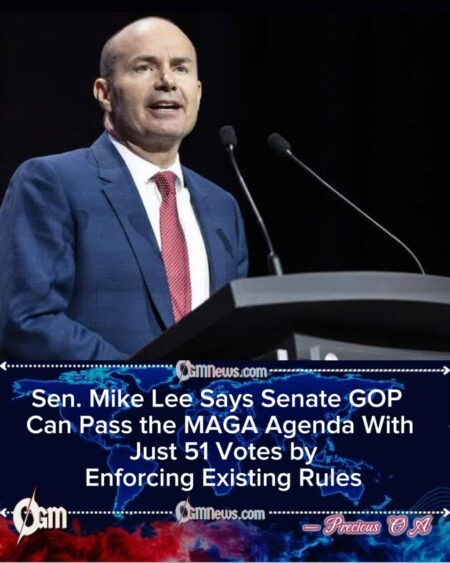
Sen. Mike Lee is arguing that Republicans already possess the procedural tools needed to advance the MAGA agenda without relying on Democratic cooperation, insisting that strict enforcement of existing Senate rules would allow major legislation to pass with a simple majority of 51 votes. He framed his position as a return to constitutional governance, saying the Senate has drifted away from its original design by overusing procedural roadblocks that were never meant to permanently paralyze the chamber.
Mike Lee emphasized that the Constitution clearly outlines how legislation is to be passed and does not mandate the modern supermajority threshold that has become common practice. He argued that many Republican lawmakers misunderstand or underutilize Senate precedents that permit decisive action when the majority is unified and disciplined in applying the rules already on the books.
Other Republican senators have reacted cautiously to the argument, with some expressing concern about long-term consequences if procedural norms are aggressively enforced. Still, Lee’s comments have resonated strongly with grassroots conservatives who believe Republicans too often campaign on bold promises but fail to deliver once in power.
The Filibuster Debate Reignited
Sen. Mike Lee pushed back against claims that his position amounts to eliminating the filibuster, clarifying that he is instead calling for a more accurate application of Senate procedure. He argued that the filibuster has evolved into something far more expansive than originally intended, transforming from a rare tool of extended debate into a routine veto on legislation.
Mike Lee noted that Senate rules already contain mechanisms allowing the presiding officer and the majority leader to interpret and enforce precedents in ways that limit obstruction. According to him, Republicans do not need to formally abolish the filibuster to advance legislation, but rather need the political will to challenge misuse of the rules.
Critics within the GOP worry that such an approach could backfire if Democrats regain control of the Senate. They argue that setting aggressive precedents now could empower future majorities to push through sweeping legislation without bipartisan consensus, something Lee acknowledges but dismisses as a secondary concern.
MAGA Agenda and Legislative Strategy
Sen. Mike Lee tied his argument directly to core MAGA priorities, including border security, fiscal restraint, and regulatory reform. He said voters repeatedly give Republicans narrow majorities expecting action, not excuses rooted in Senate procedure. In his view, failure to act erodes public trust and fuels voter frustration.
Mike Lee stressed that the Senate GOP must stop governing defensively and instead embrace the authority granted by winning elections. He argued that Democrats have repeatedly demonstrated a willingness to aggressively interpret Senate rules when it benefits their agenda, leaving Republicans at a strategic disadvantage by refusing to do the same.
Some conservative activists see Lee’s proposal as a blueprint for finally translating campaign rhetoric into law. They argue that if Republicans cannot pass key legislation even when holding majorities, the party risks appearing ineffective and disconnected from its base.
Internal GOP Resistance
Sen. Mike Lee acknowledged resistance within his own party, noting that institutional inertia and fear of media backlash often prevent senators from pursuing aggressive procedural strategies. He argued that many lawmakers are more concerned with preserving Senate traditions than delivering results to voters.
Mike Lee pointed out that Senate traditions have already been reshaped numerous times over the decades, often quietly and without controversy. He cited examples where precedents were changed through rulings of the chair, arguing that Republicans should not treat current practices as untouchable when they are historically recent developments.
Several establishment Republicans have countered that the Senate’s role is to slow down legislation, not rush it through. They warn that weakening procedural barriers could transform the chamber into a mirror of the House, undermining its deliberative nature.
Historical and Constitutional Framing
Sen. Mike Lee grounded his argument in constitutional originalism, saying the framers envisioned a Senate that debated thoroughly but ultimately allowed the majority to govern. He argued that modern Senate paralysis would be unrecognizable to the Founders, who feared minority rule more than majority power.
Mike Lee cited early Senate history, noting that supermajority requirements were rare and issue-specific, not a default standard for most legislation. He said the current system effectively requires a supermajority to do anything significant, a reality he believes contradicts democratic accountability.
Legal scholars sympathetic to Lee’s view argue that Senate rules are not immutable laws but internal guidelines that can and should evolve. Others counter that stability and restraint are essential to preventing rapid policy swings that could destabilize governance.
Implications for the 2026 Outlook
Sen. Mike Lee suggested that embracing his strategy could reshape the Senate GOP’s message heading into future elections. He argued that voters are more likely to support candidates who demonstrate a clear plan for governing rather than those who blame procedural hurdles for inaction.
Mike Lee also warned that continued failure to deliver legislative victories could depress conservative turnout, particularly among voters who feel the MAGA movement has been stalled by internal Republican hesitation. He framed enforcement of Senate rules as both a policy strategy and a political necessity.
As debates over Senate procedure continue, Lee’s argument has injected new urgency into conversations about power, responsibility, and accountability within the GOP. Whether party leadership adopts his approach or maintains a more cautious stance could significantly influence how Republicans govern—and how voters judge them—in the years ahead.


[…] […]