


























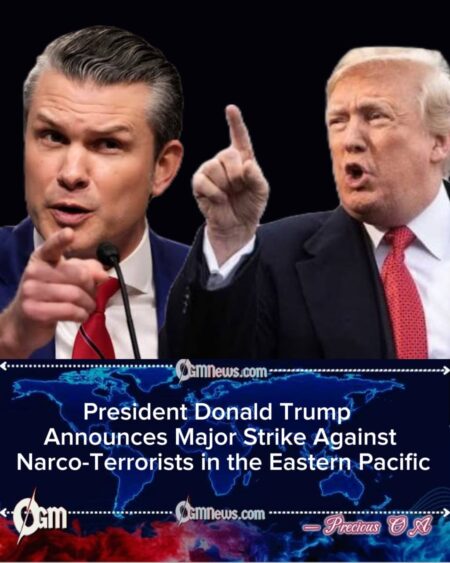
President Donald Trump, speaking alongside senior defense officials, confirmed that U.S. forces carried out another successful maritime interdiction in the Eastern Pacific, destroying a narco-terrorist vessel believed to be transporting large quantities of illicit drugs. The operation, conducted under expanded counter-narcotics authorities, resulted in the deaths of four individuals identified by U.S. officials as members of a transnational criminal network operating along key smuggling routes.
Donald Trump emphasized that the action was part of a broader campaign to disrupt violent drug trafficking organizations that threaten U.S. national security and regional stability. He framed the strike as a necessary response to what his administration has repeatedly described as narco-terrorism, arguing that these groups operate with military-grade equipment and use maritime corridors to evade law enforcement.
Donald Trump added that the Eastern Pacific has become a critical battleground in the fight against organized crime, noting that smugglers increasingly rely on fast boats and semi-submersible vessels. He said the latest operation demonstrated that U.S. surveillance and rapid-response capabilities remain unmatched in the region.
Role of the Department of War
Donald Trump highlighted the involvement of Secretary of War Pete Hegseth, crediting the Department of War for coordinating intelligence, naval assets, and air support. According to administration officials, the mission followed weeks of monitoring and was executed once the vessel entered a zone where U.S. forces had clear authority to act.
Donald Trump described the operation as “precise and decisive,” stressing that American forces acted to neutralize a direct criminal threat rather than engage in indiscriminate force. He stated that the vessel had refused to comply with repeated warnings and was believed to be armed.
Defense officials later explained that the operation fit within existing rules of engagement designed to protect U.S. personnel while maximizing the disruption of drug trafficking networks. The administration said the strike sent a strong signal to cartels operating across international waters.
Counter-Narco Strategy Intensifies
Donald Trump said the latest action reflects an intensified counter-narco strategy that treats major drug trafficking organizations as security threats rather than mere criminal enterprises. He argued that decades of leniency allowed these groups to grow more violent and sophisticated.
Donald Trump reiterated his administration’s position that narcotics trafficking fuels broader instability, including human trafficking, gang violence, and corruption in neighboring countries. He maintained that aggressive interdiction at sea is one of the most effective ways to choke off cartel revenue.
Senior officials noted that maritime operations in the Eastern Pacific have increased significantly, with U.S. forces intercepting record quantities of narcotics over the past year. They said the destruction of vessels is intended to impose real costs on trafficking organizations.
International and Regional Implications
Donald Trump addressed concerns about international reactions, stating that the United States continues to work with regional partners while reserving the right to act unilaterally when threats emerge in international waters. He said cooperation agreements remain in place with several Pacific and Latin American nations.
Donald Trump argued that strong enforcement benefits regional allies by weakening criminal groups that destabilize coastal states. He claimed that many governments quietly welcome U.S. action, even when public statements are cautious.
Analysts noted that operations in the Eastern Pacific often involve shared intelligence with partner nations, though the final decision to engage rests with U.S. commanders. The administration said it remains committed to respecting international law while defending American interests.
Political Messaging and Domestic Impact
Donald Trump used the announcement to reinforce his broader law-and-order message, linking overseas counter-narco operations to domestic concerns about drug overdoses and border security. He said cutting off supply lines abroad directly protects American communities.
Donald Trump criticized past administrations for what he called weak enforcement, arguing that decisive military and law enforcement actions are necessary to reverse years of rising drug availability. He portrayed the latest strike as proof that his approach delivers tangible results.
Supporters praised the operation as evidence of strong leadership, while critics questioned the long-term effectiveness of military force against drug trafficking. The administration responded by pointing to seizure data and disrupted routes as measurable outcomes.
Donald Trump concluded by warning that similar operations would continue as long as narco-terrorist groups operate with impunity in international waters. He said traffickers should understand that U.S. forces are prepared to act swiftly and decisively.
Donald Trump stated that the Department of War and other agencies are reviewing additional intelligence leads, suggesting that further interdictions may be imminent. He framed the campaign as sustained pressure rather than isolated incidents.
Military officials echoed that assessment, noting that the Eastern Pacific remains a priority theater in counter-narcotics efforts. They said continued vigilance, advanced surveillance, and rapid response will define U.S. operations as the administration presses forward with its strategy.

Ae888covenuscasino, okay, I'm curious. Gonna check out this site and try to find some amazing...