








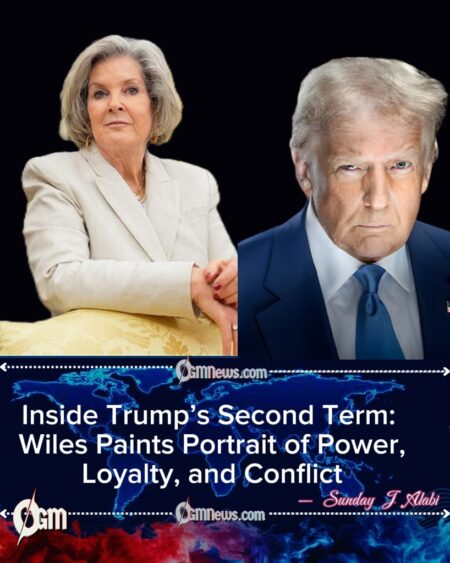
President Donald Trump believes “there’s nothing he can’t do” as president, according to his chief of staff, Susie Wiles, whose unusually candid remarks have offered a rare, inside portrait of the White House during his second term. In a series of extended interviews with Vanity Fair, conducted before and after the election, Wiles spoke with striking openness about Trump’s personality, his approach to power, internal disagreements within his administration, and the tensions shaping his governing style.
The comments, drawn from 11 interviews with author Chris Whipple, have prompted debate in Washington, drawing reactions from Trump himself and raising fresh questions about the direction, discipline, and internal dynamics of his second administration.
President Trump Who Believes Power Has No Ceiling
At the heart of Wiles’ remarks is her assessment that President Trump sees the presidency as an office largely unconstrained by convention. She told Vanity Fair that Trump believes there is “nothing he can’t do, nothing, zero” as president, a mindset she suggested defines much of his governing approach in his second term.
Wiles framed this belief not as recklessness, but as a reflection of Trump’s self-confidence and instinct to challenge institutional limits. She suggested that this outlook fuels his determination to confront what he views as entrenched bureaucratic resistance, particularly within federal agencies he and his allies often label the “deep state.”
At the same time, her comments underscored how this expansive view of presidential authority has become a defining feature of Trump’s leadership style, influencing decisions across law enforcement, immigration, and executive governance.
Personality, Power, and a Provocative Analogy
One of the most talked-about aspects of the interview was Wiles’ description of Trump as having “an alcoholic’s personality,” despite the president being a teetotaler. She attributed the analogy to her experience with her late father, broadcaster and former NFL star Pat Summerall, who struggled with alcoholism.
Wiles explained that, in her view, certain high-functioning personalities are exaggerated in intensity, dominance, and focus, traits she believes Trump exhibits. She described herself as “a little bit of an expert in big personalities,” suggesting that her observation was intended as psychological insight rather than insult.
Trump later addressed the comment directly, saying he had long acknowledged that if he drank alcohol, he might struggle with it. He defended Wiles, stating that her words were misinterpreted and that the interview itself was flawed.
Retribution, Justice, and Broken Understandings
Wiles acknowledged that Trump is willing to pursue retribution against political opponents when opportunities arise, even revealing that she once reached a “loose agreement” with him to complete such score-settling within the first 90 days of his administration. That understanding, she said, was not upheld.
More than six months into his presidency, indictments were served on New York attorney general Letitia James and former FBI director James Comey, both long-standing adversaries of Trump. Wiles conceded that some actions may appear retaliatory but defended the president’s instincts.
She insisted Trump does not obsess over retribution daily, but when circumstances allow, he is inclined to act. Her remarks highlighted the blurred line between political accountability and personal grievance that continues to shadow Trump’s second term.
January 6, Pardons, and Law Enforcement Tensions
Wiles also addressed internal debates over pardons for individuals involved in the January 6, 2021, Capitol riot. She said she initially warned Trump against issuing blanket pardons, praising the FBI for what she described as an “incredible job” in determining individual culpability.
She distinguished between non-violent participants and those who committed serious offenses, expressing concern about undermining law enforcement efforts. However, she ultimately aligned with Trump’s view that even violent offenders had, in some cases, received disproportionately long sentences.
Her comments underscored an ongoing tension within the administration: balancing loyalty to Trump’s political base with institutional respect for federal investigations and judicial outcomes.
Clashes With Musk, Bondi, and Internal Critics
Wiles expressed notable misgivings about Elon Musk, the billionaire entrepreneur who spearheaded the unofficial Department of Government Efficiency. While acknowledging flaws within USAID, she criticized the dismantling of the agency and described Musk as “an odd, odd duck,” saying she was initially alarmed by his methods.
She also attributed a controversial social media post by Musk to drug use, referencing his admitted ketamine consumption. In addition, Wiles criticized Attorney General Pam Bondi over her handling of the Epstein files, accusing her of misjudging the expectations of Trump’s core supporters.
Wiles acknowledged Trump’s name appeared in the Epstein documents but stressed that it did not involve wrongdoing. Her criticism of Bondi suggested internal frustration over messaging failures that have unsettled parts of the president’s political base.
Cabinet Loyalty, Immigration Concerns, and Power Brokers
Despite public criticism of several cabinet members, Wiles described Trump’s team as a “world-class cabinet” composed of deliberate disrupters chosen to confront entrenched systems. She praised figures such as Defense Secretary Pete Hegseth and Homeland Security Secretary Kristi Noem as fit for that mission.
Yet she admitted unease over aspects of Trump’s immigration enforcement, particularly deportations involving individuals without criminal records, noting the need for closer scrutiny of the process. Her remarks hinted at internal debate over policy execution rather than objectives.
Wiles offered mixed assessments of other senior figures, warmly referring to Health Secretary Robert F. Kennedy Jr. while calling Vice President JD Vance a long-time conspiracy theorist and labeling budget director Russ Vought an “absolute rightwing zealot,” reflecting the ideological diversity — and tension — within the administration.
Yo, just tried out that ad786game site. Pretty smooth experience, feels legit. Worth checking out...