



























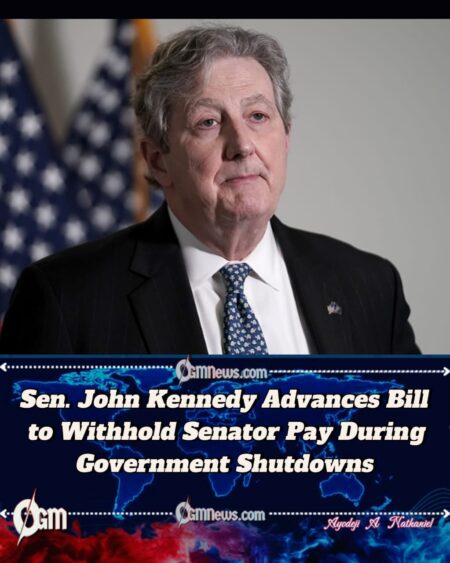
The U.S. Senate Rules Committee has advanced legislation sponsored by Senator John Kennedy that would suspend senators’ pay during a federal government shutdown, marking a significant step toward reshaping congressional accountability during fiscal standoffs. The proposal reflects growing bipartisan frustration over shutdowns that leave federal workers unpaid while lawmakers continue to receive salaries. Supporters argue the measure would create direct consequences for inaction and incentivize faster resolutions to budget impasses.
Overview of the Proposed Legislation
John Kennedy introduced the bill with the explicit aim of aligning lawmakers’ financial consequences with those faced by federal employees during shutdowns. Under the proposal, senators would forfeit their pay for the duration of any shutdown until government operations resume. Backers say the approach reflects basic fairness and reinforces the principle that elected officials should share in the sacrifices imposed on others.
The advancement of the bill by the Senate Rules Committee does not guarantee final passage, but it signals increased institutional willingness to address long-standing criticism of congressional insulation from shutdown impacts. The committee vote allows the legislation to move forward for broader consideration in the Senate.
Senator Kennedy’s Argument on Accountability
Senator Kennedy has framed the bill as a matter of equity and responsibility, arguing that lawmakers should not be exempt from the hardships created by their failure to pass funding legislation. Speaking during a recent shutdown, he emphasized that senators “don’t deserve a dime” from taxpayers if government remains closed due to legislative gridlock.
He also invoked a familiar phrase to underscore his position, stating that what applies to federal workers should apply equally to lawmakers. His remarks resonated with public sentiment that views shutdowns as avoidable crises driven by political stalemate rather than necessity.
Impact of Shutdowns on Federal Workers
During floor remarks, Senator Kennedy cited data illustrating the financial strain placed on federal employees during prolonged shutdowns. According to figures he referenced, federal workers collectively borrowed approximately $365 million during a 36-day shutdown simply to cover basic living expenses such as rent.
The senator highlighted that congressional staff members, military personnel, air traffic controllers, and recipients of federal assistance programs are among those affected. Many continue working without pay or receive only partial compensation, amplifying concerns about fairness when lawmakers remain fully compensated throughout shutdown periods.
Historical Precedent and Congressional Behavior
In support of his proposal, Senator Kennedy referenced the 2013 government shutdown, during which similar legislation gained momentum. At that time, Barack Obama publicly supported withholding congressional pay as a means of pressuring lawmakers to resolve the impasse.
Kennedy argued that the threat of lost pay contributed to a swift breakthrough, suggesting that personal financial consequences can prompt decisive action. He characterized the episode as a moment of clarity for Congress, where urgency replaced prolonged political standoff.
Political and Legislative Implications
The bill’s progress reflects mounting public demand for accountability mechanisms that discourage shutdowns. While some lawmakers caution that pay-withholding alone cannot resolve deep policy disagreements, supporters argue it changes incentives and reframes shutdowns as unacceptable governance failures rather than routine political tools.
As the legislation moves forward, debate is expected over its constitutionality, enforcement mechanisms, and potential extension to members of the House of Representatives. Nonetheless, the measure has already reignited discussion about reforming congressional behavior during budget negotiations.
The advancement of Senator Kennedy’s bill by the Senate Rules Committee represents a notable development in efforts to hold lawmakers directly accountable during government shutdowns. By linking senators’ pay to government functionality, the proposal seeks to align leadership responsibility with public service expectations. Whether the bill ultimately becomes law or not, it has placed renewed focus on the human and economic costs of legislative inaction.
[…] […]