



























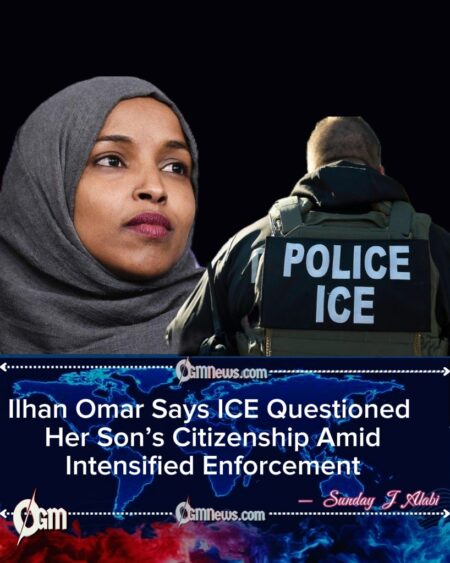
Representative Ilhan Omar of Minnesota has alleged that federal immigration agents stopped and questioned her son’s citizenship over the weekend, an encounter she says reflects heightened immigration enforcement and racial profiling affecting Somali Americans under President Donald Trump’s second-term immigration agenda. According to the congresswoman, the incident occurred in Minnesota after her son made a routine stop at a retail store and ended only when he produced a valid U.S. passport.
The account has intensified debate over immigration enforcement tactics, civil liberties, and the broader impact of federal operations on minority communities. While Omar has framed the incident as part of a pattern of intimidation and profiling, federal authorities have not publicly commented on the specific allegations.
The Alleged Stop in Minnesota
Omar said Immigration and Customs Enforcement (ICE) agents pulled over her 20-year-old son on Saturday after he stopped at a Target store in Minnesota. She stated that agents questioned his citizenship and released him only after he presented his U.S. passport. Omar recounted the incident during an interview with WCCO radio, emphasizing that her son routinely carries his passport as a precaution.
According to the congresswoman, the stop was alarming not only because of its sudden nature but also because it targeted a young American citizen. She said the experience reinforced her concerns about how enforcement actions are being carried out in areas with significant immigrant populations.
ICE did not immediately respond to requests for comment regarding the incident, leaving unanswered questions about the circumstances that led to the stop and whether it was part of a broader operation.
Claims of Broader Enforcement Pressure
Beyond the roadside encounter, Omar alleged that federal agents had previously entered a mosque where her son and others were praying before leaving without making arrests. She said the episode added to growing unease within the community, particularly among young Somali American men.
Omar linked these encounters to what she described as intensified enforcement following a major fraud investigation involving social service programs in Minnesota. While authorities have pursued cases tied to alleged misuse of public funds, Omar has rejected suggestions that such investigations justify sweeping enforcement actions affecting an entire community.
She argued that these developments have created an atmosphere of fear, with residents feeling scrutinized because of their ethnicity rather than any evidence of wrongdoing.
Somali Community at the Center of the Debate
Minnesota is home to the largest Somali population in the United States, with approximately 107,000 residents of Somali origin, according to U.S. Census Bureau data. Community leaders have long emphasized the group’s economic, cultural, and civic contributions to the state.
Omar said recent enforcement actions have disproportionately affected Somali Minnesotans, particularly young men. She expressed concern that racial profiling has become normalized, warning that ordinary activities—such as shopping or attending religious services—are now perceived as potential risks.
While some conservative commentators have linked fraud investigations to the Somali community more broadly, Omar has dismissed those claims, attributing any systemic issues to gaps in oversight of state safety-net programs rather than ethnic or religious factors.
Trump’s Rhetoric and Policy Context
President Donald Trump, now serving a second term, has publicly cited the Minnesota fraud case and linked it to members of the Somali community. During a rally in Pennsylvania last week, he made disparaging remarks about Somalia, describing it in harsh terms and questioning U.S. immigration patterns.
Trump also criticized Minnesota’s Democratic Governor, Tim Walz, accusing state leadership of allowing alleged fraud in government programs. Supporters of the president argue that his administration’s approach reflects a broader effort to strengthen border security and crack down on fraud and illegal immigration.
Omar, however, said the president’s rhetoric has fueled fear and profiling, accusing him of having what she described as an “unhealthy obsession” with the Somali community and with her personally.
Omar’s Response and Formal Complaints
In a post on X, Omar condemned what she termed “Operation Metro Surge,” describing it as state-sanctioned racial profiling used for political intimidation. She insisted that Somali Minnesotans would not be intimidated and highlighted community solidarity in the face of federal pressure.
Omar has also signed a letter addressed to Homeland Security Secretary Kristi Noem and acting ICE Director Todd Lyons. The letter accuses federal agents of “blatant racial profiling” and the use of “an egregious level of unnecessary force” during operations in Minnesota.
The letter calls for greater transparency and accountability from federal agencies, as well as assurances that civil rights protections are being upheld during enforcement actions.
Ongoing Questions and National Implications
The allegations have renewed national discussion about the balance between immigration enforcement and civil liberties, particularly for U.S. citizens from immigrant backgrounds. Legal experts note that while federal agents have broad authority in immigration matters, questioning the citizenship of U.S. citizens raises serious constitutional concerns.
Without an official response from ICE, it remains unclear whether the stop of Omar’s son was based on specific intelligence, a traffic-related issue, or broader enforcement criteria. The lack of clarity has contributed to heightened scrutiny of federal operations in Minnesota.
As the debate continues, the incident underscores the broader tensions surrounding immigration policy under President Trump’s second-term administration and its impact on communities across the country.


Logging in is a breeze and the site stability is amazing even during peak hours....