





















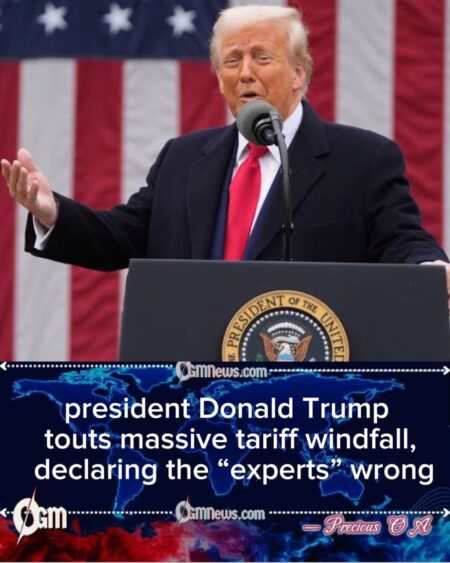
President Donald Trump used a public appearance to take a sweeping victory lap over economists and policy experts, arguing that his tariff strategy has delivered unprecedented revenue to the United States and proven long-standing critics wrong. He framed the moment as vindication after years of criticism from academics, think tanks, and media commentators who warned that tariffs would backfire or stall economic growth. In Trump’s telling, the results have instead demonstrated the power of aggressive trade policy when paired with firm political will.
Donald trump said the numbers speak for themselves, boasting that tariff collections surged to historic levels in a matter of months and reshaped how Washington thinks about trade enforcement and leverage. He emphasized that tariffs were not merely punitive tools but strategic instruments designed to rebalance trade relationships and compel foreign governments to renegotiate on terms more favorable to the United States. According to Trump, the speed and scale of the revenue gains stunned even his own allies.
The remarks immediately reignited debate among analysts, lawmakers, and trade specialists who have long questioned whether tariffs ultimately help consumers or simply shift costs across the economy. While supporters applauded the combative tone and bold claims, critics quickly pushed back, arguing that revenue figures must be contextualized within broader economic indicators such as inflation, consumer spending, and international retaliation. The clash once again highlighted the deep divide between Trump’s populist economic vision and conventional policy thinking.
Claimed Revenue Windfall
Donald trump asserted that the United States has taken in more than $18 trillion due to tariffs, describing the figure as something “there’s never been anything like” in modern economic history. He presented the claim as proof that America had been leaving massive amounts of money on the table for decades by allowing unfavorable trade arrangements to persist unchecked. In his remarks, Trump framed tariffs as a long-overdue correction rather than an economic gamble.
Donald trump contrasted that claim with the previous administration, saying far less revenue was collected over a four-year period and framing the comparison as proof of policy failure by his successors. He argued that a softer approach to trade enforcement weakened America’s negotiating position and allowed foreign competitors to exploit U.S. markets. The comparison was delivered with characteristic bluntness, designed to underscore what he sees as a stark difference in governing philosophy.
Economic observers, however, noted that tariff revenue figures are often interpreted differently depending on methodology, time frame, and broader fiscal context. Some analysts cautioned that headline numbers can obscure important nuances, such as who ultimately bears the cost of tariffs and how they interact with domestic tax policy. Even so, the sheer scale of Trump’s claim ensured that the debate would dominate economic discussions.
Revisiting the Biden Comparison
Donald trump sharpened his argument by directly targeting the Biden administration, claiming it collected less than $1 trillion in tariff-related revenue over four years. He portrayed this figure as evidence of missed opportunity and ineffective leadership, suggesting that the administration failed to capitalize on existing trade tools. The contrast was framed not just as a policy disagreement but as a fundamental difference in competence.
Donald trump presented the comparison as a clear verdict from the balance sheet, insisting that aggressive trade enforcement quickly produced results once his policies were reinstated. He argued that decisive action sends a message to both allies and adversaries that the United States will protect its economic interests without hesitation. For Trump, the numbers reinforced his belief that strength and certainty drive better outcomes.
Critics countered that trade revenue alone does not capture downstream effects such as higher prices, supply-chain shifts, or retaliatory measures from trading partners. They warned that focusing narrowly on tariff income risks ignoring broader economic consequences that may emerge over time. Nonetheless, the comparison resonated with Trump’s base, which views economic assertiveness as a sign of national strength.
A Message to Skeptics
Donald trump framed his comments as a response to experts who warned that tariffs would hurt growth or fail to generate meaningful income for the government. He accused those experts of being disconnected from real-world outcomes and overly reliant on theoretical models. In doing so, he positioned himself as a leader guided by results rather than predictions.
Donald trump argued that those predictions were rooted in theory rather than real-world outcomes, saying his approach prioritized leverage, speed, and direct results. He cited the rapid accumulation of revenue as evidence that unconventional strategies can outperform traditional policy prescriptions. The message was clear: established wisdom should be challenged when it fails to deliver.
Supporters echoed that sentiment, portraying the moment as a rare instance where unconventional policy defied elite consensus. Many praised Trump for confronting institutions they believe have long dominated economic discourse without accountability. To them, the tariff debate symbolizes a broader struggle over who gets to define success in economic policymaking.
Political Implications at Home
Donald trump’s statements also carried a clear political edge, reinforcing a broader campaign narrative that pits him against technocrats and establishment voices. By framing tariffs as a triumph over so-called experts, he appealed to voters who feel ignored or dismissed by traditional power centers. The rhetoric served to energize supporters who view economic nationalism as central to their political identity.
Some Republican allies praised the rhetoric as effective messaging that resonates with voters skeptical of globalization and international trade norms. They argued that tariffs have become a symbol of reclaiming control over economic destiny and protecting domestic industries. For these allies, Trump’s comments were as much about cultural signaling as fiscal policy.
Donald trump’s critics within Congress warned that oversimplifying complex fiscal data risks misleading the public and obscuring long-term consequences. They urged a more measured discussion that accounts for both benefits and costs. Still, even critics acknowledged that the messaging was likely to have significant political impact.
Trade Policy Going Forward
Donald trump signaled that tariffs would remain a central tool in his economic playbook, describing them as both a revenue source and a negotiating weapon. He suggested that future trade talks would continue to rely on pressure tactics to secure favorable terms. In his view, tariffs provide leverage that diplomacy alone cannot achieve.
The debate now shifts to whether future administrations will maintain, expand, or roll back such measures amid ongoing global trade tensions. Businesses and policymakers alike are grappling with uncertainty as they try to anticipate the direction of U.S. trade policy. The outcome will likely shape global markets for years to come.
Markets, businesses, and foreign governments continue to watch closely, aware that tariff policy under Trump often moves quickly and with far-reaching impact. Whether hailed as visionary or criticized as risky, the strategy has undeniably altered the global trade conversation. As the argument over tariffs intensifies, Trump shows no sign of retreating from a policy he believes has already rewritten the rules.
[…] […]