






















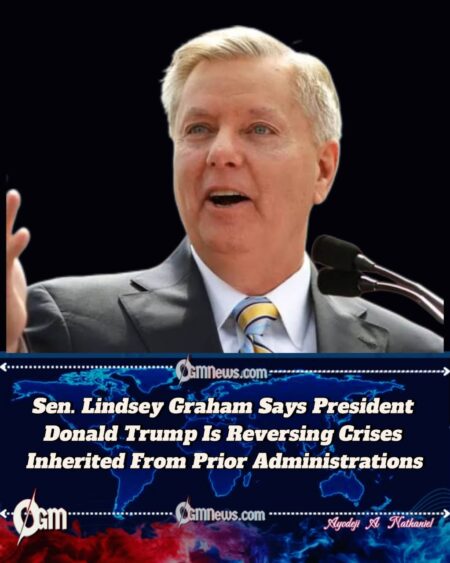
Sen. Lindsey Graham has stated that President Donald Trump assumed office amid significant domestic and international challenges left by the Obama and Biden administrations, arguing that the current president is steadily restoring stability and order. The remarks come as the Trump administration highlights its second-term agenda focused on security, diplomacy, and governance reforms both at home and abroad.
Graham’s Assessment of the Inherited Situation
Sen. Graham said the Trump administration took office facing what he described as widespread instability, including border pressures, global security concerns, and domestic governance challenges. According to Graham, these issues were the result of policy decisions made by previous administrations that, in his view, weakened institutional authority and international deterrence.
Graham emphasized that the transition into Trump’s second term occurred during a period of heightened geopolitical tension, citing conflicts abroad and diplomatic strains with major global actors. He argued that these conditions required decisive leadership and a departure from earlier approaches.
Domestic Policy and Governance Claims
Supporters of President Trump point to expanded law enforcement coordination, immigration enforcement, and regulatory restructuring as signs of renewed domestic order. Administration officials argue that these measures are designed to reinforce public safety, economic confidence, and institutional accountability.
Critics, however, maintain that the administration’s domestic policies have also generated controversy, particularly around civil liberties and federal-state relations. Analysts note that while supporters see firmness as necessary, opponents argue that some policies risk deepening political and social divisions.
Foreign Policy and Global Engagement
On the international stage, Graham credited President Trump with reasserting U.S. influence through assertive diplomacy, military deterrence, and renegotiated alliances. He said the administration has focused on projecting strength as a means of preventing conflict rather than responding to it.
The Trump administration has framed its foreign policy as results-driven, prioritizing national interest, burden-sharing among allies, and direct engagement with adversaries when deemed necessary. Observers note that this approach contrasts sharply with strategies used by previous administrations, contributing to both praise and criticism from global partners.
Comparisons With Previous Administrations
Graham’s comments draw a clear contrast between Trump’s leadership style and that of former Presidents Barack Obama and Joe Biden. He argued that earlier administrations relied too heavily on multilateral consensus and restraint, which he believes allowed global instability to grow.
Political analysts caution that such comparisons are deeply partisan and reflect broader ideological disagreements over governance and international leadership. They note that assessments of inherited conditions often depend on political perspective, policy priorities, and long-term outcomes rather than immediate results.
Public and Political Reactions
Republican lawmakers and conservative commentators have largely echoed Graham’s praise, describing Trump’s second term as a corrective phase aimed at restoring confidence in U.S. leadership. Many supporters argue that measurable outcomes, rather than rhetoric, should remain the standard for evaluation.
Democratic leaders and advocacy groups have pushed back, disputing the characterization of past administrations and questioning whether current policies are achieving lasting stability. The divide underscores how leadership narratives remain central to America’s polarized political climate.
Looking Ahead
As President Trump continues his second term, domestic security, economic performance, and global stability are expected to remain focal points of debate. Lawmakers from both parties are closely watching how policy decisions translate into long-term outcomes for the country and its allies.
With national elections and international developments on the horizon, statements such as Graham’s highlight how interpretations of leadership and legacy continue to shape public discourse around the presidency.
[…] […]