





























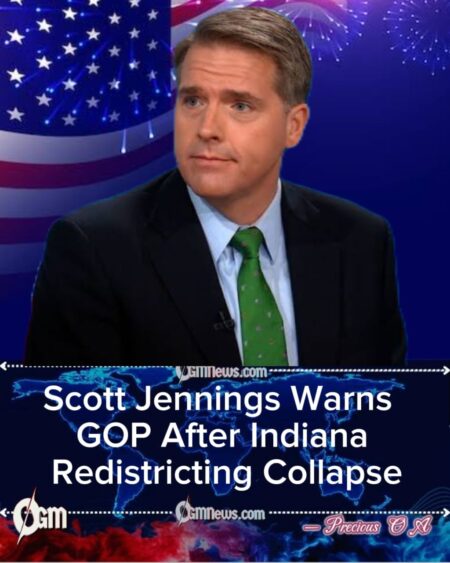
Scott Jennings issues a forceful warning to his party as he reacts to the failed Indiana redistricting effort, arguing that the collapse exposes a deeper structural weakness within Republican strategy circles. He asserts that the GOP continues to underestimate the intensity of Democratic redistricting operations, leaving conservative majorities vulnerable in key states.
Scott Jennings says the Indiana breakdown should serve as a cautionary lesson for national and state-level Republican leadership, stressing that the inability to secure favorable maps now will create long-term electoral disadvantages. He adds that the party cannot continue treating gerrymandering as an afterthought while opponents approach the process with precision and determination.
Scott Jennings warns that while Republicans celebrated short-term wins, the party’s broader map-making capabilities remain inconsistent, lacking the ruthless efficiency that Democrats have mastered over multiple cycles. He calls for an overhaul in strategy, investment, and discipline to avoid similar failures in future redistricting battles.
Growing Concerns Among GOP Operatives
Republican operatives across several states are expressing heightened anxiety after Indiana became the latest redistricting setback, raising new questions about whether the party can maintain its current legislative footholds. Some strategists argue that internal disagreements and weak coordination are undermining efforts to secure durable electoral advantages.
Scott Jennings highlights widespread frustration among conservative policy groups, noting that many believed Indiana would be an easy win for maintaining strong GOP lines in the legislature. Instead, the unexpected collapse has sparked internal debates about preparation, negotiation, and communication failures.
The incident has also intensified discussions among Republican analysts regarding the need to modernize the party’s strategic approach, particularly as Democrats continue to refine their redistricting models. Many fear that without significant reform, GOP-controlled states may continue to experience similar breakdowns.
Democratic Redistricting Strength
Democratic organizations have spent years building robust, aggressively coordinated redistricting infrastructure designed to maximize electoral gains. Observers note that their consistency, technical proficiency, and unified messaging give them a competitive edge that Republicans often fail to match.
Scott Jennings argues that Democrats are not simply more prepared—they are more relentless, treating every map as a high-stakes opportunity to engineer long-term political dominance. He warns Republicans that refusing to acknowledge this imbalance will only deepen electoral vulnerability.
Scott Jennings underscores that the GOP can no longer rely on past victories or assume that demographic shifts will compensate for structural disadvantages. Instead, he urges the party to aggressively counter Democratic operations with equally sophisticated strategies.
Impact on Future Elections
Political analysts predict that the fallout from Indiana’s failed map could influence upcoming state and federal contests, especially in regions where margins are tight. The inability to secure favorable lines may force Republicans to defend seats that were previously considered safe.
Scott Jennings notes that this redistricting misstep may also weaken the party’s negotiating power in other states, as Democrats capitalize on GOP indecision and internal disagreements. He warns that the broader implications could reverberate well into the next decade.
The failure has prompted renewed calls within the party for strategic uniformity, with some lawmakers urging immediate national coordination to prevent cascading losses in future cycles.
Internal Party Debates Intensify
Inside Republican circles, heated debate has arisen over who should be held responsible for the Indiana setback. Some blame procedural miscalculations, while others argue that leadership failed to apply sufficient pressure to ensure a successful outcome.
Scott Jennings asserts that focusing on blame alone misses the larger structural challenge: the party’s chronic underestimation of redistricting’s long-term impact. He urges Republicans to address internal weaknesses rather than merely assigning fault.
Scott Jennings emphasizes that unless the party recognizes the significance of map-drawing as a foundational electoral strategy, it risks falling further behind in a political environment where every district line matters.
Call for GOP Awakening
Conservative commentators and grassroots activists are echoing Jennings’ frustration, urging the Republican Party to adopt a more aggressive and disciplined posture on redistricting. Many argue that complacency has been the GOP’s greatest liability.
Scott Jennings insists that Republicans must abandon the assumption that they can rely on favorable geography or historical precedent to maintain power. Instead, he calls for a fully modernized, data-driven, and unflinchingly competitive approach.
Scott Jennings concludes that Indiana should be remembered not as an isolated failure but as a wake-up call—one that highlights the urgent need for the GOP to strengthen its strategic capabilities before Democrats regain full control of the process nationwide.



Logging in is a breeze and the site stability is amazing even during peak hours....