



















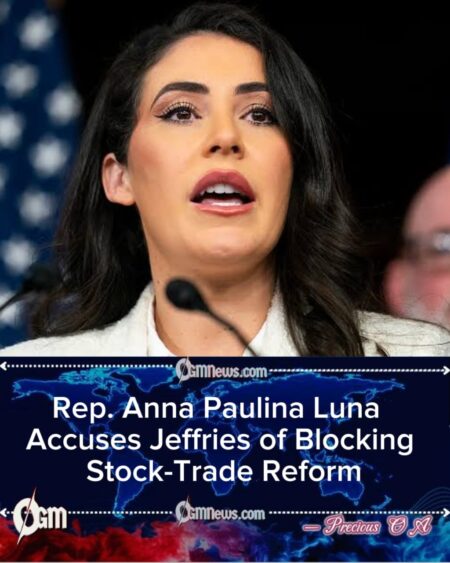
Rep. Anna Paulina Luna stated that Democratic Leader Hakeem Jeffries is actively obstructing her efforts to advance a Congressional stock-trading ban, alleging that his refusal to grant necessary procedural clearances has slowed a measure widely supported by voters demanding greater transparency. She described the situation as a troubling example of leadership using procedural power to suppress reforms that could impose stricter ethical standards on lawmakers. Her remarks reflected mounting frustration within reform-oriented circles that see stock-trading restrictions as a basic expectation for any credible governing body.
Anna Paulina Luna emphasized that multiple bipartisan proposals have been waiting for action, yet House leadership has kept them from reaching committee markup or floor consideration, an outcome she described as a deliberate attempt to shield lawmakers from accountability. She noted that several colleagues across the aisle privately express support but fear political retaliation if they openly challenge leadership’s control over the agenda. Her criticism underscored a broader tension between members pushing for institutional change and those prioritizing internal party unity over substantive reform.
Anna Paulina Luna further argued that the delay reflects a growing divide between party leaders and the public, noting that Americans across the political spectrum overwhelmingly support restrictions on lawmakers trading stocks while in office. She stressed that the public sees congressional inaction as a reflection of self-interest rather than responsible leadership, and she warned that failure to act will only deepen distrust toward government institutions. Her comments portrayed the issue not merely as legislative gridlock but as a fundamental test of Congress’s willingness to regulate itself.
Ethics and Accountability Push
Anna Paulina Luna highlighted that her legislation aims to eliminate loopholes allowing members of Congress and their families to engage in trades that may appear to conflict with their official duties, calling it a necessary step toward restoring institutional credibility. She argued that even the perception of financial impropriety diminishes public confidence and suggested that closing these loopholes is essential to rebuilding a sense of fairness within the democratic process. Her message resonated with ongoing national conversations about ethics and government integrity.
Anna Paulina Luna insisted that no elected official should profit from insider access or privileged knowledge, reaffirming her commitment to ensuring that future reforms include strict penalties for violations and full transparency for all transactions. She noted that everyday Americans are held to rigorous financial regulatory standards and that lawmakers should be subject to rules at least equally stringent, if not more demanding. Her framing positioned the stock-trading ban as a matter of moral responsibility rather than partisan ideology.
Anna Paulina Luna stressed that comprehensive ethics rules are long overdue, noting that previous attempts to pass similar measures failed because leadership blocked them from advancing beyond preliminary discussions. She criticized the pattern of allowing ethics proposals to languish in committee, where they quietly disappear from public view. Her remarks suggested that leadership’s unwillingness to confront the issue has been a persistent barrier to reform across multiple congressional cycles.
Leadership Resistance and Internal Tensions
Anna Paulina Luna said that Hakeem Jeffries’ refusal to advance the bill conflicts with his public statements supporting government accountability, pointing out that his private actions demonstrate a reluctance to limit lawmakers’ financial activities. She noted that this apparent contradiction has not gone unnoticed by members of both parties who question the sincerity of leadership’s commitment to transparency. Her comments added further pressure on Jeffries to justify the disparity between rhetoric and procedural decisions.
Anna Paulina Luna added that several members within Jeffries’ caucus have expressed quiet frustration, stating that many Democrats publicly support a ban but face internal pressure to avoid challenging leadership. She remarked that the silence of these members reflects an environment in which political conformity is encouraged over open debate, particularly on issues where leaders fear political backlash. Her observations shed light on the internal dynamics shaping the debate.
A senior Republican aide claimed that Jeffries’ hesitancy is rooted in donor relationships and internal political calculations, with several advisers reportedly warning him that pushing the ban could upset influential stakeholders. This claim, while not publicly confirmed, aligns with broader concerns that financial interests exert disproportionate influence on legislative priorities. The aide’s statement highlighted the complex network of political incentives surrounding ethics reform.
Growing Public Pressure
Anna Paulina Luna reiterated that public support for a stock-trading ban has surged, fueled by rising distrust in government and a perception that lawmakers are insulated from rules that apply to ordinary citizens. She emphasized that constituents across the country are demanding higher standards of behavior from those elected to represent them. Her remarks framed the reform effort as a response to a groundswell of civic frustration rather than a niche political initiative.
Anna Paulina Luna pointed to recent polling showing overwhelming voter backing for reform, arguing that Congress must act before the issue becomes another flashpoint eroding institutional legitimacy. She warned that failure to respond to the public’s expectations could deepen cynicism toward government and further destabilize public confidence. Her message underscored the urgency of acting before the issue becomes politically volatile.
Civic advocacy groups have stepped up pressure as well, encouraging constituents to contact their representatives and reminding leadership that continued inaction is likely to carry political consequences. These groups argue that Congressional accountability should be a non-negotiable principle in a functioning democracy. Their involvement has amplified the debate and increased public scrutiny of leadership decisions.
Concerns Over Institutional Integrity
Anna Paulina Luna warned that the refusal to move forward threatens to weaken public faith in congressional oversight mechanisms, especially at a time when ethical lapses have drawn heightened scrutiny. She suggested that delaying reforms signals an unwillingness to confront systemic vulnerabilities within federal institutions. Her remarks positioned ethical reform as essential to preserving democratic credibility.
Anna Paulina Luna argued that failure to pass the ban will reinforce perceptions that Congress is unwilling to regulate itself, undermining ongoing attempts to restore trust after a series of high-profile controversies. She stressed that ethical lapses in recent years have left the public increasingly skeptical of congressional motives. Her comments reflected a broader concern about the long-term reputational damage caused by inaction.
Ethics experts say that delaying reforms allows questionable trading patterns to continue unchecked, and they urge leadership to recognize the long-term institutional risks associated with preserving the status quo. Analysts warn that without meaningful oversight, unethical behavior may persist undetected. Their assessments further support Luna’s argument that urgent reform is necessary.
Escalating Legislative Strategy
Anna Paulina Luna vowed to continue pushing for action, saying she intends to use every procedural tool available to force a debate on the House floor if leadership continues blocking the measure. She mentioned that discharge petitions, public appeals, and strategic alliances are all options under consideration. Her determination signals a growing willingness to confront leadership directly.
Anna Paulina Luna indicated that she is securing additional bipartisan co-sponsors, believing that increased pressure from both parties will make it harder for Jeffries to avoid bringing the bill forward. She explained that a coalition of members from diverse political backgrounds strengthens the argument that the issue transcends party divisions. Her strategy aims to build momentum from the ground up.
Observers expect a brewing confrontation in the coming weeks, with Republicans, reform-minded Democrats, and advocacy groups preparing for a coordinated effort to elevate the issue and demand a final vote. Analysts predict that leadership will face mounting pressure as the movement gains visibility. The coming legislative session may see one of the most significant ethics showdowns in recent congressional history.

Logging in is a breeze and the site stability is amazing even during peak hours....