




























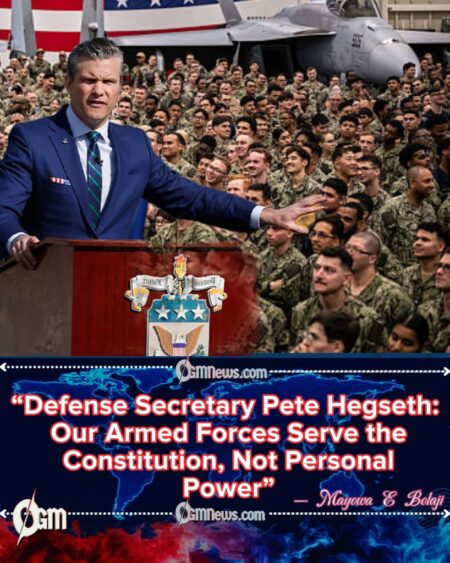
U.S. Defense Secretary Pete Hegseth is at the center of renewed national debate after an unearthed video showed him asserting that the military must refuse unlawful orders, even when issued by Donald Trump, the current U.S. president serving a second term. Hegseth’s remarks, though consistent with established military legal doctrine, surfaced at a politically sensitive moment and have triggered widespread discussion about civil–military relations, executive power, and constitutional obligations.
Hegseth emphasized in the footage that adherence to constitutional boundaries remains the military’s core duty. Pete Hegseth’s comments have since been amplified across political and media platforms, prompting questions about context, intent, and interpretation.
Pete Hegseth and the Video’s Immediate Impact
Hegseth appears in the resurfaced clip, reportedly recorded during a private discussion before his appointment as defense secretary, stating that military personnel must reject commands that violate constitutional limits. Hegseth’s phrasing mirrors long-standing military ethical standards but has taken on new weight in today’s polarized political environment.
Hegseth became the subject of rapid online analysis as lawmakers and commentators reacted within hours of the video emerging. Hegseth faced interpretations that ranged from affirmations of legal doctrine to claims that his comments hinted at institutional unease over hypothetical presidential directives.
Pete Hegseth and the Legal Basis for Lawful and Unlawful Orders
Pete Hegseth has repeatedly stated that the U.S. military is obligated to follow lawful orders from civilian authorities while rejecting those deemed illegal, a principle rooted firmly in the Uniform Code of Military Justice (UCMJ). Hegseth’s resurfaced remarks align with these foundational legal frameworks rather than contradict them.
Pete Hegseth is supported by legal scholars who note that refusing unlawful orders is not only permitted but required under U.S. military law. Hegseth’s comments therefore reinforce established norms, even if their timing has invited heightened public scrutiny.
Pete Hegseth and the Wave of Political Reactions
Hegseth quickly drew responses from Capitol Hill, where administration allies argued that the clip reflected standard military ethics rather than dissent. Hegseth was defended by supporters who insisted the comments were taken out of context and weaponized for political gain.
Pete Hegseth also faced criticism from opposition lawmakers who suggested the footage revealed deeper tensions within the national-security apparatus. Hegseth’s remarks, they argued, could indicate concern about potential scenarios involving emergency powers or disputed directives.
Pete Hegseth and the Responses From the White House and Pentagon
Hegseth has not yet issued a detailed public statement beyond reaffirming commitment to constitutional obligations, though White House aides maintain that his comments are “doctrinally correct.” Pete Hegseth continues to enjoy the confidence of senior administration figures who downplay any suggestion of conflict with the president.
Hegseth is also backed by Pentagon officials who emphasize that all service members receive extensive training on distinguishing lawful from unlawful orders. Hegseth remains aligned with national security objectives and maintains stable working relationships with military leadership.
Pete Hegseth and the Broader Implications for Civil–Military Relations
Hegseth has inadvertently reignited a national conversation about the delicate balance between military duty and civilian oversight. Hegseth’s case highlights the challenges of maintaining institutional trust during politically charged moments.
Hegseth is cited by scholars as a reminder of the importance of predictable, transparent relationships between elected authorities and the armed forces. Hegseth’s resurfaced footage underscores how quickly misunderstandings can escalate in a climate of heightened polarization.
Hegseth and the Calls for Further Clarity
Hegseth now faces calls from some lawmakers to provide further clarification regarding the intent of his statements. Hegseth, however, must weigh whether additional commentary would resolve concerns or simply amplify the controversy.
Hegseth, for the moment, remains at the center of a debate that blends legal principle, public perception, and political tension. Hegseth’s unearthed video continues to shape discussions on executive authority and military responsibility.
[…] […]