









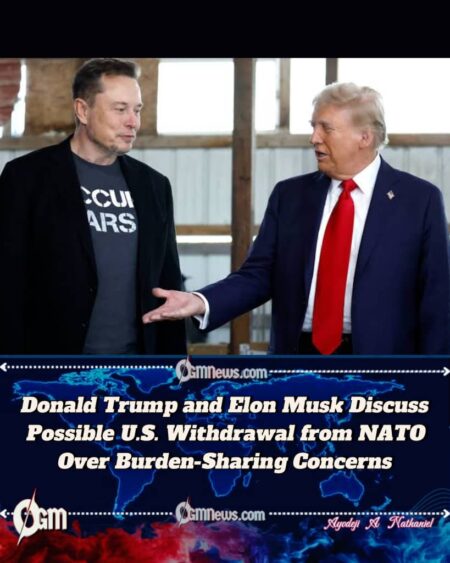
Donald Trump is once again placing America’s role in the NATO alliance under sharp scrutiny, following new discussions with technology entrepreneur Elon Musk about whether the United States should consider withdrawing entirely from the bloc. Their conversation comes amid long-standing frustrations within Washington over what Trump describes as an unsustainable imbalance, with the U.S. paying far more for Europe’s security than European nations contribute toward their own defense.
Donald Trump has repeatedly argued that the alliance cannot survive without proportional commitment, warning that American taxpayers should not continue carrying the overwhelming share of NATO’s financial and military responsibilities. His latest discussions with Musk, insiders say, signal that the debate over the future of the transatlantic alliance is moving back to the forefront of U.S. strategic policy under his second-term administration.
Donald Trump Questions Decades of Unequal Burden Sharing
Donald Trump has long contended that NATO’s structure places a disproportionate burden on the United States, which consistently contributes the majority of the alliance’s funding, military capability, and strategic infrastructure. Trump’s view is that such an arrangement may have been defensible during the Cold War, but it is no longer viable in an era where Europe possesses the economic strength to shoulder its own defense responsibilities.
Donald Trump’s renewed focus on this issue reflects mounting frustration within his national security team, who argue that the gap between U.S. contributions and those of key European powers—especially Germany—remains too wide. Despite years of pressure, only a subset of NATO members have met the alliance’s 2% defense-spending target, reinforcing Trump’s belief that America’s allies benefit from the U.S. security umbrella without adequately investing in collective defense.
Elon Musk’s Influence on Strategic Policy Conversations
Donald Trump’s discussion with Elon Musk marks the latest in a series of high-level conversations between the president and business leaders whose insights he values. Musk, who has increasingly engaged in national policy debates, has voiced concern about the financial sustainability of U.S. global commitments and the need for a more rational approach to defense spending.
Donald Trump is said to appreciate Musk’s blunt assessments and unconventional strategic thinking, which often challenge entrenched assumptions in Washington. While Musk does not hold a formal government position, his proximity to the administration has elevated his voice in national security, economic, and technological policy discussions. Their talks on NATO, aides say, reflect the president’s willingness to reassess long-standing frameworks if they no longer align with U.S. interests.
Donald Trump Considers Strategic Options for NATO’s Future
Donald Trump is weighing several potential pathways for the future of U.S. involvement in NATO. These range from a more aggressive push for burden-sharing reform to, in the most dramatic scenario, a full U.S. withdrawal from the alliance. While no decision has been made, the fact that withdrawal is now part of internal discussions underscores the seriousness of the administration’s concerns.
Donald Trump’s advisors caution that any major shift would require careful diplomacy, noting that sudden changes could destabilize transatlantic security structures. Still, they argue that Europe’s longstanding reliance on U.S. power cannot continue indefinitely. Trump’s central message remains unchanged: the United States will not remain in an alliance where American citizens pay the most and benefit the least.
European Leaders React With Growing Anxiety
European governments are reportedly alarmed by the renewed possibility of a U.S. exit from NATO, fearing that such a move would leave the continent exposed amid rising geopolitical tensions. Officials in Berlin, Paris, and Brussels continue urging Washington to remain committed, insisting that Europe is increasing its defense budgets and that NATO remains essential to collective security.
However, Donald Trump’s team argues that incremental improvements are insufficient and that Europe’s defense systems still depend heavily on American funding, intelligence, logistics, and nuclear deterrence. The divide underscores a deeper tension: Europe wants continued U.S. protection, while the United States seeks a recalibrated relationship that reflects twenty-first-century realities.
National Security Analysts Warn of a Potential Realignment
Analysts say Washington’s internal debate marks a potential turning point in U.S. grand strategy. If the administration seriously considers withdrawing from NATO, the global security order—built for decades around American military leadership—could undergo profound realignment. Some argue such a shift could free the U.S. to pursue more flexible bilateral partnerships; others warn it could embolden rival powers and destabilize existing deterrence structures.
Donald Trump, for his part, maintains that American national interest must guide every foreign policy decision. Whether that ultimately means remaining in NATO with new terms or stepping back entirely remains an open question as the administration continues its internal review.
Casinoabc999? Good Site. The interface is sleek, and there is a lot of stuff to...