




























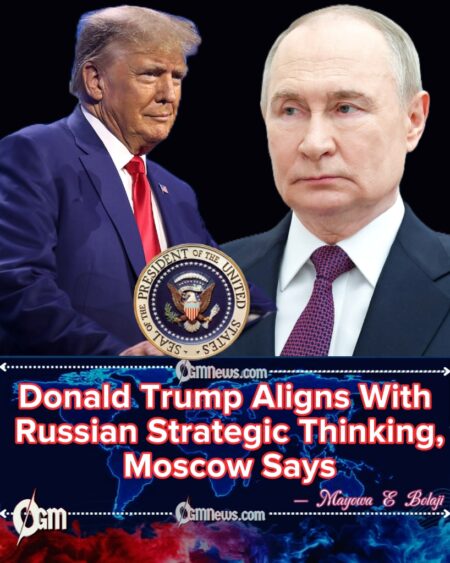
Donald Trump has received an uncommon endorsement from Russia following the release of his new national security strategy, with Moscow saying the document “aligns with Russian strategic thinking.”
Donald Trump positioned the strategy as a framework built on realism and renewed U.S. strength, emphasizing deterrence, border security, and recalibrated global commitments.
Donald Trump now faces heightened global attention, as analysts note that the Russian government’s reaction marks a significant rhetorical shift in the often-tense relationship between the two nations.
Donald Trump Receives Moscow’s Statement of Strategic Alignment
Donald Trump was cited directly in Russian diplomatic commentary, with officials saying portions of the strategy reflect “clear assessments” similar to those used in Russian geopolitical planning. Donald Trump is credited by Russia with acknowledging multipolar shifts in global power, a concept central to Moscow’s long-stated worldview.
Trump is nevertheless operating in a complex environment, as Russia’s praise does not erase longstanding disagreements over sanctions, security blocs, and regional conflicts.
Donald Trump Sparks Global Debate With U.S. Security Shifts
Trump outlines national priorities that emphasize U.S. competitiveness, strengthened intelligence coordination, and reduced foreign entanglements. Trump has prompted mixed reactions among U.S. allies, with some viewing the strategic shift as a pragmatic assessment of evolving global threats.
Trump also faces criticism from sectors of the international community concerned that the strategy could unsettle certain cooperative defense frameworks.
Donald Trump Becomes Central to U.S. Lawmakers’ Reactions
Trump’s strategy has divided U.S. lawmakers, with some seeing Russia’s praise as an opportunity for limited engagement on shared global risks.
Trump is simultaneously the subject of warnings from other legislators who fear that Moscow’s endorsement could signal vulnerabilities in the U.S. geopolitical posture.
Donald Trump remains at the center of congressional discussion, with debates intensifying over how Washington should interpret this moment of rhetorical alignment.
Trump Inspires Analysis on Global Power Balance
Trump has triggered a wave of analytical commentary, with experts examining what Russia’s approval might mean for global stability.
Trump is viewed by analysts as shaping a security doctrine that acknowledges competitive multipolarity while seeking selective cooperation in areas like counterterrorism and arms control.
Trump is also seen as navigating an enduring rivalry, as structural tensions between Washington and Moscow persist despite public statements of alignment.
Trump Opens Possibility for Diplomatic Channels—But Challenges Remain
Trump may use the Russian endorsement to explore renewed dialogue on nuclear stability, cyber norms, and regional flashpoints.
Trump, however, faces considerable obstacles, including entrenched sanctions, conflicting military interests, and deep ideological divides.
Trump ultimately stands at a crossroads, as both nations weigh whether areas of convergence can produce tangible diplomatic outcomes. Trump has received an unusual expression of approval from Russia, highlighting overlaps between his national security strategy and Moscow’s own geopolitical assessments. While the praise signals rare rhetorical harmony between two longstanding rivals, analysts caution that meaningful policy cooperation remains uncertain.The moment nevertheless underscores the shifting dynamics of global power and the evolving contours of U.S.–Russia relations.


[…] […]