




























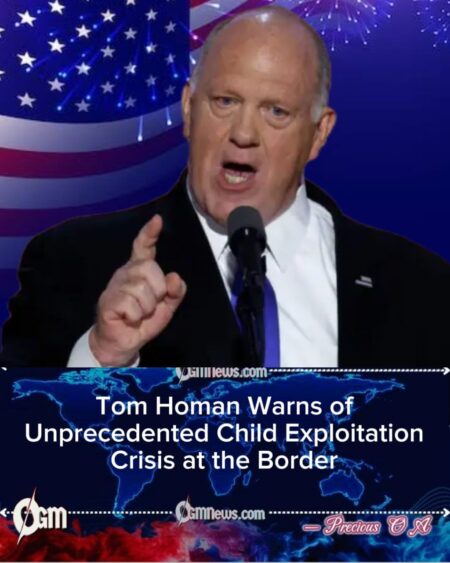
Tom Homan, former acting director of Immigration and Customs Enforcement, delivered a stark and deeply unsettling assessment as he confirmed that more than 62,000 children were located after being brought across the border during the current administration, stressing not only the scale of the issue but also the urgency, humanitarian consequences, and national security concerns surrounding such an extraordinary revelation. His statements carried a heavy undertone of institutional frustration, revealing systemic weaknesses, broken oversight mechanisms, and long-standing failures that have allowed the exploitation of minors to flourish in ways that should alarm every responsible policymaker.
Tom Homan emphasized that the staggering number reflects only the cases authorities have managed to identify and process, raising the possibility—indeed, the likelihood—that additional unreported incidents remain hidden within fragmented bureaucratic systems, unreliable documentation chains, and inconsistent agency coordination. He warned that traffickers, smugglers, and opportunistic criminal networks often operate faster than the government’s ability to track them, making the true scope potentially far greater and more disturbing than current data indicates.
Federal analysts noted that the cumulative reports have placed renewed pressure on security agencies, prompting extensive multi-layered reviews of documentation practices, cross-border intelligence sharing, staffing allocation, and the long-term outcomes for minors processed through the system. Their assessments highlight deep institutional strain, suggesting that agencies once designed for moderate caseloads are now struggling under volumes that overwhelm record-keeping, delay investigations, and complicate efforts to ensure appropriate follow-up care, safety, and legal protection for every child recovered.
TOM HOMAN: BORDER ENFORCEMENT OPERATIONS
Tom Homan argued that the operational challenges faced by frontline agents are compounded by rising caseloads, inconsistent policy directives, and the logistical strain of coordinating with multiple jurisdictions responsible for child safety assessments, intake processing, and emergency relocation efforts. He described a workforce stretched thin by the sheer magnitude of arrivals, forced to balance enforcement duties with humanitarian responsibilities that were never intended to fall solely on border personnel.
Operational officers reiterated that the discovery of tens of thousands of minors underscores the evolving tactics of sophisticated smuggling organizations, many of which leverage vulnerabilities in regulatory procedures and physical terrain to move migrants across high-risk corridors with increasing precision. They explained that these groups employ deceptive strategies, rapid-movement caravans, and digital communication networks that exploit slow-moving government processes, creating a cat-and-mouse dynamic that endangers both migrants and enforcement agents.
Stakeholders in border states have increasingly demanded clearer enforcement frameworks, highlighting concerns that overlapping mandates between federal, state, and local authorities have slowed rapid response efforts, complicated rescue operations, and blurred the lines of responsibility. They argue that without a more unified chain of command and improved communication systems, enforcement efforts will continue to be reactive, fragmented, and chronically inefficient.
HUMANITARIAN AND WELFARE CONCERNS
Tom Homan stated that the welfare of these children remains a central question, noting that many arrive without verifiable documentation, established guardianship, or confirmed histories, making long-term placement efforts extremely complex and frequently chaotic. He stressed that the federal system is often forced to reconstruct entire life histories from fragments, an impossibly slow process that places vulnerable minors at further risk.
Tom Homan described the ongoing reviews of shelter systems and sponsorship verification as a monumental and burdensome task, emphasizing the need for deeper accountability standards, expanded investigative protocols, and more rigorous tracking mechanisms to prevent children from simply disappearing after initial processing. He warned that previous lapses have already led to cases where minors were handed over to unvetted adults, exposing them to exploitation.
Child welfare advocates reported sharp increases in caseloads and emergency accommodation requests, arguing that systemic strain has elevated the risk of exploitation, inconsistent care, and administrative delays that affect everything from medical evaluations to psychological support services. They stressed that the crisis has outgrown the capacity of existing institutions, leaving both caregivers and minors struggling within an overloaded system.
POLITICAL AND POLICY RESPONSES
Tom Homan contended that the current policy environment has contributed to unprecedented migration incentives, asserting that agencies have been overwhelmed by the volume of arrivals, by insufficient deterrent structures, and by frequent reversals in operational guidance that create confusion at every level of enforcement. He highlighted the need for durable, long-term policy consistency rather than fluctuating directives reshaped by political cycles.
Lawmakers across multiple committees have called for reevaluation of current border directives, seeking expanded data transparency, enhanced interagency briefings, and stronger legislative guardrails to address processing failures, record-keeping inconsistencies, and gaps in risk assessment models. They warn that without decisive action, the problem will escalate further.
Opposition members argued that long-term policy coherence has been undermined by rapid shifts in enforcement priorities, leaving frontline officials with conflicting mandates that hinder consistent federal intervention, weaken institutional authority, and diminish the public’s trust in the government’s ability to manage national borders.
INTERNATIONAL AND CROSS-BORDER DYNAMICS
Tom Homan pointed to the expanding involvement of transnational smuggling networks, asserting that these organizations have grown increasingly sophisticated in coordinating child transport, concealment strategies, and document falsification efforts that make detection vastly more difficult. He stressed that this is no longer a localized issue but part of a global criminal enterprise.
Diplomatic analysts observed that regional instability, economic pressures, and cartel-driven exploitation continue to drive child migration patterns, demanding deeper cooperation between U.S. security forces and foreign governments to dismantle trafficking routes and intercept coordinated smuggling operations.
Senior officials in neighboring countries have publicly expressed concerns about the growing influence of criminal intermediaries, warning that fragmented monitoring systems and under-resourced border checkpoints have allowed traffickers to operate with alarming reach, often beyond the control of law enforcement.
CALLS FOR SYSTEMIC REFORM
Tom Homan reiterated that the magnitude of the discovered cases represents a failure of both enforcement mechanisms and protective services, urging significant restructuring of federal protocols governing minors in migration, including modernized data systems and stronger oversight of private contractors.
Tom Homan maintained that oversight systems must be rebuilt to ensure immediate identification, continuous tracking, and proper welfare evaluation for every child located after crossing the border, emphasizing that the safety of minors cannot depend on outdated or inconsistent procedures.
Policy experts stressed that without durable bipartisan reforms, the strain on immigration infrastructure, investigative agencies, and humanitarian organizations will continue to escalate, complicating long-term national security and child protection objectives while fostering conditions that traffickers are eager to exploit.


[…] […]