

























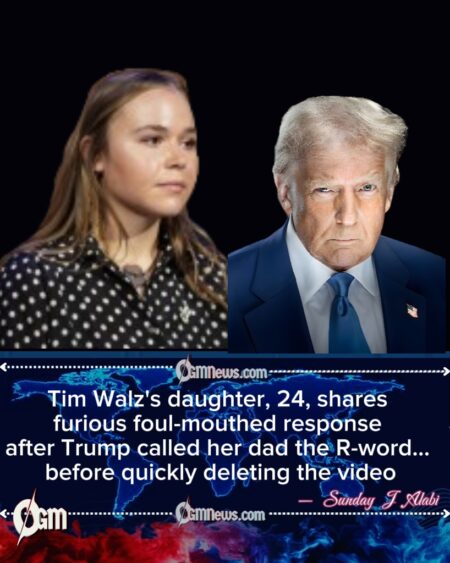
The daughter of Minnesota Governor Tim Walz has issued a strongly worded response after the current U.S. president serving a second term, Donald Trump, used an offensive term to describe her father in a recent online post. Hope Walz, 24, briefly posted a video on TikTok condemning the remark before deleting it, but copies circulated widely across social media. Her message focused not only on the insult directed at her father, but also on the impact such language can have on her family, particularly her brother, Gus, who has a non-verbal learning disability.
Hope Walz’s Online Video and Rapid Deletion
In the video, Hope Walz accused the president of encouraging his supporters to attack her family, claiming that online harassment had intensified after Trump’s remark. She expressed anger at what she described as a “storm” of insults targeting her younger brother. Though the video was swiftly removed, users had already saved and shared copies.
Hope warned that name-calling directed at public officials can extend to their families, especially when a family member lives with a disability. She stressed that criticism of political leaders should not translate into harassment of vulnerable individuals.
The President’s Remarks and Their Political Context
President Trump used the term while criticizing Governor Tim Walz following reports concerning large-scale fraud in Minnesota’s pandemic-era social programs. In a Truth Social post, he referred to the governor Tim Walz with an offensive expression while blaming Tim Walz for what he described as administrative failures.
The president’s comments followed investigative reports alleging widespread fraud within state-managed safety-net programs. Trump connected these allegations to what he suggested was inadequate oversight during Tim Walz’s administration.
Governor Tim Walz Responds on National Television
Governor Tim Walz addressed the controversy during an interview on Meet The Press, describing the president’s language as “damaging” and emblematic of a broader deterioration in political discourse. He suggested that the normalization of insulting language could have long-term social consequences.
Tim Walz also expressed concern about the influence such remarks may have on young people and families facing disabilities. He argued that public leaders should avoid rhetoric that marginalizes vulnerable communities.
Allegations of Fraud in Minnesota Safety-Net Programmes
Beyond the controversy over language, Minnesota continues to face intense scrutiny over alleged fraud in pandemic-related programs. Federal prosecutors say dozens of individuals have been charged or convicted in schemes that diverted public funds intended for low-income families and children.
A central case involves the nonprofit Feeding Our Future, which prosecutors allege falsely claimed to serve large numbers of meals during the pandemic. Officials say millions of dollars were instead spent on luxury purchases including property, vehicles, and international real estate.
Questions About Oversight and Decision-Making
Some critics argue that state officials were reluctant to confront potential wrongdoing for fear of appearing discriminatory against Somali communities involved in certain programs. The New York Times reported that warnings and concerns raised by oversight staff did not halt approvals for questionable reimbursement claims.
State officials have responded by saying that the unprecedented circumstances of the pandemic required swift action. Tim Walz has argued that the state “erred on the side of generosity,” prioritizing aid distribution even as applications surged.
Federal Pressure and Future Implications
The controversy has prompted federal officials to demand stronger accountability measures. The Administrator of the Centers for Medicare & Medicaid Services has warned that Minnesota could face funding consequences if oversight failures continue. The state has been instructed to provide regular updates on audits and corrective plans.
The political dimension of the dispute may continue to widen as both supporters and critics debate whether the fraud cases are primarily a failure of administration, a by-product of emergency conditions, or a combination of both.
Social and Political Fallout
For the Tim Walz family, however, the immediate concern appears to be the impact of targeting language. Hope Walz’s brief video highlighted how public insults can have private consequences, especially for relatives with disabilities who may already face stigmatization.
As the debate expands beyond Minnesota’s programs to a broader discussion of civility in public life, observers warn that inflammatory rhetoric could deepen political divisions while overshadowing complex policy challenges.
[…] […]