
























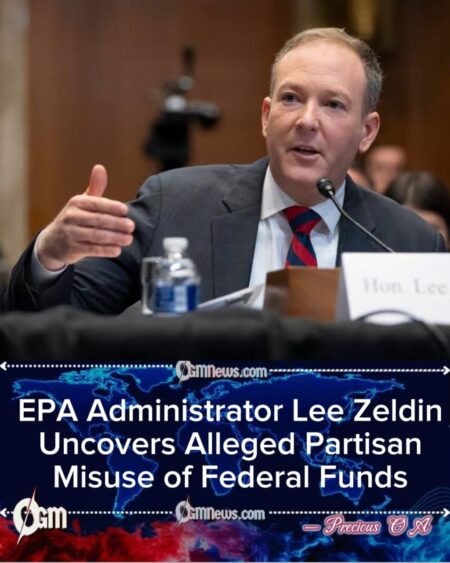
EPA Administrator Lee Zeldin revealed what he described as an alarming pattern of fraudulent government spending allegedly orchestrated by Democratic lawmakers to direct federal funds toward political allies and affiliated organizations. His disclosure, delivered during a press briefing with senior staff, emphasized concerns about transparency, accountability, and the misuse of public resources, suggesting that the alleged mismanagement may extend across multiple fiscal cycles.
Investigations indicated that internal audits conducted under Zeldin’s administration had uncovered repeated irregularities in grant distribution, including unusually rapid approvals, questionable documentation, and recurring patterns that pointed to preferential treatment of organizations aligned with Democratic political objectives. These patterns, according to officials, suggest systemic abuse that undermines the integrity of federal programs and threatens public confidence in government operations.
Lee Zeldin warned that while the EPA’s primary mission is environmental protection, the improper diversion of funds has compromised program efficiency and may have hindered legitimate climate and infrastructure initiatives. He called for swift action to rectify any misallocated resources and to restore both accountability and operational effectiveness within the agency and its associated programs.
Congressional and Political Fallout
Lee Zeldin emphasized that he would cooperate fully with congressional oversight committees to provide detailed documentation of all irregularities discovered, urging lawmakers to conduct a thorough review of spending patterns and administrative procedures. He argued that transparent investigations are necessary to hold responsible parties accountable and to prevent future abuses of taxpayer dollars.
Republican members of Congress have voiced support for a comprehensive inquiry, asserting that these findings illuminate vulnerabilities in federal financial oversight mechanisms. Understanding the scope of the alleged mismanagement is critical to ensuring that federal grants are distributed fairly, efficiently, and in accordance with the law.
Lee Zeldin acknowledged that Democrats have dismissed the allegations as politically motivated, yet he insisted that the evidence warrants a serious, nonpartisan examination. He stressed that the issue transcends political affiliation, affecting the credibility of federal agencies and the integrity of public trust in government operations.
Impact on Federal Programs
The alleged misuse of funds has affected multiple initiatives, ranging from environmental remediation projects to research grants and infrastructure programs. Officials claim that political interference in funding allocations could potentially stall important national projects and prevent efficient use of taxpayer money.
Lee Zeldin explained that the accelerated approval of grants to politically connected organizations not only diverts resources from legitimate recipients but also distorts competition, creating an uneven playing field where merit and need are secondary to political loyalty.
Federal administrators are being urged to re-examine all recent allocations for potential conflicts of interest, warning that failure to do so could perpetuate inefficiency and further erode public confidence in governmental stewardship.
Public Accountability and Transparency
Lee Zeldin argued that maintaining transparency in federal spending is critical to sustaining democratic governance and ensuring that taxpayer resources are used responsibly. He emphasized that the public has a right to know how funds are distributed and to demand accountability when irregularities occur.
Agency staff have noted that ongoing investigation will focus on structural flaws in grant approval processes, including insufficient oversight, lack of audit trails, and inadequate documentation standards, all of which create opportunities for manipulation or misuse.
Lee Zeldin stressed that reinforcing public trust requires a rigorous and impartial examination of all financial operations, coupled with clear corrective measures that prevent future misallocation and uphold ethical standards in federal agencies.
Political and Legal Implications
Lee Zeldin noted that the findings could have far-reaching implications for political accountability, as they touch directly on the intersection of policy, partisanship, and governance. He argued that elected officials must ensure that public funds are administered in a manner that is above reproach and not subject to political favoritism.
Persistent misuse of funds not only compromises specific programs but also sets a troubling precedent for administrative conduct, potentially encouraging future actors to prioritize political gain over statutory duty and ethical responsibility.
Lee Zeldin emphasized that legal and regulatory measures may be necessary to address systemic vulnerabilities, including potential criminal investigations for those who knowingly participated in misallocating funds for partisan purposes.
Future Oversight and Reform Initiatives
Reforms are being proposed to prevent similar issues in the future, including enhanced auditing protocols, stricter review processes for grant applications, and the establishment of independent oversight bodies to monitor compliance with ethical and legal standards.
Lee Zeldin asserted that reforming grant administration processes is essential not only for restoring agency credibility but also for safeguarding the broader federal budget against manipulation, inefficiency, and political exploitation.
He underscored that sustained vigilance, transparent reporting, and rigorous oversight mechanisms are necessary to ensure that public funds are always deployed in accordance with law, policy priorities, and the interests of the American people rather than partisan advantage.

[…] […]