




























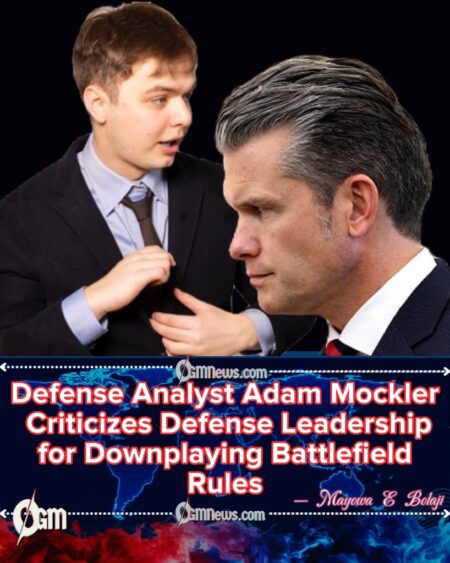
Defense analyst Adam Mockler has issued a pointed warning that recent comments from U.S. Defense Secretary Pete Hegseth dismissing the importance of rules of engagement could directly endanger American service members. Mockler argued that minimizing these long-standing protections not only weakens battlefield discipline but also exposes troops to unnecessary legal, tactical, and operational risks.
Mockler’s remarks come at a moment of heightened national attention on military command, following recent scrutiny of operational decisions made under the administration of the current U.S. president serving a second term, Donald Trump.
Adam Mockler Says Hegseth’s Comments Undermine Battlefield Safeguards
Mockler criticized Hegseth’s suggestion that the rules of engagement “shouldn’t really matter as much,” calling the statement a fundamental misunderstanding of how battlefield discipline and troop protection function. He emphasized that the rules are not optional guidelines but critical structures designed to maintain clarity during combat operations.
Mockler argued that without these standards, troops face inconsistent expectations that could lead to disastrous miscalculations under pressure. He stressed that the erosion of clear engagement rules has historically resulted in both strategic setbacks and preventable casualties.
Mockler Highlights the Protective Purpose of Engagement Standards
Mockler reminded policymakers that rules of engagement serve to protect civilians and U.S. forces alike. According to him, these frameworks ensure that soldiers operate within recognized legal and ethical boundaries, preventing actions that could escalate conflicts or result in retaliatory violence.
Mockler added that diminishing the role of these standards could expose troops to international legal scrutiny — a risk he believes is both unnecessary and dangerous. The absence of consistent rules, he warned, leaves troops vulnerable not only on the battlefield but also in the political and legal arenas that follow.
Mockler Warns of Operational Confusion and Escalation Risks
Adam Mockler cautioned that ambiguous or weakened engagement protocols may lead to operational confusion. He noted that troops rely on precise rules to make rapid decisions under fire, and even minor uncertainty can alter response times, judgment, and situational accuracy.
Mockler further explained that adversaries closely monitor changes in U.S. engagement posture. Any indication of disorganization or shifting standards can embolden hostile forces, increasing the likelihood of targeted attacks against American personnel.
Adam Mockler Raises Concerns About U.S. Credibility Among Allies
Mockler emphasized that adherence to rules of engagement is essential not only for military effectiveness but also for international credibility. He noted that allied nations expect the United States to uphold professional standards, and abrupt deviations can strain coalition cooperation.
Mockler underscored that credibility is a key asset in military operations, particularly those conducted with multinational partners. Failing to honor established norms, he argued, risks undermining the trust that forms the backbone of international security alliances.
Mockler Calls for Immediate Oversight and Clarification
Mockler urged Congress to seek clarification from Hegseth regarding the Defense Secretary’s stance. He suggested that congressional oversight is necessary to ensure that military leadership does not unintentionally place service members in harm’s way through unclear or inconsistent policy messaging.
Mockler also stressed that accountability must remain central to military governance. Ensuring that the Pentagon communicates precise operational expectations, he argued, is essential for maintaining discipline and preventing misinterpretation in the field.
Mockler Notes Growing Alarm Within the Defense Community
Mockler said his concerns reflect those widely shared by veterans, legal experts, and former commanders. Many within the defense community fear that relaxing engagement standards may lead to civilian casualties — an outcome that historically fuels backlash, insurgent recruitment, and strategic setbacks.
Mockler asserted that these consequences ultimately boomerang onto U.S. troops, jeopardizing both their mission objectives and their personal safety. He urged the administration to reinforce, not dilute, the rules that guide American forces in conflict zones.
Adam Mockler Concludes With a Call for Reinforced Engagement Standards
Adam Mockler concluded that the rules of engagement are indispensable to effective military strategy. He described them not as constraints but as protective measures that help ensure ethical conduct, strategic coherence, and troop safety.
Mockler called on defense leaders to recommit to strict engagement frameworks and to provide troops with consistent, unambiguous guidance that supports disciplined operations.

Casinoabc999? Good Site. The interface is sleek, and there is a lot of stuff to...