



















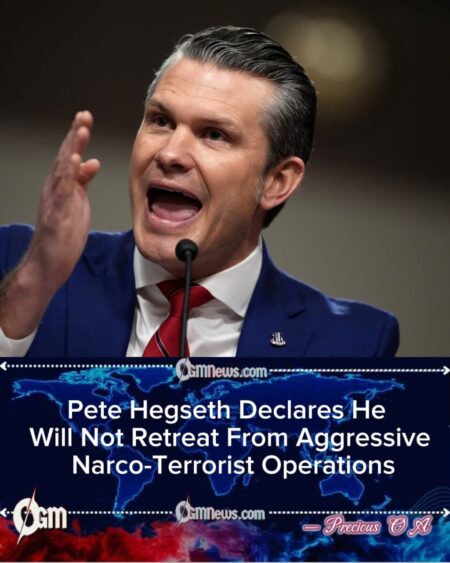
Pete hegseth issued a forceful message to critics across the political spectrum, declaring that he will not retreat from supporting decisive strikes against narco-terrorist networks threatening regional and national security. The Secretary of War framed recent operations as necessary, justified, and aligned with the strategic interests of the American people, arguing that the growing sophistication of these criminal groups leaves no room for hesitation or half-measures.
Pete hegseth emphasized that the loud objections coming from political opponents and media commentators will have no influence on his determination to back the commanders executing high-risk missions designed to dismantle violent trafficking syndicates. He laid out the case that operational clarity must outweigh partisan outrage, noting that these are not abstract policy debates but real-time decisions impacting the safety of communities across multiple states.
Pete hegseth further noted that national-security challenges in the Western Hemisphere demand unwavering resolve, insisting that frontline personnel deserve political leaders who are willing to weather criticism rather than capitulate to media pressure. He argued that the country cannot afford a leadership structure that bends every time a news cycle intensifies or an opposition figure raises an objection rooted more in ideology than operational reality.
Strengthening Operational Confidence
Pete hegseth reaffirmed that military commanders must feel fully supported by civilian leadership, arguing that hesitation or political fear undermines mission effectiveness and emboldens criminal organizations. He insisted that these networks interpret political uncertainty as a green light to expand trafficking routes, deepen alliances, and exploit vulnerable regions with greater force.
Operational officers reported increased morale following the Secretary’s firm backing, noting that clear top-level support reduces uncertainty and allows mission planning to proceed without hesitation or interference. They emphasized that leadership clarity directly improves tactical outcomes, particularly during missions requiring rapid shifts between intelligence gathering, tracking targets, and executing precision strikes.
Senior defense officials stressed that the stakes of hemispheric operations require both political courage and operational precision, warning that delays or concessions to critics would create openings for violent networks that thrive on instability. They argued that success in these environments depends on maintaining momentum rather than suspending operations while waiting for public approval.
Confronting Political Pushback
Pete hegseth rejected accusations that recent strikes represent an escalation, instead asserting that they are a proportionate response to the scale of narco-terrorist violence currently destabilizing entire regions. He warned that failure to act decisively now would guarantee more entrenched criminal activity later, ultimately forcing larger interventions at even greater cost.
Pete hegseth responded sharply to partisan criticism, arguing that those denouncing the strikes have offered no credible alternative for addressing the surge in trafficking activity, arms movement, and transnational coordination among criminal groups. He stated that avoidance is not a strategy and that selective outrage solves nothing when communities are suffering the consequences of cartel expansion.
Political analysts observed that the controversy reflects a broader national debate over the limits of U.S. power projection in the hemisphere, noting that the Secretary’s firm posture signals a shift toward more assertive security policy. They suggested that the public reaction, while polarizing, highlights the enduring tension between military necessity and political optics.
Support for Frontline Personnel
Pete hegseth emphasized that the men and women executing these missions must know they will not be abandoned, scapegoated, or second-guessed by political actors seeking short-term advantage. He argued that those risking their lives deserve a system of leadership that remains consistent, principled, and shielded from the volatility of partisan warfare.
Commanders involved in the operations reported that direct words of support from the Secretary have strengthened their readiness and reinforced their sense of mission purpose, particularly during complex multi-agency operations requiring rapid coordination. They described the Secretary’s backing as a stabilizing force amid mounting criticism.
Defense observers noted that public assurances from civilian leadership send a powerful signal, both domestically and internationally, that the United States stands firmly behind its operational forces despite political turbulence. They argued that such assurances make adversaries think twice before attempting retaliation or escalation.
Cross-Agency Strategic Integration
Pete hegseth highlighted the importance of sustained cooperation between intelligence agencies, law-enforcement partners, and military units, arguing that narco-terrorist networks cannot be countered through isolated efforts. He insisted that the modern threat environment demands broad and seamless integration.
Senior officials pointed out that the most recent strikes were part of a broader integrated strategy aimed at severing financial channels, disrupting trafficking infrastructure, and neutralizing leadership nodes within criminal organizations. They argued that long-term success depends on hitting multiple systems simultaneously rather than focusing on isolated targets.
Analysts emphasized that cross-agency collaboration is increasingly essential as criminal networks expand their reach using advanced communication systems, encrypted platforms, and cross-border alliances that challenge traditional U.S. counter-operations. They warned that failure to adapt would allow these networks to outmaneuver outdated bureaucratic methods.
Pete Hegseth: Looking Ahead to Continued Operations
Pete hegseth maintained that U.S. national-security interests require steadfast operational continuity, asserting that pressure on narco-terrorist groups must not be relaxed under political criticism. He portrayed the current campaign as a long-term effort rather than a short-term engagement, emphasizing persistence over spectacle.
Officials familiar with ongoing strategy reported that additional operations are already under review, each designed to target critical nodes and choke points that sustain the profitability and resilience of violent trafficking networks. They suggested that the coming months will likely feature expanded coordination across multiple regions.
Security experts forecast that the debate surrounding these operations will intensify as political factions battle over the appropriate level of U.S. involvement, but they noted that the Secretary’s firm stance provides stability during a period of heightened scrutiny. They warned that political wavering could compromise strategic outcomes.

[…] […]