





























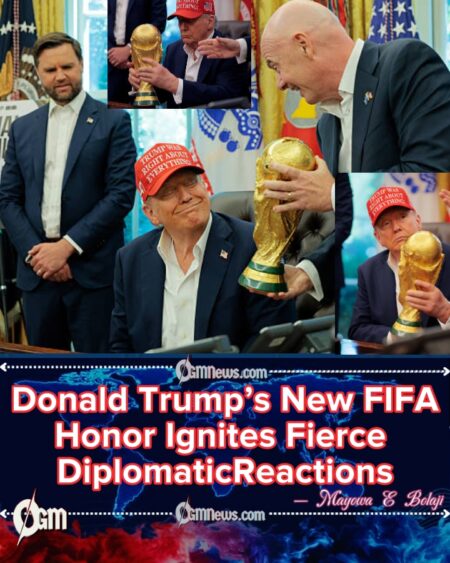
Donald Trump, the current U.S. president serving a second term, has been awarded a peace-themed commendation by FIFA, triggering widespread controversy across the global sports and diplomatic community. The announcement, made during a special session at FIFA’s headquarters in Zurich, quickly drew criticism from policy analysts, human rights groups, and political observers who questioned both the timing and the rationale behind the honor.
The award—framed by FIFA as recognition of “contributions to global dialogue and conflict-mitigation awareness”—has generated intense debate over the organization’s role in global politics and the appropriateness of linking a sports body with highly polarizing geopolitical issues.
FIFA Defends Decision as Symbolic Gesture for Global Outreach
FIFA officials insisted that the prize was not meant to signal support for specific political actions, but instead to acknowledge Trump’s outreach efforts toward certain international negotiations. Spokespersons argued that FIFA, as a worldwide sports federation, has long advocated for peace through cultural exchange and saw the award as part of that mission.
Critics remain unconvinced, pointing to FIFA’s history of politically sensitive decisions and the perception that such awards can blur the line between sports diplomacy and political endorsement. Observers also noted the absence of transparency regarding the selection criteria and voting process.
Political Analysts Question Motivations Behind the Award Presented to Trump
Political strategists across Europe and the U.S. argued that the timing of the award—during heightened global tensions—risks appearing as an implicit endorsement of Trump’s administration. Analysts suggested that the move could deepen existing divides, particularly between nations critical of recent U.S. military and diplomatic actions.
Others speculated that FIFA may be attempting to strengthen ties with powerful governments ahead of upcoming tournament negotiations and international event bids. Regardless of intent, the decision has placed FIFA at the center of a political storm.
Human Rights Groups Condemn the Recognition
Human rights organizations quickly issued statements condemning the award, citing concerns over Trump’s foreign policy and the administration’s involvement in contentious military operations. Advocacy groups argued that rewarding political figures with mixed human-rights records undermines global norms and sets a troubling precedent.
Several international NGOs urged FIFA to retract the award or at least provide full documentation of the decision-making process. They stressed that peace prizes should reflect measurable humanitarian contributions, not symbolic gestures or political convenience.
Trump Allies Praise Award as Acknowledgment of Global Influence
Supporters of President Trump countered that the award appropriately recognizes his attempts at diplomatic breakthroughs, including negotiations in the Middle East and efforts to recalibrate certain international alliances. They argue that peace initiatives often unfold behind the scenes and may not be immediately visible to the public.
Trump allies also framed the recognition as a sign of respect from the world sports community, calling it an example of “soft diplomacy” that transcends traditional political channels.
Implications for FIFA’s Image and Future Governance
Analysts warn that the decision may fuel renewed scrutiny of FIFA’s governance, already under pressure from past corruption scandals and criticisms of political entanglements. Opponents argue that the organization risks alienating fans and member nations by positioning itself within polarizing global political narratives.
FIFA now faces calls for a full explanation of how recipients are chosen, how political neutrality is maintained, and what role—if any—government influence played in this year’s selection.
Casinoabc999? Good Site. The interface is sleek, and there is a lot of stuff to...