


























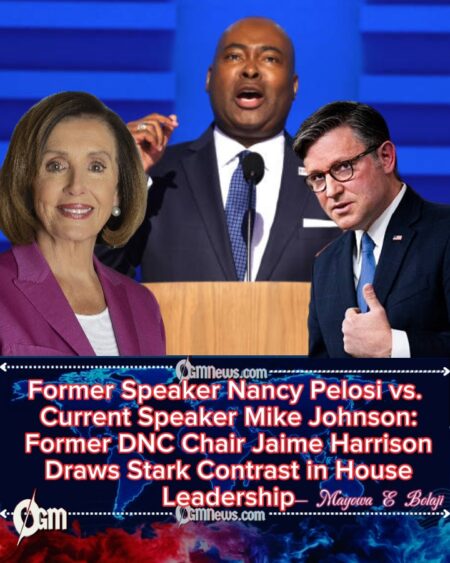
Jaime Harrison, Former Democratic National Committee Chair publicly criticized current House Speaker Mike Johnson on Wednesday, drawing a stark contrast with former Speaker Nancy Pelosi. Harrison, who served in House leadership during Pelosi’s tenure, described Pelosi as “probably the greatest speaker of all time” while asserting that Johnson is “not a good speaker” and “not a good leader.”
Jaime Harrison’s remarks highlight the ongoing partisan discourse over leadership styles, legislative effectiveness, and the strategic direction of Congress under Republican control. The comments are expected to resonate within both Democratic and Republican circles as political debates intensify ahead of the next election cycle.
Jaime Harrison Reflects on Pelosi’s Leadership
Harrison emphasized that Pelosi’s tenure as Speaker was marked by effective legislative strategy, discipline among party members, and the ability to pass key legislation even in challenging political climates.
According to Jaime Harrison, Pelosi’s approach combined meticulous planning with strong interpersonal leadership, which allowed the Democratic caucus to maintain cohesion and advance its priorities in the House. He suggested that her experience and strategic vision set a benchmark for what successful congressional leadership should look like.
Political analysts note that Pelosi’s leadership style often involved balancing competing factions within the Democratic Party while negotiating across the aisle, a skill Harrison says is missing under the current Speaker.
Jaime Harrison Critiques Speaker Mike Johnson
Jaime Harrison’s remarks about Johnson focused on perceived weaknesses in both leadership and procedural management. He argued that Johnson has struggled to unify his party and provide clear direction on legislative priorities, resulting in delays and internal conflicts.
Observers point out that Johnson faces a divided House majority and that some of the challenges may reflect structural and partisan difficulties rather than personal shortcomings. Nevertheless, Harrison framed the current leadership as falling short of historical standards.
Implications for Partisan Strategy
Harrison’s public critique aligns with broader Democratic efforts to define contrasts between past and present congressional leadership. By highlighting differences between Pelosi and Johnson, Democrats aim to underscore perceived Republican inefficiencies and motivate their base ahead of upcoming elections.
Political strategists suggest that such comparisons are often used to craft messaging that emphasizes Democratic unity and competence while framing Republicans as less effective managers of Congress. Harrison’s comments could become a recurring talking point in Democratic campaigns.
Reactions and Responses
As of now, the office of Speaker Johnson has not issued a formal response to Harrison’s statements. Some Republican lawmakers have defended Johnson, citing his work to navigate a divided House and manage complex legislative negotiations.
Media analysts note that public evaluations of congressional leadership often vary sharply along partisan lines, with internal metrics of success sometimes differing from public perception. Harrison’s remarks contribute to this ongoing debate about what constitutes effective legislative leadership.
Historical Context and Leadership Comparisons
Harrison’s comparison also underscores a historical perspective on House leadership. Pelosi is widely recognized for her strategic acumen during multiple terms as Speaker, including major legislative achievements and crisis management.
Comparing her tenure with Johnson’s current leadership frames contemporary challenges in the House against historical successes. Political scholars argue that such comparisons, while common in political discourse, can shape public perception and influence the narrative around legislative effectiveness.
How Will Mike Johnson Respond to this Criticism?
Jaime Harrison’s critique is likely to spark further discussion in political media and within Congress itself. Questions remain about how Johnson will respond to criticism and whether Democrats will continue leveraging comparisons to Pelosi in their messaging.
Observers expect that leadership debates will intensify as Congress confronts pressing legislative priorities, including budgetary matters, national security, and policy reforms. Harrison’s comments may serve as an early indicator of how Democrats plan to define the election narrative around leadership competence.



[…] […]