



























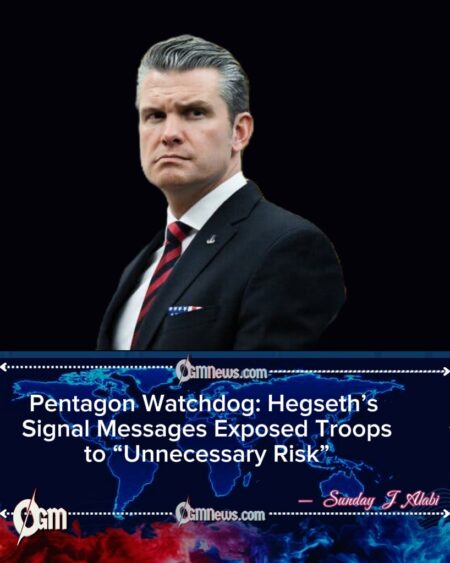
An official investigation led by Acting Inspector General Steven Stebbins has concluded that Secretary of War Pete Hegseth endangered American service members by sharing highly sensitive operational details over the encrypted messaging application Signal, a platform prohibited for classified communications. The probe, launched at the request of bipartisan Senate Armed Services Committee leaders, found that Hegseth circulated real-time strike plans—including exact timing—during U.S. military operations in the Red Sea and in waters near Venezuela.
The release of a declassified version of the Inspector General’s report, expected Thursday, comes as the Pentagon faces intensified scrutiny over allegations that Hegseth approved or helped coordinate lethal boat strikes in Venezuelan waters. The White House and Pentagon maintain that Adm. Frank Bradley—not Hegseth—authorized the second strike that killed two survivors.
Findings of the Inspector General: Protocol Violations and High-Risk Messaging
The classified report delivered to Congress on Tuesday lays out clear evidence that Hegseth used Signal to transmit operational details that should have remained confined to secure military communication channels. Among the messages was a line referencing the exact moment ordnance would fall: “This is when the first bomb will drop.”
Stebbins emphasized in his assessment that while a defense secretary holds declassification authority, the disclosure of active military planning on a non-secure platform violated long-standing Defense Department policies. The report also recommended enhanced training for senior officials on communication protocols, noting that encryption alone does not make a platform suitable for classified exchanges.
Multiple current and former military officials told the Associated Press that no scenario would justify sharing pre-strike specifics via an unsecured device. Veterans’ groups and military families echoed those concerns, citing the stringent rules they must follow to protect sensitive information.
Hegseth’s Response: Claims of Operational Judgment and Declassification Authority
Hegseth declined an interview with the Inspector General, instead submitting a written response. According to a source close to him, Hegseth maintains that the disclosures were made as “operational decisions in the moment,” and that he appropriately declassified the information—despite the absence of any documentation supporting such action.
Legal sources familiar with classification procedures told reporters that Hegseth, as the original classifying authority, has broad latitude to declassify Defense Department materials. However, one source noted that such discretion “does not necessarily make it a good idea,” especially when real-time strike planning is involved.
Hegseth had previously stated publicly that the information shared over Signal consisted of “informal, unclassified coordination,” a characterization that the Inspector General’s findings now contradict.
The Venezuela Boat Strike Controversy: Conflicting Accounts and Rising Scrutiny
The IG inquiry unfolded as bipartisan lawmakers broadened their attention to Hegseth’s role in U.S. military actions off Venezuela. A congressional investigation is examining allegations that he ordered or contributed to decisions resulting in deadly strikes on small boats believed to be carrying drug traffickers. These operations, according to Hegseth, were meant to “stop lethal drugs, destroy narco-boats and kill the narco-terrorists who are poisoning the American people.”
The White House, the Pentagon, and senior administration officials have rejected claims that Hegseth directed the second lethal strike, insisting instead that Adm. Frank Bradley made the call. Nonetheless, the controversy has intensified calls for greater oversight of the Pentagon’s chain of command during maritime interdiction missions.
The United States has escalated operations in the region amid concerns about transnational drug trafficking networks and their connections to hostile non-state actors. The deaths of those aboard the Venezuelan boats have drawn international attention and raised questions about proportionality, targeting decisions, and reporting transparency.
Origins of the Investigation: A Mistaken Group Chat and Bipartisan Pressure
The initial alarm was raised in March after journalist Jeffrey Goldberg of The Atlantic was accidentally added to a Signal thread by then–National Security Adviser Mike Waltz. The group included high-ranking national security officials—among them Secretary of State Marco Rubio, Director of National Intelligence Tulsi Gabbard, Vice President JD Vance, and the current U.S. president serving a second term.
The mistaken inclusion of a journalist drew immediate attention to the sensitive discussions taking place across Signal channels. Reports later revealed that Hegseth also created a second Signal chat with 13 participants, including his wife and brother, where similarly sensitive information was shared.
Senate Armed Services Committee Chairman Roger Wicker and Ranking Member Jack Reed formally requested an investigation in April, triggering the IG’s inquiry one month later. Their bipartisan pressure underscored shared concerns over the preservation of operational security during coordinated U.S. strikes on Iran-backed Houthi forces disrupting Red Sea commerce.
Red Sea Context: Heightened Tensions and Global Trade Disruptions
The investigation unfolded amidst ongoing Houthi missile and drone attacks on commercial and military vessels in the Red Sea. The Houthis, aligned with Iran, framed their operations as retaliation against Israel’s offensive in Gaza. Their sustained campaign forced significant rerouting of global shipping, disrupting an estimated $1 trillion in annual trade that normally passes through the corridor.
Against this backdrop, Hegseth faced pointed questioning during a June congressional hearing over whether his Signal communications constituted a breach of national security. When asked by Rep. Seth Moulton whether he would hold himself accountable should the IG find misconduct, Hegseth declined to answer directly, stating only that he serves “at the pleasure of the president.”
The Pentagon has not issued public comment on the latest findings.
Next Steps: Declassified Report Release and Congressional Review
The declassified version of the Inspector General’s findings will be presented to the public Thursday, providing clearer insight into how sensitive information was handled at the highest levels of the Defense Department. Lawmakers from both parties have signaled their intent to review the matter thoroughly and assess whether disciplinary, procedural, or legislative remedies are warranted.
As Congressional committees prepare to parse the upcoming release, the case underscores enduring challenges around digital communication, chain-of-command accountability, and safeguarding operational secrecy during high-stakes military operations. The public version of the report is expected to intensify debate over how senior officials navigate real-time decision making in an era of rapid, informal digital exchange.
Casinoabc999? Good Site. The interface is sleek, and there is a lot of stuff to...