

























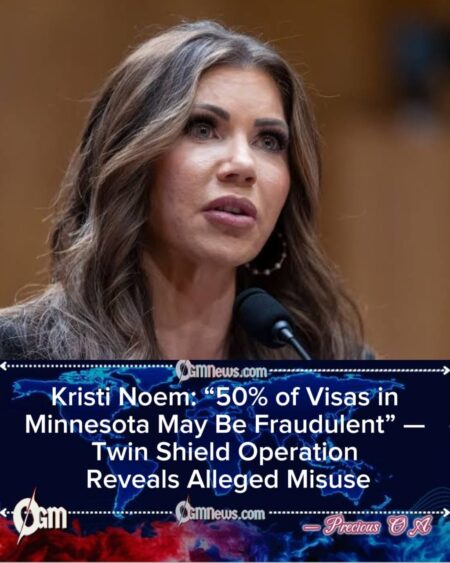
Kristi Noem, the current U.S. Secretary of Homeland Security, revealed in a press briefing that a major federal enforcement operation, known as Twin Shield, had conducted a thorough investigation of visa compliance across Minnesota and uncovered what she described as “alarming irregularities” in the issuance and usage of immigration documents. She further stated that preliminary findings, if verified, suggest that nearly 50 percent of the visas currently in use in the state may involve some form of fraudulent activity, ranging from forged documents to misrepresentation of eligibility. Kristi Noem described the findings as “unprecedented in scale” and emphasized that this operation aimed to identify systemic weaknesses rather than target specific communities.
Kristi Noem emphasized that the Twin Shield operation focused on multiple categories of visas, including work permits, student visas, and other non-immigrant classifications. Federal agents reportedly conducted home visits, verified documentation, interviewed residents, and cross-checked information against federal databases to determine authenticity. The operation involved coordination between the Department of Homeland Security, Immigration and Customs Enforcement (ICE), and the United States Citizenship and Immigration Services (USCIS), highlighting the federal government’s prioritization of integrity in visa programs.
Kristi Noem warned that this investigation represented only an initial phase, suggesting that additional scrutiny could reveal further cases of visa misuse or fraud. She stressed that the intent is not punitive toward immigrant communities indiscriminately but rather to ensure that legal pathways for migration remain credible and properly administered. Officials indicated that follow-up investigations and enforcement actions are likely in the coming months to address unresolved cases identified by Twin Shield.
Local Government and Community Reactions
City officials and representatives in Minneapolis and St. Paul expressed significant concern over the federal findings, noting that sweeping statements about “50 percent fraudulent visas” could contribute to the stigmatization of immigrant communities. Local authorities called for the release of detailed evidence, stressing that public policy decisions should be informed by verified data rather than preliminary reports. Municipal leaders emphasized that immigrant populations in Minnesota include long-term residents and lawful permanent residents whose contributions to the local economy and society are significant.
Kristi Noem defended the need for immediate public disclosure, stating that transparency in federal operations is crucial for maintaining accountability across municipal and state governance. She emphasized that federal agencies must collaborate closely with local authorities to ensure enforcement actions comply with both legal standards and community sensitivities. Kristi Noem argued that public awareness encourages cooperation and mitigates misunderstandings between law enforcement and immigrant residents.
Civil-rights advocates warned that broad statements about visa fraud, if not carefully contextualized, could generate fear among immigrant populations, potentially deterring cooperation with local law enforcement and community services. Kristi Noem acknowledged these concerns but reiterated that the scope of the investigation, based on preliminary evidence, indicates a systemic issue requiring federal intervention. She maintained that the Twin Shield operation is guided by legal protocols to protect the rights of those under investigation while addressing fraudulent activity.
Link to Social-Services Fraud in Minnesota
Recent social-service fraud scandals in Minnesota have drawn attention to potential vulnerabilities in administrative oversight, particularly with programs distributing large sums of taxpayer funds. Kristi Noem highlighted that these cases, including the misappropriation of over $1 billion in state-administered aid programs, underscore the importance of stringent verification and monitoring mechanisms to prevent abuse. She argued that similar vulnerabilities exist in immigration systems, where fraudulent documentation can compromise national security and program integrity.
Kristi Noem observed that oversight gaps in both immigration and state-administered social-service programs exacerbate financial losses, administrative inefficiencies, and public distrust. Federal authorities, she noted, have recommended coordinated reforms to enhance accountability across sectors and reduce the likelihood of future misuse. Kristi Noem suggested that aligning enforcement strategies across immigration and state social-services programs could help identify patterns of fraud that would otherwise remain undetected.
The convergence of social-service fraud and alleged visa fraud presents complex challenges for policymakers, administrators, and the public alike. Kristi Noem stated that failure to address these interconnected issues could erode public confidence in both state and federal institutions. She stressed that proactive measures are necessary to prevent similar large-scale abuses from occurring in the future and to ensure that taxpayer dollars and immigration programs are protected from exploitation.
Federal Enforcement and Visa Policy Implications
Kristi Noem outlined plans for expanding ICE and USCIS agent deployments throughout Minnesota to enforce stricter compliance with immigration laws. She indicated that additional field operations could target locations identified as high-risk during the Twin Shield investigation, particularly areas with a high concentration of non-immigrant visa holders. Kristi Noem emphasized that enforcement would focus on identifying fraudulent cases while minimizing disruption to lawful residents and businesses.
Lawmakers and policy analysts have suggested that legislative reforms may be required to tighten visa issuance standards, enhance documentation verification procedures, and implement more frequent audits. Kristi Noem highlighted the need for systemic deterrents that prevent fraud without creating unnecessary barriers for legitimate visa applicants. She emphasized that carefully calibrated reforms are essential to maintain balance between enforcement and protection of lawful immigration pathways.
Kristi Noem stressed that enforcement measures must be accompanied by protections for lawful visa-holders, warning that overly aggressive or broad actions could disrupt sectors dependent on immigrant labor, including healthcare, agriculture, and service industries. She underscored the importance of strategic planning and communication to ensure that the economic and social fabric of Minnesota is preserved while combating visa fraud effectively.
Calls for Transparency and Evidence
Kristi Noem acknowledged that despite the preliminary claims, many questions remain regarding the specific nature and scope of the alleged visa fraud. She called for the public release of verifiable data regarding the number of affected visas, the types of irregularities identified, and the demographic distribution of those involved. Kristi Noem emphasized that transparency is vital to maintaining credibility in federal enforcement operations.
Judicial experts and civil-rights groups stressed the importance of due process, arguing that accused individuals must receive fair and impartial consideration before enforcement actions are implemented. Kristi Noem echoed this sentiment, asserting that all investigations would follow legal protocols, and that preliminary findings should not be interpreted as final determinations of guilt.
Investigators assured the public that updates would be provided as the Twin Shield operation progresses, aiming to clarify both the scale and specifics of the alleged fraud. Critics, however, urged caution, noting that public interpretations of early findings could lead to exaggeration or misrepresentation of the actual circumstances. Kristi Noem maintained that federal authorities are committed to balancing transparency with accuracy, ensuring both accountability and fairness in their ongoing efforts.
Social, Economic, and Political Impacts
Kristi Noem warned that escalating enforcement could have far-reaching social consequences, including increased fear, heightened anxiety, and decreased trust among immigrant communities in Minnesota. She emphasized that careful communication and community engagement are necessary to avoid unnecessary panic and to foster cooperation between federal authorities and local populations.
Economic analysts highlighted that labor-intensive sectors, including agriculture, hospitality, and service industries, could face critical labor shortages if enforcement actions lead to deportations or suspension of visa programs. Kristi Noem noted that these economic ramifications must be considered when planning enforcement operations, emphasizing that maintaining workforce stability is a key priority alongside legal compliance.
Political observers warned that visa-fraud allegations could have significant implications for upcoming elections in Minnesota. Kristi Noem concluded that the issue is likely to become a focal point of policy debates, with advocacy groups and policymakers mobilizing around both enforcement and immigrant-rights concerns. She stressed that balancing public safety, economic needs, and legal protections is essential in guiding the state through this complex and contentious situation.
[…] […]