






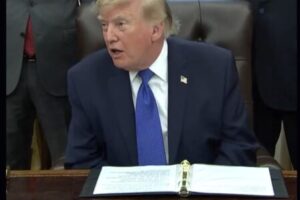






















Marjorie Taylor Greene’s sudden decision to resign from Congress has sent shockwaves through Washington and her home state of Georgia, ending one of the most turbulent and closely watched alliances of the Trump era. Once a fierce defender of President Donald Trump, now serving a second term in the White House, Greene’s break with the president and the MAGA movement culminated in a public rupture that allies say pushed Trump “beyond breaking point” and convinced her she could no longer effectively represent Georgia’s 14th District.
Her resignation, effective January 5, 2026, has raised questions about the limits of loyalty in Trump-era Republican politics, the president’s grip on his party in Congress, and why a politician known for relishing confrontation chose to walk away at the apparent height of her influence.
From Trump’s Fiercest Defender to High-Profile Dissenter
In her first years on Capitol Hill, Greene built a national profile as one of Trump’s most outspoken defenders, amplifying his grievances, backing efforts to overturn the 2020 election results and positioning herself at the forefront of the MAGA movement. She campaigned in lockstep with him and styled her political brand almost entirely around the president’s base.
That loyalty brought her clout. Trump repeatedly praised Greene, boosted her politically, and helped solidify her hold on a reliably Republican district. In 2024, she won re-election by a landslide margin, convincing many in Georgia that her seat was one of the safest in the country.
But beneath the surface, tensions were building. During Trump’s second term, Greene began to question some of his foreign-policy decisions and the direction of his “America First” agenda, particularly over U.S. involvement in the Middle East and the administration’s posture in the Iran–Israel conflict. Those policy disagreements marked an early break from a lawmaker who had previously anchored herself to Trump’s positions.
The Epstein Files and a Public Clash with the President
The clearest point of rupture came in 2025, when Greene emerged as one of the most vocal Republican advocates for full disclosure of files linked to convicted sex offender Jeffrey Epstein, backing legislation and petitions to release a comprehensive database of associates and clients.
According to public statements and media interviews, Greene argued that transparency around the Epstein files was essential for restoring trust in U.S. institutions, even if it implicated powerful figures across parties. She framed her position as a matter of principle and accountability, insisting that “no one should be protected” by political influence or donor status.
The White House took a different view. Trump and his allies were wary of broad disclosures and, at various points, signaled resistance to the scope and pace of Greene’s push. Greene later said the president’s stance on the files was “a huge miscalculation,” an unusually sharp public rebuke of a leader she once defended almost without reservation.
Threats, ‘Traitor’ Label and a Loyalty Test Gone Too Far
As Greene’s advocacy expanded to other issues — including efforts to protect health-care affordability and social safety-net programs, and her increasingly vocal criticism of Israeli military actions in Gaza — she drifted further from the core of Trump’s coalition. She also broke with parts of the Republican establishment over campaign finance and pro-Israel lobbying groups, supporting an organization critical of AIPAC’s influence in U.S. politics.
The response from Trump was swift and personal. In social-media posts and statements, he accused Greene of betraying his movement, reportedly calling her “a traitor” and “wacky” while signaling he would back a primary challenger in her deep-red district. Those comments, broadcast across conservative media, transformed a policy dispute into a test of loyalty to the president himself.
Greene has since said that the rhetoric unleashed a new wave of threats against her, not only from political opponents but from former supporters who viewed her shift as a betrayal. Colleagues and analysts say that moment — when a onetime ally was publicly targeted by the president she helped elevate — marked the point at which Trump was pushed “beyond breaking point” and Greene began to conclude that her position in Congress was no longer tenable.
Shockwaves in Georgia: Could Greene Have Stayed?
In Georgia’s 14th District, Greene’s impending departure has stunned local Republicans and political observers who believe she could have survived even a bruising break with Trump. Despite the president’s withdrawal of support, polling and past results suggest she retained strong name recognition and a loyal base that might have carried her through a contested primary.
Local officials and activists quoted in recent reports argue that Greene misjudged Trump’s electoral influence in the district, where several recent statewide races have shown that his endorsements are no longer decisive for Republican candidates. In their view, Greene’s resignation reflects less a political necessity than a personal decision to step away from a fight she once might have welcomed.
Even some critics concede her departure leaves a vacuum. Greene was a polarizing figure, but she was also a dominant presence in district politics, shaping debates on immigration, cultural issues and national security. The special election to replace her, which Governor Brian Kemp must call under Georgia law, is expected to draw a crowded field in a safely Republican but newly unsettled race.
Fractures in the MAGA Movement and Pressure on GOP Leadership
Greene’s exit comes at a time of broader turbulence inside the Republican Party and the MAGA movement. Her resignation has been cited in national coverage as part of a pattern of internal feuds, retirements and shifting alliances that complicate Trump’s efforts to project unity ahead of the next midterm elections.
On Capitol Hill, her decision is viewed as another challenge for House Speaker Mike Johnson and GOP leaders, who must now manage ideological rivalries and candidate selection in a district long dominated by one of the party’s highest-profile firebrands. Strategists warn that the fight to define “true” loyalty to Trump — and to his second-term agenda — could spill into other primaries and legislative battles in the months ahead.
At the same time, Greene’s break with Trump over foreign policy, Israel and transparency around the Epstein files has opened space for other Republicans to question aspects of the president’s agenda without immediately leaving the party. Some analysts see her resignation as both a cautionary tale and a possible inflection point, illustrating the political risks of challenging Trump while hinting at an emerging, more independent conservative bloc.
What Comes Next for Greene — and for Trump’s Grip on Congress?
Greene has publicly ruled out near-term runs for the U.S. Senate, governorship or presidency, fueling speculation that she may be stepping away from electoral politics altogether, at least for now. Supporters suggest she could reemerge as a media figure, activist or policy advocate focused on issues like government transparency and civil liberties. Others believe she may simply be exhausted after years at the center of national controversy.
For Trump, Greene’s departure is both a demonstration of his continued influence and a reminder of its limits. He successfully turned a onetime ally into a cautionary example for dissenters, but in doing so, he may have deepened divisions inside his own coalition and raised questions about how many high-profile defections the movement can absorb.
The Georgia special election and the broader battle for control of the House will offer the clearest test. The candidates who seek to replace Greene will be forced to define their relationship to Trump’s agenda, while Republicans in Congress weigh how far they are willing to go to challenge, or defend, a president now in his second term and still reshaping the party in his image.



[…] […]