



























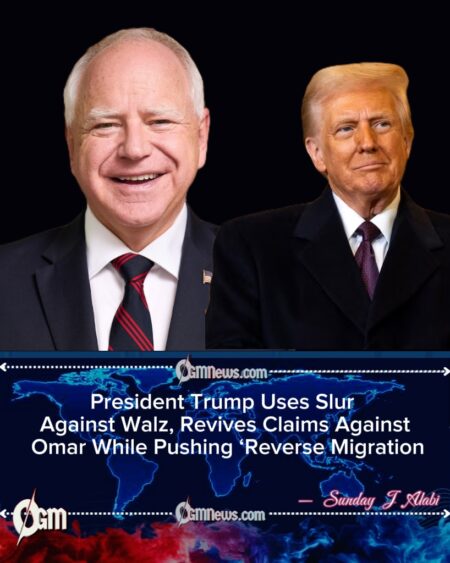
President Donald Trump, the current U.S. president serving a second term, ignited a fresh political firestorm with a late-night Thanksgiving message in which he used an ableist slur against Minnesota Governor Tim Walz and accused Minnesota congresswoman Ilhan Omar of incest, while vowing to impose sweeping new restrictions on immigration.
The comments came in a lengthy post on Truth Social on Thanksgiving night, following the death of National Guard member Sarah Beckstrom, who succumbed to injuries sustained in a shooting near the White House earlier in the week. Trump linked the attack to broader concerns about immigration and national security, framing his response as a necessary “cure” for what he described as a crisis caused by “disruptive populations” admitted to the United States.
In the same post, the president reiterated his proposal for what he called “reverse migration,” an approach he said would “fully cure” the challenges associated with illegal immigration. He coupled those remarks with renewed pledges to halt immigration from “third world” countries and to reexamine green cards issued to immigrants from a list of 19 nations he labeled “countries of concern.”
Offensive Language and Personal Attacks on Walz
In his late-night message, President Trump launched a personal attack on Governor Tim Walz, referring to him with an ableist slur and accusing him of failing to protect Minnesotans from alleged crimes committed by Somali migrants. Trump claimed that “Somalian gangs” were “roving the streets looking for ‘prey’” while residents remained indoors “hoping against hope” to be left alone.
“The seriously retarded Governor of Minnesota, Tim Walz, does nothing, either through fear, incompetence, or both,” Trump wrote, employing language that has drawn widespread criticism in the past for its derogatory nature toward people with disabilities. His remarks framed Walz as both ineffective and unwilling to act, casting Minnesota as a state under siege from migrant-linked crime without providing specific evidence in this particular message.
Trump further alleged that Walz had permitted “hundreds of thousands” of Somali migrants to enter and “prey” on innocent people, depicting Minnesota’s immigrant population as a fundamental threat to public safety. The characterization reflects a longstanding rhetorical pattern from Trump, who has frequently linked immigration to crime and instability, while his critics argue such language fuels xenophobia and stigmatizes entire communities.
Ilhan Omar Accused of Incest and Illegal Entry
The president’s post also targeted Representative Ilhan Omar, a Democrat from Minnesota and one of the first Muslim women elected to Congress. Trump mocked what he called her “swaddling hijab” and repeated a long-standing allegation that she married her brother as part of an immigration scheme, a claim Omar has consistently denied.
“Probably came into the USA illegally in that you are not allowed to marry your brother, does nothing but hatefully complain about our Country, its Constitution, and how ‘badly’ she is treated,” Trump wrote, presenting the accusation as a basis to question her right to be in the United States and her loyalty to the country.
The comments combined an attack on Omar’s personal life, religious appearance, and political views, fitting into a broader pattern in which she has been singled out by Trump and his allies as emblematic of what they portray as ungrateful or “anti-American” attitudes among some immigrants and progressive lawmakers. Critics say such rhetoric places Omar at heightened personal risk and further polarizes public debate on immigration and race.
A ‘Cure’ Through ‘Reverse Migration’ and Expanded Deportations
Beyond the personal insults, Trump used his Thanksgiving message to outline a hardline immigration agenda framed around what he called a “cure” for the problems he associates with illegal migration. He wrote that “only REVERSE MIGRATION can fully cure this situation,” suggesting that large-scale removals of migrants would be necessary to restore security and order.
The president asserted that “disruptive populations” had been admitted to the country through what he described as Joe Biden’s “illegal autopen approval,” a phrase apparently intended to imply that immigration decisions were made in a reckless or illegitimate manner during the prior administration. He argued that such policies had allowed dangerous individuals into the United States, culminating in tragedies such as the recent shooting in Washington, D.C.
Trump also pledged to end all federal benefits for noncitizens, denaturalize migrants who, in his view, “undermine the US,” and deport any foreign nationals deemed a security risk or “non-compatible with Western Civilization.” His language suggested a wide interpretive scope for defining which individuals or communities might be considered “non-compatible,” raising questions about how such policies would be implemented and who would be affected.
DC Shooting, Beckstrom’s Death, and the Alleged Gunman
The timing and tone of the president’s message were closely tied to the shooting of two National Guard soldiers near the White House earlier in the week. Trump noted that Guard member Sarah Beckstrom had died on Thanksgiving from injuries sustained in the attack, a development he had publicly announced only hours before launching his late-night tirade.
Beckstrom’s death added a layer of national mourning to an already tense political atmosphere. The other soldier, Andrew Wolfe, remains in critical condition and is “fighting for his life,” according to the information referenced in the president’s remarks. The incident has intensified debates about security, immigration, and the risks faced by service members even within the nation’s capital.
Authorities have named 29-year-old Afghan migrant Rahmanullah Lakanwal as the alleged gunman in custody over the shooting. According to details cited in the discussion surrounding the case, Lakanwal reportedly entered the United States in 2021 under the Biden administration following the Taliban’s takeover of Afghanistan and had previously worked with the CIA during the war. His immigration history has been seized upon by Trump as evidence that vetting processes failed and that individuals with ties to conflict zones present an elevated danger.
Crackdown Agenda: ‘Countries of Concern’ and Policy Proposals
In addition to his broader calls for “reverse migration,” the president reiterated his desire to review and potentially revoke immigration benefits for people from a list of 19 “countries of concern.” The countries he singled out are: Afghanistan, Burma, Chad, the Republic of the Congo, Equatorial Guinea, Eritrea, Haiti, Iran, Libya, Somalia, Sudan, Yemen, Burundi, Cuba, Laos, Sierra Leone, Togo, Turkmenistan, and Venezuela.
Trump demanded that every green card issued to immigrants from these nations undergo an “urgent reexamination,” arguing that existing approvals may represent a national security risk. While he did not provide specific evidence in this message to support his claims, he framed the move as a necessary protective measure to prevent further attacks and to ensure that only individuals compatible with “Western Civilization” remain in the country.
The president also vowed to shut down all immigration from “third world” countries, a broad term that could potentially affect millions of prospective migrants and refugees. Combined with the proposed end to federal benefits for noncitizens and expanded powers to denaturalize and deport, these proposals signal an aggressive policy posture that would significantly reshape America’s immigration system if fully implemented.
Walz’s Sharp Response and Renewed Scrutiny of Trump’s Health
Governor Tim Walz responded to the president’s insults not by engaging with the substance of the immigration accusations, but by raising questions about Trump’s health. In a pointed post on X (formerly Twitter), Walz wrote, “Release the MRI results,” referencing a recent medical check-up in which the president reportedly underwent an MRI scan, the results of which have not been made public.
Walz’s response shifted attention from his own record in Minnesota to the president’s physical and cognitive fitness, an issue that has surfaced repeatedly in modern American politics. By calling on Trump to release his MRI results, Walz implied that the president’s language and behavior may reflect underlying health concerns that the public has a right to understand.
The exchange underscores the intensely personal nature of contemporary political conflicts in the United States, where policy disagreements are frequently entangled with attacks on health, character, and personal lives. Trump’s language toward Walz and Omar, combined with Walz’s MRI challenge, illustrates how debates over immigration policy are increasingly framed through the lens of personal animosity and mutual delegitimization.
Thanksgiving Wishes Shadowed by Division
Trump concluded his message with a terse Thanksgiving greeting that underscored the combative tenor of his remarks. “Only REVERSE MIGRATION can fully cure this situation,” he wrote, before adding: “Other than that, HAPPY THANKSGIVING TO ALL, except those that hate, steal, murder, and destroy everything that America stands for.”
The phrasing drew a sharp distinction between those the president considers loyal to American values and those he portrays as enemies within, including migrants he labels as criminals and lawmakers he describes as hostile to the United States. The juxtaposition of a national holiday traditionally associated with unity and gratitude with threats, accusations, and sweeping policy demands highlights the deep polarization surrounding immigration and national identity.
As the country processes the death of Sarah Beckstrom, prays for Andrew Wolfe’s recovery, and debates the appropriate response to the DC attack, Trump’s Thanksgiving message is likely to intensify arguments over how the United States should define its borders, its security priorities, and its obligations to migrants and refugees. For supporters, his words signal resolve and a willingness to confront uncomfortable realities. For critics, they represent a dangerous escalation in rhetoric that stigmatizes minorities, undermines decorum, and threatens democratic norms.
[…] […]