


























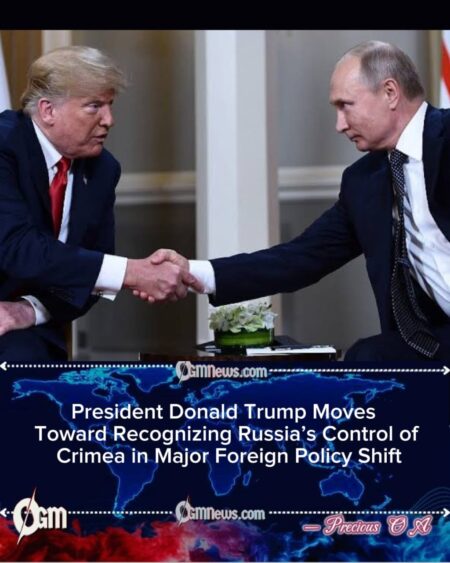
President Donald Trump, serving his second term as the current U.S. president, is preparing a far-reaching policy recalibration that could formally recognize Russia’s control over Crimea and other occupied Ukrainian territories, an initiative that has triggered intense deliberations within diplomatic, military, and legislative circles. The president is said to be evaluating how acknowledging Russia’s authority might recast the United States’ long-standing engagement with Eastern Europe, potentially redrawing strategic expectations that have guided several administrations before him. Senior officials familiar with the discussions describe the moment as delicate, given the magnitude of the geopolitical and security implications tied to the decision.
Donald Trump has repeatedly expressed dissatisfaction with what he views as rigid and outdated foreign policy frameworks that have shaped Washington’s approach to the region for more than a decade. According to advisers, he is drawn toward strategies that reflect what he considers “practical realities on the ground,” a phrase he reportedly uses to challenge existing diplomatic conventions. Those close to internal talks say the president is weighing whether a revised stance could unlock new avenues of communication with Moscow, even though a shift of this nature risks triggering sharp responses from allies concerned about the future of regional stability.
Donald Trump is said to be reviewing extensive documents outlining anticipated global reactions, with security assessments emphasizing both the immediate and long-term consequences for NATO member states. Briefings reportedly detail the potential ripple effects on European defense coordination, illustrating how a U.S. policy realignment could encourage new conversations but also provoke fresh uncertainties. White House sources suggest that the president is determined to make a decision that aligns with his strategic instincts, regardless of the controversies that may follow.
International Reactions and NATO Concerns
Donald Trump has already sparked quiet but significant conversations across European capitals, where diplomats are expressing early concern that U.S. recognition of Russian territorial claims could weaken the cohesion of the NATO alliance. Officials from multiple member states have conveyed private messages to Washington warning that such a shift could embolden Moscow, complicate collective deterrence planning, and weaken political solidarity at a time when European security is undergoing renewed scrutiny. Reports from closed-door discussions indicate that leaders are bracing for a potential policy break that could alter how the alliance responds to evolving threats in Eastern Europe.
Donald Trump has drawn determined responses from Ukrainian officials, who insist that Crimea and the occupied regions remain sovereign Ukrainian territory under international law—a position upheld by numerous United Nations resolutions and diplomatic agreements. Kyiv has emphasized that any modification in the U.S. stance would represent a significant setback for international norms governing territorial integrity, especially in regions where political tensions and military pressures remain volatile. Ukrainian authorities argue that recognition could discourage future diplomatic negotiations by reinforcing Russia’s position.
Donald Trump remains the subject of close monitoring from European governments eager for clarity regarding Washington’s intentions. Analysts across the continent suggest that policymakers are preparing for major recalibrations in security planning, including potential increases in defense spending and new discussions about long-term strategic autonomy. The overarching concern is that the U.S. may prioritize bilateral diplomacy with Russia in ways that shift the balance of transatlantic cooperation.
Donald Trump: Domestic Political Debate Intensifies
Donald Trump has ignited intense debate within Washington, where lawmakers from both major parties are evaluating the consequences of recognizing Russian control over Ukrainian territory. Supporters within his political circle claim that the move could inject fresh realism into a stagnant diplomatic dispute, potentially reducing tensions that have persisted since the annexation of Crimea in 2014. These allies argue that acknowledgment could allow the U.S. to redirect resources toward more urgent foreign policy challenges without abandoning its long-term global commitments.
Donald Trump has faced strong criticism from opponents who contend that the policy shift could undermine decades of U.S. foreign policy principles and weaken America’s moral authority on the global stage. Critics assert that it could send an alarming signal that territorial expansion by force may be rewarded, diminishing the credibility of international institutions tasked with maintaining global stability. Several lawmakers are reportedly drafting resolutions to challenge or scrutinize any such recognition if it proceeds.
Committee leaders in Congress are preparing formal hearings to examine the issue from strategic, legal, and ethical perspectives. Legislators from both parties have expressed interest in understanding how such recognition might reshape sanctions, military cooperation, and diplomatic partnerships across Eastern Europe. The unfolding debate is expected to dominate foreign policy discussions in Washington in the coming weeks.
Strategic Implications for Eastern Europe
Donald Trump has intensified conversations among NATO states bordering Russia, such as Poland and the Baltic nations, where concerns about military security have long occupied national agendas. Defense officials warn that U.S. recognition of Russian territorial claims might complicate deterrence measures and shift the balance of regional power in unpredictable ways. These governments worry that even symbolic shifts in U.S. policy could influence their vulnerability assessments.
Regional security analysts argue that recognition of Russian control could influence conflicts beyond Ukraine, particularly in regions where Moscow maintains political or military leverage. Such a precedent could embolden efforts to challenge borders in other contested areas, altering the global landscape of territorial disputes. Experts warn that a single geopolitical decision may reverberate across multiple strategic theaters.
European nations may be compelled to strengthen their own defense capacities if Washington’s new direction places greater responsibility on NATO partners to counterbalance Russian influence. Planning documents circulating among European ministries outline scenarios where national defense budgets would need substantial expansion to maintain equilibrium in the region.
Diplomatic Signals from Moscow
Russian officials have welcomed developments emerging from Washington, describing potential U.S. recognition as an affirmation of what they frame as “geopolitical truth.” Kremlin spokespersons continue to argue that Crimea’s status is irrevocable, pointing to the 2014 referendum that Western nations widely condemned as illegitimate. Moscow portrays any shift in U.S. policy as validation of its longstanding narrative regarding historic and political ties to the territory.
State-controlled media outlets in Russia have amplified the potential American policy shift for domestic audiences, using the moment to present Russia as diplomatically resilient and strategically vindicated. Analysts caution, however, that such portrayals should be interpreted as part of Moscow’s internal messaging framework rather than concrete predictions about future bilateral relations. Despite optimistic tones, U.S.–Russia negotiations remain complex.
Diplomats warn that Moscow could interpret Washington’s signals as an opportunity to negotiate for further concessions, potentially involving sanctions relief, military deployments, or recognition of additional areas of influence. The delicate nature of these negotiations underscores how even subtle policy shifts can produce substantial diplomatic consequences.
Global Stability and the Road Ahead
Economic experts warn that major foreign policy changes often carry significant financial implications, influencing global markets, energy prices, investment behaviors, and international trade flows. A U.S. decision on Crimea could impact several sectors tied to Eurasian stability, including natural gas routes, defense contracting, and multinational cooperation agreements.
Security institutions and global organizations are assessing how a shift in U.S. policy might affect the broader architecture of European security established after the Cold War. Some analysts believe the move could introduce new uncertainties into existing alliances and disrupt efforts aimed at maintaining stability across vulnerable border regions. Others suggest the decision might prompt renewed diplomatic engagement among great powers.
Governments worldwide are waiting for clear guidance from Washington as the U.S. evaluates one of its most consequential foreign policy choices of the decade. Observers note that decisions of this scale can transform global alignments and reshape international expectations for years to come.
[…] […]