








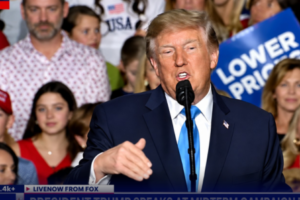




















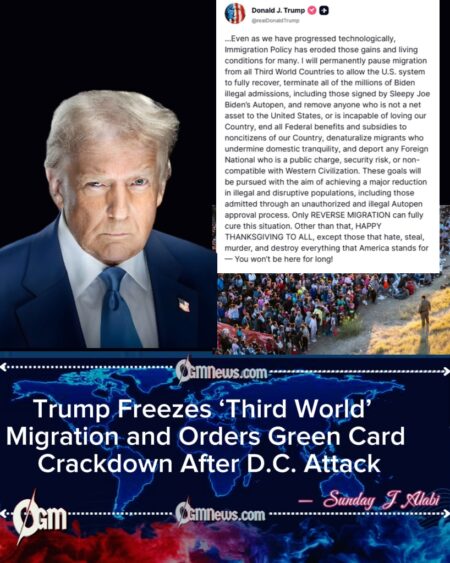
President Donald Trump, the current U.S. president serving a second term, has announced a “permanent pause” on migration from what he described as “all Third World Countries,” alongside an urgent audit of green cards issued to nationals from 19 “countries of concern.”
The move follows a terror-related shooting in Washington, D.C., in which 29-year-old Afghan national Rahmanullah Lakanwal allegedly opened fire on two National Guard members on duty near the White House. The attack left 20-year-old National Guard soldier Sarah Beckstrom dead and 24-year-old Staff Sgt. Andrew Wolfe critically injured.
In a lengthy post on his Truth Social platform, President Trump linked the attack to broader concerns about immigration and national security, arguing that the current system is overwhelmed and vulnerable. He pledged an aggressive reset of migration policy, saying, “I will permanently pause migration from all Third World Countries to allow the U.S. system to fully recover.”
Green Card Audit Targets 19 ‘Countries of Concern’
As part of the new security measures, the administration has ordered a comprehensive review of all green cards issued to immigrants from 19 specified nations. Federal officials have described the effort as a “full-scale, rigorous” audit aimed at reassessing legal residency status for thousands of individuals.
The countries listed as “countries of concern” are: Afghanistan, Burma, Chad, Republic of the Congo, Equatorial Guinea, Eritrea, Haiti, Iran, Libya, Somalia, Sudan, Yemen, Burundi, Cuba, Laos, Sierra Leone, Togo, Turkmenistan and Venezuela. According to administration officials, every green card issued to nationals from these countries will be reexamined to determine whether any recipients pose a security risk or have misrepresented their background.
The review represents a significant escalation of the Trump administration’s approach to immigration enforcement, extending beyond border control to scrutinize immigrants who have already obtained lawful permanent resident status. Critics are expected to raise concerns about due process, profiling, and the impact on families who have lived legally in the United States for years. Supporters, however, are likely to characterize the move as a necessary step in light of security threats.
Trump Blames Biden Over Afghan Shooter, Sparking Heated Exchange
In explaining the new measures, President Trump sharply criticized his predecessor, former president Joe Biden, accusing him of having allowed “unvetted migrants” into the country during the 2021 U.S. withdrawal from Afghanistan. He claimed the alleged D.C. shooter, Lakanwal, entered the United States as part of that evacuation effort.
During a press exchange, a reporter challenged the president Trump’s version of events, noting that an internal review by the Department of Justice Inspector General had stated that Afghans brought into the U.S. underwent vetting by the Department of Homeland Security (DHS) and the Federal Bureau of Investigation (FBI). The reporter questioned why Trump placed responsibility on the Biden administration if the vetting process occurred under government oversight.
The president Trump reacted angrily, repeatedly asking the reporter, “Are you stupid?” and calling her “a stupid person” as she attempted to press her question. He argued that regardless of the vetting process, “they let them in” and insisted his predecessor’s administration bore ultimate responsibility for the alleged attacker’s presence in the United States. The exchange underscored the highly charged political environment surrounding immigration and security, and is likely to fuel further debate over accountability for post-war resettlement policies.
Victim Identified as Young Guardswoman; Second Soldier Critical
The Washington, D.C. shooting has had a deeply personal and emotional impact on the military community and the broader public. The two National Guard members shot near the White House were identified as 20-year-old Sarah Beckstrom of West Virginia and 24-year-old Staff Sgt. Andrew Wolfe.
In a live-streamed call with service members, President Trump delivered the news that Beckstrom had died from her injuries. He described her as a “highly respected, young, magnificent person… outstanding in every way,” adding that the news of her passing had reached him “just seconds” before he went on air. The president said Beckstrom was “savagely attacked” and said he believed she was now “looking down on us,” offering condolences to her family.
Wolfe remains hospitalized in critical condition, and officials say he continues to fight for his life. The case has intensified calls from the Trump administration for tougher measures against individuals considered security risks and has been held up by the president as evidence of what he describes as systemic failures in immigration policy and refugee admissions.
Reverse Migration’ and New Crackdown on Benefits and Citizenship
Beyond the immediate pause on migration and the green card audit, President Trump outlined a broader framework he termed “reverse migration,” which he said was necessary to “fully cure this situation.” In his Truth Social statement and subsequent remarks, he set out a series of proposed steps aimed at dramatically reducing the number of noncitizens living in the United States.
He pledged to:
End all federal benefits and subsidies for noncitizens;
Denaturalize migrants who “undermine domestic tranquility”;
Deport any foreign nationals considered public charges, security risks, or “non-compatible with Western Civilization”;
Terminate what he called “millions of Biden illegal admissions,” including those he claims were approved via an “unauthorized and illegal Autopen approval process.”
The president Trump framed these proposals as necessary to reduce what he called “illegal and disruptive populations,” arguing that current refugee and migration policies have placed excessive strain on schools, hospitals, housing, and public safety. Citing census figures, he claimed there are 53 million foreigners in America, “most of which are on welfare, from failed nations, or from prisons, mental institutions, gangs, or drug cartels.”
These assertions are likely to be disputed by advocacy groups, immigration experts, and statisticians, who often note that immigrants, including refugees, contribute to the economy and public finances. Nevertheless, the president’s language suggests he intends to pursue an expansive review of both legal and unauthorized migration, with a view to removing individuals he deems not to be “net assets” to the country.
Hardline Rhetoric on Refugees, Census Data and Social Strain
President Trump has linked his new policies to what he describes as a broader pattern of social and economic strain arising from refugee inflows and migration. He argued that the “refugee burden is the leading cause of social dysfunction in America,” listing what he called “failed schools, high crime, urban decay, overcrowded hospitals, housing shortages, and large deficits” as consequences of current population trends.
He claimed that this “did not exist after World War II,” contrasting the post-war era with contemporary America, which he portrays as struggling under the weight of what he calls “massive payments from Patriotic American Citizens” to support newcomers and their children. According to Trump, many citizens “put up with what has happened to our Country, but it’s eating them alive to do so,” casting frustration over immigration as widespread but often unspoken.
Critics are expected to argue that such broad claims oversimplify complex social and economic issues and risk stigmatizing entire communities. Advocates for immigrant and refugee communities have previously warned that similar rhetoric can fuel discrimination and hostility against lawful residents and asylum seekers.
Targeting Minnesota’s Somali Community and Rep. Ilhan Omar
In the same extended message, President Trump singled out Minnesota’s Somali refugee community, claiming they are “completely taking over the once great State of Minnesota.” He also directed pointed criticism at Democratic congresswoman Ilhan Omar, a Somali-born lawmaker, calling her “the worst ‘Congressman/woman’ in our Country.”
He referred to Omar as being “always wrapped in her swaddling hijab” and suggested she “probably came into the U.S.A. illegally,” adding a disparaging remark that “you are not allowed to marry your brother.” These comments appeared to revive unsubstantiated online rumors, which surfaced years earlier and have been repeatedly rejected or labeled as baseless by Omar and her allies.
The president accused Omar of doing “nothing but hatefully complain about our Country, its Constitution, and how ‘badly’ she is treated,” contrasting that with his description of her place of origin as “a decadent, backward, and crime ridden nation, which is essentially not even a country.” The remarks are likely to attract strong reactions from civil rights organizations, faith leaders, and political opponents, who have previously condemned similar comments as Islamophobic and xenophobic.
Next Steps: Implementation and Legal Challenges Ahead
Federal officials say the implementation of the migration pause and the green card audit will involve multiple agencies, including the Department of Homeland Security, the Department of Justice, and intelligence services. The review process is being described as “rigorous” and “full scale,” indicating that case-by-case assessments of affected green card holders will take time and may lead to revocations or deportation proceedings.
Legal experts anticipate major court challenges, particularly regarding any attempt to denaturalize citizens, withdraw previously granted permanent residency on broad national-origin grounds, or categorically end federal benefits for all noncitizens. Civil liberties groups, immigration advocates, and some state governments are expected to argue that such measures may violate constitutional protections, federal statutes, and international agreements.
As the country processes the deaths and injuries from the Washington, D.C. attack, debate will likely intensify over whether these sweeping policy shifts enhance national security or undermine fundamental rights and America’s longstanding role as a destination for immigrants and refugees. For now, President Trump has made clear he views “reverse migration” and strict immigration controls as central pillars of his second-term agenda.
Casinoabc999? Good Site. The interface is sleek, and there is a lot of stuff to...