




























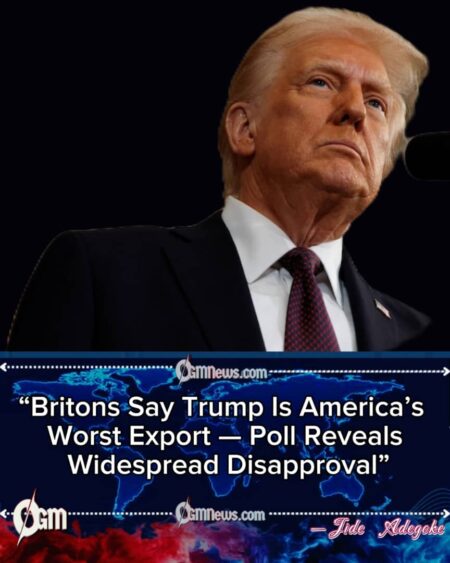
In a striking demonstration of public sentiment in the United Kingdom, a new poll reveals that a significant portion of Britons now regard Donald J. Trump — the incumbent U.S. president serving a second term — as “the worst thing to ever come out of America.” The findings highlight a sharp decline in trust toward the United States, widespread disapproval of Trump’s leadership, and growing concern over the implications for UK-US relations and global stability.
British Confidence in the U.S. Slumps Sharply
Donald Trump’s return to the White House has coincided with a marked erosion of British public confidence in America. According to polling data published earlier in 2025, trust in the United States has dropped precipitously over the past year.
Donald Trump’s presidency appears to be a central factor in this shift. The poll shows that only a minority now view the U.S. favourably — a stark contrast to prior years — reflecting scepticism not only toward the president but toward America’s global standing and reliability.
Broad Unfavourability: Majority of Britons View Trump Negatively
Donald Trump commands a deeply unfavourable image across much of British society. A recent survey by Ipsos found that 63% of British adults hold an unfavourable view of him, while only 22% view him favourably.
Donald Trump’s unpopularity spans across age groups and political affiliations, though younger Britons (aged 18–34) are somewhat more likely to express a favourable view compared to older cohorts.
Fears for Global Security, UK’s International Standing, and Transatlantic Relations
Donald Trump’s second term has heightened British concerns about global stability and the future of the “special relationship” between the UK and US. Over half of respondents in the Ipsos survey predicted negative impacts on global security, political stability in other countries, and Britain’s economic and strategic interests.
Donald Trump’s foreign-policy posture — perceived as unpredictable and potentially destabilizing — appears to underlie many of these fears. Many Britons now question whether the U.S. can be relied upon as a steady ally, particularly on issues such as trade, defence, and international cooperation.
Surprise: Even Some Pro-Reform Voters Are Divided
Donald Trump maintains pockets of support among certain segments of the British electorate, particularly among supporters of Reform UK. Indeed, the Ipsos data suggests that many Reform UK voters view Trump more favourably than the general population.
Donald’s appeal among these voters appears driven in part by shared views on nationalism, scepticism of the European Union, and a desire for stronger UK-US ties. Yet even within this group, opinions remain divided, especially when it comes to the potential negative consequences of a Trump presidency on global affairs.
What This Means for UK-US Relations and British Leadership
Donald Trump’s deep unpopularity among large swaths of the British public presents a delicate challenge for UK leadership. The current British government may face growing pressure from voters to distance itself from Trump’s agenda — particularly in areas like trade, defence alliances, and immigration policy.
Donald’s second state visit to the UK — widely criticized by nearly half of Britons as a mistake — underscores the risk of political backlash at home.
Implications for Global Diplomacy and the Future of American Influence
Donald Trump’s increasingly negative global reputation — as reflected by British and broader European opinion — suggests his presidency may be reshaping the perception of America’s role in the world. Recent research by the Pew Research Center confirms that confidence in Trump’s leadership of world affairs is extremely low across many countries.
Donald’s approach could therefore have long-term consequences for alliances, international cooperation, and the international standing of the United States — with Britain’s growing scepticism emblematic of a wider shift in transatlantic sentiment.
The new British poll paints a stark picture: a majority now view President Trump as “the worst thing to ever come out of America,” reflecting deep distrust in his leadership and growing anxiety over the direction of US power globally. As Britain and its allies reassess their relationships with Washington, the implications of this shift could reverberate far beyond public opinion — influencing diplomacy, trade, security, and the broader architecture of international cooperation.
[…] […]