


























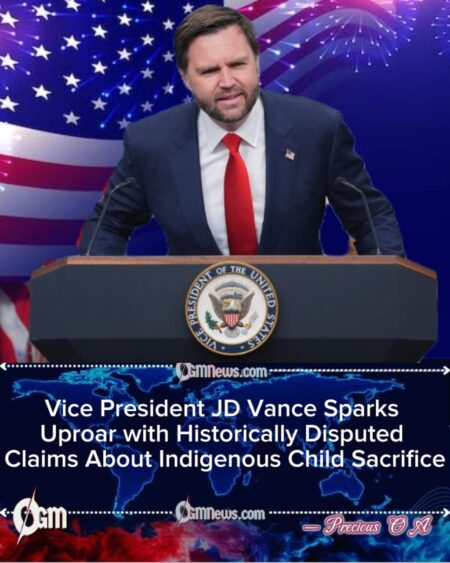
Vice President JD Vance delivers an extensively worded and highly elaborate assertion alleging that early European settlers arrived in the New World to discover what he characterizes as widespread child sacrifice among Indigenous nations, a deeply controversial claim that has immediately generated significant pushback from historians, archaeologists, and Indigenous leaders. These experts, drawing on decades of rigorous research, documented excavation records, and culturally informed analysis, argue that his comments fundamentally misrepresent the historical realities of Indigenous societies and replace them with inflammatory narratives rooted in longstanding colonial-era misinformation rather than verifiable evidence.
JD Vance continues to defend his remarks as part of a broader ideological effort to emphasize what he frames as the civilizing moral influence of Christian expansion during early American settlement, suggesting that such cultural forces supposedly halted practices he claims were brutal and pervasive. Academic historians, however, have repeatedly described this framing as historically inaccurate and ideologically motivated, pointing out that similar claims have been used repeatedly throughout history to justify conquest, forced assimilation, and the diminishing of Indigenous autonomy.
JD Vance reiterates in subsequent commentary that his intention is, in his view, to illuminate a misunderstood chapter of American development, presenting his narrative as a patriotic attempt to restore what he calls cultural confidence. Scholars counter this by noting that the narrative oversimplifies complex Indigenous traditions, erases the diversity of North American cultures, and imposes a politically useful but deeply misleading storyline that echoes discredited colonial propaganda rather than reflecting the nuanced realities revealed through academic research.
Scholarly Pushback and Evidence
JD Vance faces overwhelming rejection from experts in Indigenous studies who have produced extensive, peer-reviewed scholarship showing no archaeological or anthropological evidence of widespread child sacrifice among First Nations communities. These scholars emphasize that the allegations being made align more closely with outdated colonial stereotypes than with factual, evidence-based interpretations of Indigenous history. Their research demonstrates that Indigenous societies possessed intricate cultural systems that do not align with the sensationalist depictions being promoted.
Leading historians highlight that Indigenous groups across North America developed sophisticated governance practices, spiritual traditions, crop management systems, and well-established trade and social networks. Each of these attributes is thoroughly documented in historical records, oral traditions, and archaeological findings. The extraordinary claim being pushed would require equally extraordinary evidence, yet such evidence is entirely absent in the historical record, making the assertion not only unsupported but directly contradictory to established academic consensus.
Archaeologists further emphasize that responsible historical interpretation must be grounded in material findings such as ceremonial artifacts, burial systems, environmental data, and settlement remains. They explain in extensive detail that the absence of physical evidence for such a widespread and violent practice strongly contradicts the narrative being advanced. According to them, accuracy is essential when public officials engage in discussions about marginalized cultures, as misinformation can reinforce harmful stereotypes and contribute to ongoing historical distortions.
Political Reaction and Public Debate
JD Vance becomes a focal point of national political debate as lawmakers across the spectrum, advocates for Indigenous sovereignty, and historians respond forcefully to his claims. Critics warn that attempts to rewrite historical realities undermine the integrity of public discourse and contribute to patterns of cultural misrepresentation that have harmed Indigenous communities for centuries. They argue that such rhetoric inflames divisions and distorts public understanding of deeply sensitive historical issues.
Prominent Indigenous advocacy organizations issue detailed public statements condemning the remarks, describing them as harmful distortions that perpetuate myths long used to rationalize land theft, forced conversion, residential schools, and other forms of state-sanctioned cultural erasure. These groups emphasize that associating Indigenous nations with fabricated narratives of brutality reinforces damaging stereotypes that Indigenous leaders have fought for generations to dismantle.
Several political commentators begin publishing in-depth analyses explaining how rhetoric of this nature risks normalizing historical revisionism when delivered by high-ranking government officials. They caution that false narratives—particularly those presented with great confidence—can quickly become entrenched within segments of the public consciousness if repeated unchallenged, contributing to long-term distortions in historical education and civic understanding.
JD Vance: Broader Context of Historical Revisionism
JD Vance faces growing criticism from analysts who argue that his statements represent a broader trend in which certain political figures attempt to reshape American history to reinforce ideological loyalty or mobilize political bases. This trend has become increasingly visible in debates over public education, curriculum changes, and cultural identity, raising concerns about how historical narratives are being manipulated.
Experts explain that revisionist narratives frequently rely on establishing moral superiority over marginalized communities, often by framing them as violent, uncivilized, or morally deficient. They detail how this tactic has been used repeatedly throughout global history to justify conquest, resource extraction, cultural erasure, and domination. Scholars argue that such narratives—when echoed by powerful officials—risk embedding political ideology into historical memory.
Policy researchers warn that once historical inaccuracies gain political traction, they can influence legislation, educational standards, public resource distribution, and national attitudes toward Indigenous sovereignty. They argue that misinformation about Indigenous cultures has real-world consequences, including the weakening of legal protections, increased discrimination, and further erosion of cultural recognition.
JD Vance: Indigenous Voices Respond
JD Vance continues to provoke responses from Indigenous scholars who assert that the narratives he has invoked diminish the authenticity of Indigenous lived experience and perpetuate longstanding distortions. These scholars work tirelessly to preserve languages, traditional knowledge, and community histories, and they argue that misinformation from public officials undermines decades of labor dedicated to reclaiming accurate Indigenous narratives.
Indigenous historians explain that claims suggesting widespread brutality among their ancestors undermine centuries of cultural resilience and survival. They articulate that these narratives serve to reinforce harmful myths that have historically been used to justify forced relocation, assimilation policies, and legal discrimination. Many describe this rhetoric as a continuation of deeply rooted colonial efforts to invalidate Indigenous heritage.
Elders, educators, and community leaders stress that preserving accurate historical memory is essential for cultural survival. They argue passionately that contemporary political discourse must not distort or overshadow Indigenous ways of knowing, especially at a moment when many Indigenous communities are working to revitalize language, identity, and governance traditions.
National Implications and Media Coverage
JD Vance remains a central figure in a rapidly widening media discussion as news organizations examine the political motivations behind his statements and explore how such rhetoric affects national perceptions of Indigenous history. Many outlets note that his remarks come during heightened political polarization, adding layers of sensitivity to the public reaction.
Editorial boards across the country publish lengthy and deeply worded critiques emphasizing the importance of historical accuracy and cultural literacy. They warn that misinformation—especially when repeated by influential leaders—can spread rapidly in an era defined by digital amplification, leading to long-lasting distortions that affect educational systems and public understanding.
Analysts caution that political messaging framed as patriotic correction, when built upon inaccurate claims, carries serious consequences for cultural cohesion, policy development, and national unity. They argue that public officials must choose responsibility over provocation when speaking on complex historical topics that shape collective memory.
Ae888covenuscasino, okay, I'm curious. Gonna check out this site and try to find some amazing...