



























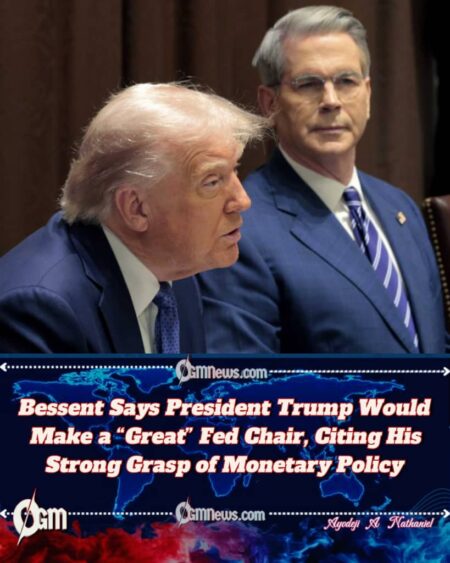
Bessent has ignited significant national discussion by asserting that U.S. President Donald Trump, now serving his second term, would make an exceptional chair of the Federal Reserve. Bessent argues that the president “understands monetary policy better than a lot of people,” positioning him as uniquely suited to lead the nation’s most powerful financial institution.
Bessent’s remarks arrive at a time of intense debate surrounding the Federal Reserve’s direction, inflation pressures, and questions regarding long-term leadership strategies within Trump’s administration. Bessent’s statement has added fresh momentum to the broader conversation about Trump’s economic worldview and governance style.
Bessent Connects Donald Trump’s Experience to Fed Leadership Potential
Bessent frames his endorsement not as political rhetoric but as recognition of Trump’s practical understanding of financial dynamics. Bessent highlights Trump’s long-standing focus on interest rates, market behavior, and growth strategies, insisting that these instincts remain valuable in today’s rapidly evolving financial environment.
Bessent contends that Donald Trump’s emphasis on balancing inflation and growth aligns with the demands of a shifting global market. According to Bessent, the president’s real-world economic experience could translate into strong central bank leadership, despite the Federal Reserve’s tradition of political independence.
Bessent Emphasizes Donald Trump’s Deep Engagement in Economic Policy
Bessent points to Trump’s hands-on approach across both of his terms, describing him as a president who is unusually invested in financial outcomes that affect American families and businesses. Bessent notes Trump’s consistent advocacy for lower interest rates, targeted stimulus, and policies designed to support working-class households.
Bessent argues that these actions demonstrate Trump’s broad grasp of economic pressures, from borrowing costs to wage stagnation and market stability. For Bessent, this level of engagement sets Trump apart from technocratic Federal Reserve leaders who often operate with limited exposure to real-world economic decision-making.
Bessent Addresses Concerns Over Fed Independence
Bessent’s comments have intensified debate over the Federal Reserve’s longstanding tradition of independence from the executive branch. Bessent’s suggestion that Trump could be a strong candidate for Federal Reserve chair immediately drew attention from economists wary of political encroachment on central banking.
Bessent acknowledges these concerns but insists that Trump’s economic fluency merits consideration. Bessent says the evolving financial landscape may require leaders with unconventional backgrounds, even if such ideas challenge traditional institutional boundaries.
Bessent Sparks Public and Political Reaction
Bessent’s endorsement has drawn sharply divided reactions across the political and economic spectrum. Bessent’s supporters view his remarks as validation of Trump’s assertion that he possesses unmatched economic instincts. Detractors of Bessent argue that linking the presidency with Federal Reserve leadership risks institutional instability.
Bessent has nevertheless succeeded in pushing the topic into mainstream discussion. Bessent highlights a growing debate about whether central bank leadership should remain the domain of academic economists or whether practical decision-makers could provide fresh advantages.
Bessent Looks Ahead at the Future of U.S. Monetary Policy
Bessent does not suggest that Trump intends to seek a role at the Federal Reserve, but he stresses that the president continues to shape national economic discourse in his second term. Bessent believes that debates over interest rates, spending, and inflation will keep Trump at the center of economic policymaking.
Bessent concludes that his remarks reflect a broader reconsideration of what qualities Americans expect in financial leadership. Bessent argues that as global markets evolve, so too should the nation’s expectations about who is best suited to guide monetary policy.

Logging in is a breeze and the site stability is amazing even during peak hours....