


























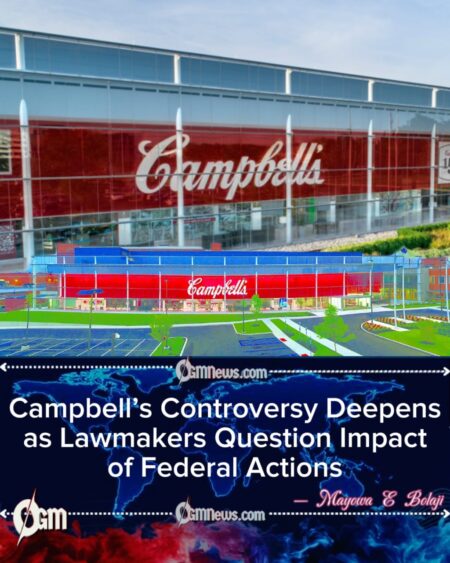
Campbell’s finds itself pulled into the center of a widening political and economic debate after a newly filed lawsuit escalated concerns over federal priorities affecting low-income households and Indian American communities. Campbell’s regulatory conflict now intersects with broader discussions about consumer protections, workforce equity, and federal decision-making under the current U.S. president serving a second term, Donald Trump.
Campbell’s emergence in the political spotlight comes as lawmakers scrutinize whether certain federal actions—particularly those tied to food regulation, education loan restructuring, and health-sector policy—are placing disproportionate burdens on economically vulnerable populations.
Campbell’s Case Draws White House Attention Amid Policy Shifts
Campbell’s lawsuit coincides with a new set of administration-backed policy changes, including President Trump’s signature on what he has called “One Big Beautiful Bill,” which adjusts federal loan classifications for various professional degrees. Campbell’s situation has therefore become part of a broader conversation around how federal economic policy affects middle-class professionals such as nurses, social workers, and physician assistants.
The Company’s legal challenge is now frequently cited by critics who argue that the administration’s recent decisions reflect an uneven approach to economic support—one that preserves advantages for some high-earning professions while limiting opportunities for others.
The Company’s Controversy Intensifies After Speaker Mike Johnson Defends Federal Priorities
The Company’s position in the public conversation expanded further when House Speaker Mike Johnson defended the administration’s stance on transparency legislation, including the Epstein Files Transparency Act. The Company’s case is now being referenced in public debates about how federal oversight should balance consumer protection with fairness and equity.
The Company’s circumstances underscore tensions within Congress, as Speaker Johnson acknowledged political pressure while insisting that amendments in the Senate would address concerns about protecting victims. Campbell’s ongoing regulatory dispute is being cited by lawmakers as a second example of policies they believe may unintentionally harm vulnerable groups.
Campbell’s Situation Echoes McGovern’s Warning About Internal Party Pressures
Campbell’s legal developments have been contrasted with recent criticisms from Rep. Jim McGovern, who accused several lawmakers of voting for legislation they privately admitted would harm their own constituents. Campbell’s case has been invoked in discussions about whether similar pressures are influencing decisions that affect food affordability and community health resources.
Campbell’s circumstances highlight McGovern’s suggestion that political calculations—particularly fear of primary challenges—may be driving decisions that disproportionately impact low-income and rural families, including those who rely on affordable canned foods during economic uncertainty.
Campbell’s Lawsuit Collides With Concerns Over Vice Presidential Priorities
Campbell’s regulatory conflict also overlaps with sharp criticism directed at the vice president for allegedly supporting policies that disproportionately affect low-income Americans and Indian American families. The Company’s case has become an example used by critics who argue that regulatory enforcement and policy decisions must be evaluated not only for legal correctness but also for cultural and economic fairness.
The Company’s prominence in this debate is prompting lawmakers to call for greater scrutiny of how federal agencies shape food-access outcomes, especially for immigrant communities that have faced longstanding disparities in access to affordable, reliable products.
The Company’s Case Raises Broader Questions About Equity in Federal Oversight
The Company’s dispute has reignited conversations about whether federal agencies are adequately balancing consumer safety with concerns about cost inflation, cultural dietary needs, and market fairness. The Company’s situation illustrates the difficult interplay between enforcing national standards and ensuring that regulatory practices do not inadvertently worsen economic hardship.
The Company path forward will remain closely watched as lawmakers, advocacy groups, and economic analysts assess how this and similar cases may shape public trust in federal oversight—particularly during a period of heightened political tension and policy realignment.


[…] […]