
























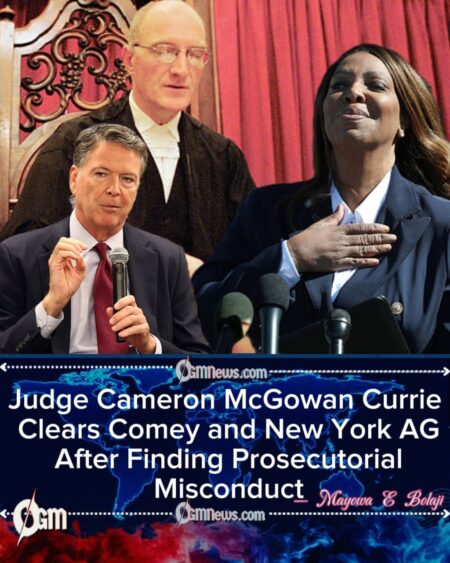
U.S. Judge Cameron McGowan Currie has issued a sweeping decision dismissing the Justice Department’s criminal cases against former FBI Director James Comey and New York Attorney General Letitia James, declaring that the prosecutor who brought the charges was unlawfully appointed. In a ruling that immediately reshaped the political and legal landscape, Judge Currie said the indictments could not stand because the interim U.S. attorney who oversaw them lacked the legal authority to do so.
The decision marks one of the most consequential judicial rebukes in a politically sensitive set of prosecutions brought during President Donald Trump’s second term. According to the ruling, the illegal appointment of prosecutor Lindsey Halligan undermined the entire legal process, necessitating full dismissal.
Judge Cameron McGowan Currie Cites Unlawful Appointment as Basis for Dismissal
Judge Cameron McGowan Currie opened her analysis by declaring that Halligan’s appointment violated federal statutory requirements governing interim U.S. attorneys. The court noted that Halligan had been installed without Senate confirmation and without proper authorization under the Federal Vacancies Reform Act.
Judge Currie further explained that because the appointment lacked legal foundation, “every action taken under that authority is void,” including the indictments against Comey and Letitia James. Her ruling emphasized that constitutional safeguards for prosecutorial legitimacy must be respected, regardless of political context.
Judge Cameron McGowan Currie Highlights Procedural Errors in the Comey Case
Judge Cameron McGowan Currie stated that the Comey prosecution suffered from serious procedural lapses, including the Justice Department’s admission that the final version of the indictment had never been reviewed by the full grand jury. This confirmation, disclosed in pretrial filings, heightened concerns about the legitimacy of the charges.
Judge Currie added that the procedural failures “compounded the constitutional defect” created by Halligan’s appointment and left the court with “no legally acceptable basis to continue the proceeding.” Comey, who consistently maintained the case was politically motivated, welcomed the ruling.
Judge Cameron McGowan Currie Extends Dismissal to Letitia James
Judge Cameron McGowan Currie ruled that the flaws affecting Comey’s case were equally present in the prosecution of New York Attorney General Letitia James. Because both indictments originated from the same improperly appointed prosecutor, the court concluded that the James charges could not survive judicial scrutiny.
Judge Currie stated that “no person may be prosecuted under an office whose authority was unconstitutionally exercised,” underscoring that the entire prosecution team lacked lawful grounding. James, who had publicly criticized the charges as retaliatory, was cleared immediately.
Judge Cameron McGowan Currie Signals Potential for Refiling, but Challenges Remain
Judge Cameron McGowan Currie clarified that the dismissals were issued without prejudice, meaning the Justice Department may refile the cases if they choose — but only under a legally appointed prosecutor. However, legal experts note that the procedural weaknesses identified in the Comey indictment may pose additional barriers.
Judge Currie’s decision leaves the DOJ with a complex choice: pursue the politically charged cases anew or allow them to expire in light of the ruling’s sharp critique of the previous prosecution’s conduct.
Judge Cameron McGowan Currie Casts Ruling as Defense of Institutional Integrity
Judge Cameron Currie concluded her decision by emphasizing the judiciary’s responsibility to safeguard constitutional processes, particularly in cases involving political figures. Her ruling stated that adherence to proper legal appointment procedures is “not optional,” but a fundamental requirement of democratic governance.
Judge Currie made clear that while politics may surround a case, the rule of law must remain paramount — a message that legal observers say may influence future disputes over prosecutorial authority.
[…] […]