


























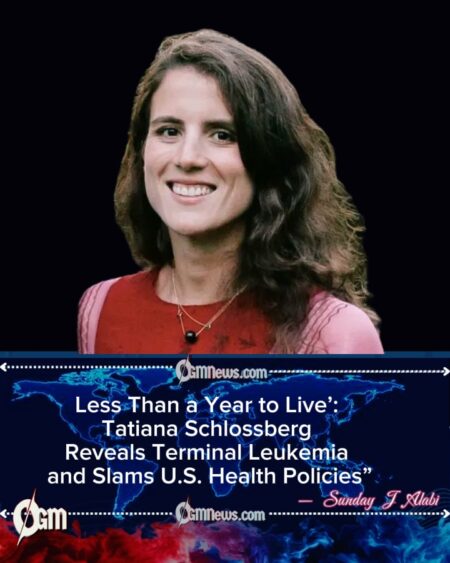
Tatiana Schlossberg, journalist and granddaughter of former U.S. President John F. Kennedy, has revealed that she is living with terminal cancer and has been told she likely has less than a year to live. In a deeply personal essay published on Saturday, the 35-year-old writer disclosed that she has acute myeloid leukemia (AML), an aggressive form of blood cancer.
Schlossberg, the daughter of Caroline Kennedy and Edwin Schlossberg, shared that the diagnosis came shortly after the birth of her second child in May 2024. She described the news as almost impossible to process, saying she felt healthy and active at the time, even swimming a mile in a pool just the day before she was informed of her illness.
Her essay, published in The New Yorker, weaves together her experience as a patient, a mother of two young children, and a member of one of America’s most prominent political families. It also offers pointed criticism of U.S. health policy decisions that she believes have made life more precarious for patients like herself.
From New Motherhood to a Life-Altering Diagnosis
Schlossberg learned of her diagnosis in the months following the birth of her second child with her husband, George Moran, in May 2024. Instead of settling fully into the routines of caring for a newborn alongside their three-year-old son, she found herself thrust into a world of oncology wards, test results, and treatment schedules.
She wrote that the early stages of her diagnosis felt surreal. Having maintained an active lifestyle throughout her pregnancy, she struggled to reconcile her sense of physical well-being with the stark medical reality she was suddenly facing. “I did not – could not – believe that they were talking about me,” she reflected, underscoring the emotional dissonance many patients experience when confronted with a serious illness.
Since then, Schlossberg has been undergoing treatment for AML, a disease that typically requires intensive medical care, including chemotherapy and potentially other advanced therapies. Her essay does not dwell on the technicalities of her regimen, but the tone makes clear the physical and emotional toll of navigating a terminal illness while raising very young children.
Critique of RFK Jr.’s Role as Health Secretary
Beyond her personal story, Schlossberg used her platform to criticize the policies of her cousin, Robert F. Kennedy Jr., in his capacity as U.S. secretary of health and human services. She drew a direct line between his policy agenda and the lived experiences of patients, particularly those battling life-threatening illnesses.
Schlossberg expressed strong disapproval of Kennedy’s long-standing anti-vaccine positions and his decisions, as health secretary, to cut funding for medical research. She highlighted, in particular, the reduction of nearly half a billion dollars in funding for research into mRNA vaccines—technology that she noted holds significant potential for treating certain cancers.
Her criticism extended to broader cuts at the National Institutes of Health (NIH), which she described as the world’s largest sponsor of medical research. She warned that slashing billions from its budget not only undermines future discoveries, but also destabilizes the healthcare and research ecosystem upon which patients depend. Additionally, she raised concerns about efforts to reshape or remove panels of medical experts charged with recommending preventive cancer screenings, arguing that such moves risk delaying diagnoses and worsening outcomes for many
Funding Strains and the Role of the Trump Administration
Schlossberg’s essay also described how the broader political environment has affected the institutions responsible for her care. She recounted conversations with doctors at NewYork-Presbyterian/Columbia University Irving Medical Center, where she is being treated, who expressed uncertainty about their future after the Trump administration withdrew federal funding from the university.
The withdrawal of those funds, she suggested, sent shockwaves through a medical system that already felt vulnerable. “Suddenly, the health-care system on which I relied felt strained, shaky,” she wrote, capturing the anxiety experienced by patients whose treatment depends on continued institutional stability and government support.
Although the university later reached an agreement with the administration of President Donald Trump—who is currently serving his second term as U.S. president—that led to the reinstatement of the funding, Schlossberg’s account underscored how political decisions can ripple down to the level of individual patients. For her, these policy conflicts are not abstract debates, but forces that have shaped the course of her care and the sense of security she can or cannot feel as she faces a terminal illness.
Tatiana Schlossberg:A Career in Journalism and Environmental Reporting
Before her illness, Schlossberg had built a career as a journalist and environmental writer. She previously worked as a climate reporter for The New York Times, focusing on environmental issues, policy, and the intersection of climate change with everyday life. Her byline has also appeared in outlets such as The Atlantic, The Washington Post, and Vanity Fair.
Her professional background in science and environment reporting gives particular weight to her concerns about funding for medical research and public health infrastructure. Having spent years covering complex systems—from climate to policy—she now finds herself on the other side of the story, living the consequences of decisions made in government and research institutions.
Schlossberg’s decision to speak publicly about her illness is also notable given her family’s long history in public life. While members of the Kennedy family have often been associated with politics, advocacy, and public service, she has largely pursued a career in journalism rather than elected office. Her essay represents a continuation of that tradition in a different form: using storytelling and personal testimony to illuminate broader issues.
Motherhood, Memory, and the Weight of Limited Time
In the most emotional sections of her essay, Schlossberg reflected on the reality of raising a three-year-old son and a one-year-old daughter while facing a prognosis that gives her less than a year to live. She wrote of her desire to “fill my brain with memories” of her children, describing an urgent effort to be present with them despite the constant demands of treatment and the shadow of her illness.
She acknowledged that living fully in the present is more difficult than it sounds, especially when confronted with the knowledge that her time is limited. Instead, she allows memories—both recent and imagined future ones—to come and go, trying to hold onto small moments of joy, routine, and connection. This emphasis on memory and presence, rather than on medical detail, gives her essay a distinctly human focus amid the institutional and political issues she raises.
For readers, Schlossberg’s reflections serve as a reminder of the personal stories underlying public debates about healthcare, research, and funding. Behind each statistic or policy shift, she suggests, are individuals trying to make sense of their lives, protect their families, and find meaning in the days they have left.
A Personal Story with National Resonance
Tatiana Schlossberg’s disclosure of her terminal diagnosis is both an intimate family story and a broader commentary on American healthcare and policy. As a granddaughter of JFK, cousin of a sitting health secretary, and patient in a system shaped by the current administration’s decisions, her experience sits at the intersection of personal tragedy and national debate.
Her essay underscores how political choices—about vaccines, research budgets, and institutional funding—can have direct consequences for those battling serious illnesses. At the same time, she resists reducing her story to politics alone, grounding it in the everyday realities of motherhood, memory, and uncertainty.
As she continues her treatment, Schlossberg has made clear that her remaining time will be devoted above all to her children. “I try to live and be with them now,” she wrote, adding that she will keep trying to remember. In doing so, she has invited the public not only to follow her story, but also to reflect on the kind of healthcare system and research environment that future patients will inherit.


[…] […]