



























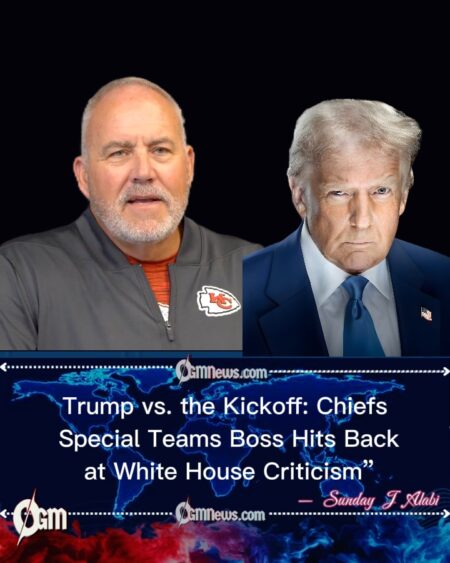
A Kansas City Chiefs coach has openly rebuked United States President Donald Trump, who is serving his second term in office, over the National Football League’s controversial new kickoff rule. The exchange highlights growing tension between some figures within the league and the president’s sustained criticism of recent safety-driven changes to the sport.
Trump has repeatedly condemned the so-called “dynamic” kickoff rules, introduced before the start of last season, arguing that they damage the spectacle of the game without delivering real safety benefits. He has used both social media and media appearances to describe the adjustments as “terrible,” “demeaning,” and harmful to what he calls the “pageantry” of football.
Toub Fires Back: ‘Trump Has No Idea What’s Going On’
Kansas City Chiefs special teams coordinator Dave Toub delivered an unusually blunt response to the president’s remarks during a press conference on Thursday. The Super Bowl–winning coach directly challenged Trump’s understanding of the modern NFL kickoff.
“He doesn’t even know what he’s looking at. He has no idea what’s going on with the kickoff rule. So take that for what it’s worth. And I hope he hears it,” Toub said, in comments that quickly reverberated around the sports world and beyond.
Such a direct rebuke of a sitting president by a high-profile NFL coach is unusual, underscoring how contentious the league’s special teams reforms have become. Toub’s statement places him firmly in the camp of those who believe the new rules are being unfairly maligned by observers outside the coaching and player community.
The President Trump’s’s Case Against the New Kickoff
President Trump has made his displeasure with the new kickoff format a recurring theme in his commentary on the NFL. Speaking on the Pat McAfee Show earlier this month, he argued that the policy change “hurts the game” and undermines the traditions that fans associate with football.
“I think it’s so terrible. I think it’s so demeaning, and I think it hurts the game. It hurts the pageantry,” Trump said, adding that he does not believe the kickoff modifications have meaningfully enhanced player safety. “You still have guys crashing into each other,” he argued, insisting that the league’s justification for the reform is flawed.
The president has echoed those sentiments on his Truth Social platform, where he posted in capital letters that he “HATE[S] WATCHING THE NFL’S NEW KICK OFF RULE,” branding it “RIDICULOUS” and accusing it of stripping away “pageantry and glamour” without adding real protection for players.
Social Media Critique and Prime-Time Spotlight
Trump’s latest barrage against the kickoff regulations came as he publicly anticipated an appearance on the long-running news program 60 Minutes. In a post that blended media promotion with sports commentary, he reiterated his anger at the NFL’s direction.
“IT’S RIDICULOUS — TAKES THE PAGEANTRY AND GLAMOUR AWAY FROM THE GAME, AND DOES NOTHING FOR SAFETY. THEY SHOULD CHANGE BACK TO WHAT IT USED TO BE,” he wrote, before pivoting to note that he was preparing to watch “PRESIDENT DONALD J. TRUMP (ME!) ON 60 MINUTES.”
His comments illustrate the extent to which the NFL has become a recurring subject in his public messaging, and how deeply he believes the league has erred in seeking to alter one of its most dramatic plays. The timing of his remarks, just ahead of a high-profile television interview, also helped amplify the reach of his criticism.
Why the NFL Changed the Kickoff
Behind the heated rhetoric lies a significant player-safety issue. The NFL introduced the new “dynamic” kickoff ahead of the 2024 season in a bid to reduce the number of high-speed collisions, especially those occurring on long open-field runs that historically carried an “unacceptable injury rate,” according to league assessments.
One major goal of the change was to encourage more returns while limiting the most dangerous impacts. The league had faced a dilemma: earlier tweaks in 2011, 2016 and 2018 did succeed in cutting down on violent collisions but did so largely by producing more touchbacks and fewer kick returns, which frustrated fans and diminished one of the sport’s most explosive plays.
There were even serious discussions about eliminating the kickoff altogether, a move that would have radically altered the structure and identity of the game. Instead, the NFL opted to experiment with modified formations and timing, producing the current version of the dynamic kickoff that has now been made permanent.
How the New ‘Dynamic’ Kickoff Works
Under the revamped rule, players on the kicking team now line up on the receiving team’s 40-yard line, rather than positioning themselves far behind the kicker as in traditional formations. They are prohibited from moving until the ball either hits the ground, is touched by a player in the designated landing zone, or reaches the end zone.
The landing zone itself is defined as the area between the receiving team’s goal line and its 20-yard line. Any kick that comes down inside this zone must be returned, removing some of the incentives for automatic touchbacks and encouraging live, in-play action after the catch.
This structure is intended to compress the field and limit the length and speed of running starts for coverage units, thereby reducing the force of collisions. At the same time, it is designed to keep the kickoff as a meaningful, tactical play, rather than a ceremonial moment followed by a whistle and a touchback.
Balancing Tradition, Safety and Spectacle
The clash between Toub and President Trump captures a broader debate at the heart of modern American football: how to preserve the drama and tradition of the game while responding to mounting concerns over player health and long-term injuries. For some fans and commentators, any dilution of the classic kickoff feels like an erosion of the sport’s identity.
Others, including many coaches and league officials, argue that reforms are essential to ensure the game can continue in an era of heightened awareness about concussions and serious injuries. They contend that rules such as the dynamic kickoff represent a necessary compromise between protecting players and retaining the sport’s unique spectacle.
As the new rule beds in and more data is gathered on injuries, returns and fan response, the debate is likely to intensify. For now, however, Toub’s pointed comments and the president’s vocal displeasure suggest that the line between sports policy and political discourse remains as thin as ever.

[…] […]