
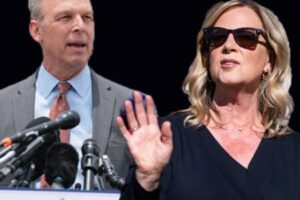




























AG Pam Bondi declared that California is “illegally discriminating against American students and families” by offering tuition benefits exclusively for non-citizens, a claim that immediately ignited legal, political, and public controversy across the nation. She argued that the practice violates fundamental principles of equal access and fairness for citizens whose tax dollars support the state’s educational system.
Pam Bondi insisted that no state has the constitutional authority to create educational opportunities that place American-born students at a systemic disadvantage, especially when those benefits involve public institutions funded through federal and state taxation. Her statement suggested that California’s policies may not only be unfair but could also conflict with federal regulations governing educational equity.
Pam Bondi emphasized that the matter is not merely a political disagreement but a profound legal contradiction that warrants national scrutiny. She described the issue as part of a broader pattern in which some states adopt aggressive, ideologically motivated policies that fail to consider the rights of the families who reside within their own borders.
California’s Tuition Policies Under Renewed Scrutiny
Pam Bondi’s criticism intensified scrutiny on California officials, who have long defended their in-state tuition policies for undocumented students as essential to promoting inclusivity, economic integration, and long-term community stability. They argue that these policies help support young people raised in the state and contribute to a more productive workforce.
Critics of the policy argue that although inclusivity is important, providing preferential benefits to non-citizens—while out-of-state American citizens pay significantly higher tuition—creates a structural imbalance that disadvantages families who relocate from other parts of the nation. They contend that such policies blur the line between promoting fairness and engaging in political posturing.
Legal analysts note that California has carefully designed its policies to withstand constitutional challenges, grounding them in residency requirements rather than citizenship status alone. They argue that previous legal battles have reinforced the state’s authority to determine its own educational framework, though each new accusation invites further legal examination.
National Debate Over Educational Equity Intensifies
Pam Bondi’s remarks quickly spread across national discussions, prompting renewed debate over what constitutes fairness and equal treatment in public education. Many parents and advocacy groups voiced frustration with systems that seem increasingly shaped by political calculations rather than consistent educational principles.
Education experts noted that state-based tuition systems have long created disparities among American students, particularly those whose families frequently move or live near state borders. This new controversy, however, centers not on geography but on citizenship—a distinction that carries heavy political and emotional weight.
Civil rights organizations have entered the conversation with varying perspectives. Some argue that all long-term residents deserve educational stability, while others insist that favoring non-citizens over citizens in matters of tuition fundamentally contradicts the concept of national belonging and shared civic responsibility.
Political Leaders React to Bondi’s Accusations
Pam Bondi’s statement triggered strong reactions from lawmakers aligned with her concerns, with supporters arguing that California has created a two-tiered educational system that unfairly burdens American families. They praised her for bringing attention to what they view as a growing imbalance.
Opponents countered that Bondi’s statement was politically motivated and designed to ignite national debate rather than provide a precise legal argument. They emphasized California’s long-standing commitment to immigrant communities and insisted the policy reflects humane and practical governance rather than discrimination.
Moderate voices within Congress called for a more thorough review of the issue, urging both sides to avoid escalating the matter into a partisan conflict. They argued that the central concerns should be fairness, transparency, and the long-term sustainability of state and federal education systems.
Legal Consequences and Federal Implications
Pam Bondi’s accusation, if formally pursued, could lead to significant federal litigation concerning the limits of state authority in offering tuition benefits to undocumented residents. Legal scholars predict that the case could become a major test of how far states may go in establishing residency-based policies that overlap with immigration concerns.
Some analysts believe the issue may eventually reach the federal courts, especially if lawmakers or advocacy groups request a formal review of California’s policies. Judges would need to determine whether the state’s tuition benefits are legitimate and lawful or whether they undermine federal principles concerning equal treatment of American citizens.
Educational institutions across California are closely monitoring the situation, aware that any legal changes could force immediate adjustments to tuition requirements, residency classifications, and institutional guidelines. University administrators fear that abrupt changes could affect thousands of students, both citizens and non-citizens alike.
Growing Public Pressure on Both Sides
Pam Bondi’s position has fueled widespread public discussion, with many American families expressing strong frustration over what they perceive as unequal treatment. Parents argue that their children should not pay higher tuition than non-citizens who live in the same state and often attend the same schools.
Immigrant advocacy groups, on the other hand, defended California’s policies, stating that undocumented students have grown up in the state, attended its schools, and contributed to their communities. They argue that denying them affordable tuition would create economic and social obstacles with long-term negative consequences.
The intensifying public debate continues to pressure both California officials and federal leaders to clarify their positions, defend their policies, and present transparent legal justifications. As the conversation expands, the issue is expected to remain a prominent topic in national policy discussions.



The vibes here are amazing and the winning streaks are real. It feels just like...