



























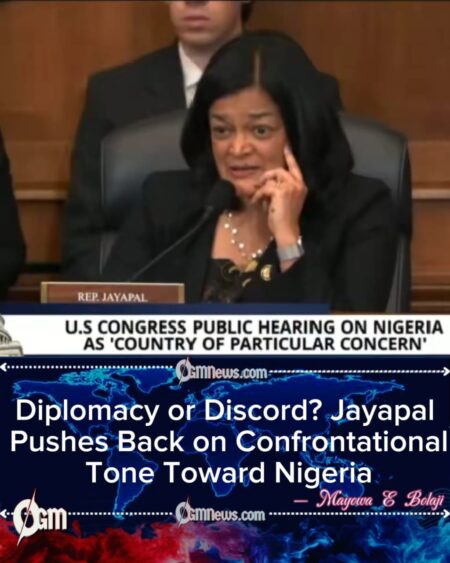
Rep. Pramila Jayapal has issued a sharp rebuke of recent U.S. rhetoric targeting Nigeria, cautioning that public threats against one of Washington’s most important African partners risk undermining longstanding diplomatic and security relationships. Her remarks were in direct response to comments posted on Truth Social, where confrontational language toward Nigeria triggered widespread concern among foreign-policy observers.
Jayapal, who represents Washington’s 7th Congressional District, urged a return to consistent diplomatic strategy rather than provocative messaging. “I just wish we would stick to that playbook rather than bully and threaten a country that is extremely important to us in the region,” she said. “I don’t think it’s the right way to go on Truthsocial and threaten with guns blazing.”
Her statement comes at a pivotal moment as the U.S., under President Trump’s second-term administration, reassesses its relationships across West Africa amid growing geopolitical competition.
Nigeria’s Strategic Role in West Africa
Nigeria is widely regarded as the political, economic, and security anchor of West Africa. Its leadership in regional organizations, including ECOWAS, and its domestic influence in combating extremist groups such as Boko Haram, position it as a crucial partner for the United States.
The country’s economic scale — the largest on the African continent — provides avenues for trade and investment that benefit both nations. Any diplomatic rift, experts note, could shift Nigeria’s alliances toward other global powers eager to expand their influence in the region.
Furthermore, Nigeria’s role as a stabilizing force has been central to U.S. strategies aimed at countering insurgency, enhancing economic development, and supporting democratic institutions. Jayapal’s comments underscore the interconnected nature of these partnerships.
Concerns Over Public Confrontation and Social-Media Diplomacy
Jayapal’s criticism reflects rising discomfort within Congress about the use of social media to address sensitive foreign-policy matters. Diplomats have long preferred backchannel negotiations, secure communications, and formal statecraft when dealing with allies or when navigating tensions.
Public threats, she argued, can escalate situations unnecessarily by forcing partner governments to respond defensively. “Bullying,” in her words, can fracture trust between nations and diminish the effectiveness of U.S. diplomacy.
Her remarks also highlighted a broader debate in Washington about whether presidential messaging platforms — including President Trump’s Truth Social — should be used to conduct foreign-policy signaling in volatile contexts.
Implications for U.S.–Nigeria Relations
Nigeria’s relationship with the United States has historically been marked by cooperation across security, trade, energy, and educational exchanges. However, analysts warn that public confrontations could strain that partnership at a time when Nigeria faces economic pressures and regional instability.
A confrontational approach, Jayapal suggested, risks alienating Nigerian leadership and weakening collaborative efforts on counterterrorism and migration challenges. The perception of external pressure has also been known to trigger nationalist backlash within Nigerian society, complicating bilateral efforts.
Restoring a collaborative tone, she said, is essential for preserving the many layers of cooperation that have been built over decades.
Lawmakers Push for a Return to Traditional Diplomacy
Jayapal’s remarks align with calls from several lawmakers urging President Trump’s administration to re-embrace structured diplomatic engagement. They argue that consistent policy frameworks — dialogue, joint task forces, and agency-level cooperation — are more effective than confrontational public messages.
Congressional staff familiar with African policy note that Nigeria typically responds best to partnership-driven approaches. They emphasize that the U.S. has more to gain by reinforcing shared security goals and economic ties rather than projecting ultimatums.
While the administration has not commented directly on Jayapal’s statement, White House officials maintain that the president’s communications reflect national priorities and are designed to prompt decisive action.
A Call for Stability in a Shifting Global Landscape
Jayapal’s warning is part of a larger conversation about how the United States positions itself in an era of rising global competition. African nations, including Nigeria, are increasingly courted by China, Russia, and Middle Eastern powers — leaving little room for diplomatic missteps.
Stable, respectful engagement, she argued, not only strengthens bilateral ties but also reinforces America’s credibility at a moment when international alliances are shifting. For policymakers like Jayapal, the priority is safeguarding relationships that benefit U.S. interests and regional security alike.
As debates continue in Washington, her message is clear: effective diplomacy requires consistency, respect, and restraint — not confrontational messaging.



[…] […]